 By Anesa Miller
Big Fiction: How Conglomeration Changed the Publishing Industry and American Literature
by Dan Sinykin
Columbia University Press
Dec 2023, 313 pages, ISBN-13: 978-0231192958
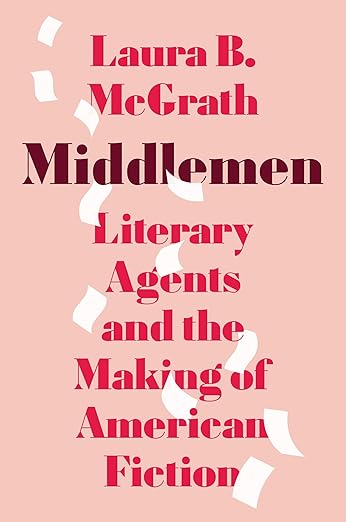 Middlemen: Literary Agents and the Making of American Fiction
by Laura B. McGrath
Princeton University Press
April 2026, 296 pages, ISBN-13: 978-06912561602026
Plowing through two recent books on the history of publishing was a challenging process. Each page stuffed with facts, it was a massive learning experience and well worth the effort, despite some resulting sad feels. In truth (full disclosure), this essay is more an attempt to grapple with those stunning facts than it is a book review per se. Even so, I’ll do my best to fulfil expectations of the latter genre, starting with a recommendation: Every aspiring fiction writer should read these books before their hopes and dreams advance to the stage of cherished delusion.
First, a brief explanation of the title, so my fellow aspiring fiction writers can assess where I’m coming from. All the rest of the words included here will be about literature and the above-named authors’ takes thereon. I promise.
I was slow to learn to read, catching up to my cleverer peers around age seven and only beginning to enjoy it closer to my ninth birthday. Until then, illustrations, preferably by Tasha Tudor or Garth Williams, were absolutely required. Once I fully accepted that squiggly shapes could represent words such that a story took shape in my mind, I was forever changed. Prior to that, I was primarily an outdoor kid. Tree-climbing, wading in ditches, exploring, and the like formed my best days. Had I kept up more outdoor activity as life advanced, I might be a happier person today.
But books prevailed, perhaps due to winter weather, and soon I was hooked. “Carolyn Keene” (now, there’s an “industrial author”!) gave way to Margot Benary-Isbert, Margarite Henry, Joyce Barkhouse, Marjorie Kinnan Rawlings, Betty Smith, and others. These were surely the smartest people in the world! They brought to life entrancing scenes of times, places, and people I’d never known. I heard voices and began narrating my actions to myself, as if nothing mattered in the world until someone described it.
As the years stacked up, I duly enjoyed the Brontës, Hawthorne, Poe, Cather. Anyone reading this probably knows exactly what I’m getting at. Gradually, I conceived the hope of making my own contribution to the storehouse of wonderful reads. I dreamed of sharing words with the world that someone might care about almost as much as I loved my favorite stories. Someone I would never meet might join me from afar in a thought or feeling! Could there be a higher calling, a more magical connection? Now and then, I tried my hand. Mostly at doggerel.
As Sinykin would have it in Big Fiction, I had strayed into the bog of romanticizing the author. He presents this as a form of false consciousness that detracts from an otherwise functional system of provisioning Americans with acceptable reading matter. By contrast, he extolls the colophon, the publisher’s emblem presented on the lower spine of most books nowadays. He argues that it represents the numerous contributors to a finished product:
The colophon…contains within it a collective, all the people who work to make the book we hold in our hands but whose names we seldom know…I want us to enter the world of the colophon, to unfetishize the commodity, to respect the author whose name adorns the front cover by returning her to the milieu from which she sprang. Our outsize attention to the author alone is a trick of history… If we want to know what conglomeration did to books—why books are different now than they were—then we need to unearth what conglomeration did to the people who live inside the colophon, how it took power from some and gave it to others, transformed incentives, and invented new jobs altogether. (3)
Among other unflattering terms—such as “industrial authors” (223), quoted above in reference to the several writers who penned Nancy Drew mysteries, long before corporations began acquiring publishing houses—Sinykin speaks of “the epiphenomenal author” (8). Here he borrows a scientific term that denotes noncausal side effects of a target process. He suggests that today’s corporate publishers foster the mystique of literary genius to serve our “cultural expectations of creative originality” (8) and to enhance successful authors’ branding and advertising value, although their role in writing a manuscript is not actually central to a book’s existence. Author branding may boost sales, but is it really comparable to an incandescent bulb giving off heat as well as the intended light?
So vital it must be to break our romantic habits that, later, Sinykin explains:
If this book has a villain, it is the romantic author, the individual loosed by liberalism, the pretense to uniqueness, a mirage veiling the systemic intelligences that are responsible for more of what we read than most of us are ready to acknowledge. [It’s a process whereby we] become vessels through which flow the currents of culture. (25)
I’ll admit, it ruined an enjoyable afternoon’s reading to discover that romantic notions about authorship are greater villains than late-capitalistic conglomerates with their bottom lines, unexplained cancellation of contracts, shrunken advances, nonexistent promotional plans for most books, and so on. Of course, this is one man’s opinion, but Sinykin has mustered mountains of evidence and cites other thinkers who have agreed with him over the decades, including the renowned French thinker, Roland Barthes, and Oxford University Press author Jack Stillinger.
I expect the world would be a better place if more of us gave greater thought to others’ contributions in all sorts of enterprises. But are starry-eyed writers with dreams of touching the heart of someone they’ll never meet the best starting point for such a campaign? Are they destructive narcissists or just introverts hoping to marry self-expression with communication?
As my young life unfolded beneath this cloud of misimpressions, Dostoevsky and Turgenev arose to stop me in my tracks. On discovering the nineteenth-century Russians, I pondered, Could there be more brilliant philosophical novels? More arduous social issues to portray through plot? Those were the Cold War times, and as fate would have it, the United States government was eager to pay me to go to graduate school and learn the native “strategic language” of those renowned authors. This was an important mission: I would teach my fellow Americans to love our enemies, promoting the elusive understanding that would lead to peace.
My list of favorite authors filled up with tricky triplicate names, while my dreams of becoming a writer curled up like hibernating grubs beneath the weight of irregular verbs, three genders of nouns, seven case declensions, and so on. Regrettably, I neglected to consider the eventual job market. As an academic gypsy upon finishing my PhD, there was no such thing as a living wage. With perhaps a trace of resentment for the profession I had chosen, I comforted myself with the resolution that I never had to read another book by a man unless I really wanted to. After the Slavic Department reading list, which back then featured only three females—Gippius, Akhmatova, Tsvetaeva—I had some catching up to do. I turned to Banana Yoshimoto, Barbara Kingsolver, Leslie Marmon Silko, Alice Walker, Carol Shields, Alice Munro, Margaret Atwood, Annie Proulx and so many more.
I still revered Russian writers, and—knowing their dire fates before and after 1917—I still regarded literature as a sacred human achievement. The U. S. government and every educated Russian I ever met believed that reading Russian novels and poetry created a deeper understanding of their society and history than political facts possibly could.
I found myself wanting to remind Sinykin —as he nearly disproves free will with his exposition of the rationalized, digitized, data-driven work of market analysts, feeding us unsuspecting “vessels” the spoonfuls of culture geared to our social positions—that Russian writers were imprisoned, tortured, and killed for their words. Even for unpublished manuscripts. And their publishers also risked life and livelihood to print work that deserved to see the light of day, which required dangerous feats of smuggling and illegal distribution in the home country.
Sinykin’s interest in dialectical interactions of social forces leads me to wonder if he, too, may have had a Russophile streak at some point. He argues that the ruptures and “trauma of the market’s perceived wounding of literature” (212), as corporate businesses took over independent houses, created an inevitable impetus for nonprofit enterprises to spring into being. The latter came to save literary quality from the capitalist machine. The two approaches have, he suggests, worked out a symbiosis that allows worthy literary actors to find a niche with the conglomerate business model vs nonprofit idealism forming a perfect obverse of each others’ motives. And since something always falls through the cracks, we also have the last-standing large independent house in employee-owned W.W. Norton to provide a home for the “misfits.” Why, it’s almost evidence of intelligent design!
Where the dialectic approach became strained, for this reader, is in the passage devoted to efforts at Random House and Knopf to transform Cormac McCarthy from a stream-of-consciousness navel-gazer into a commercially viable author. Sinykin analyses the process in terms of chaos theory, in which fractals repeat earlier patterns established across extended development:
A logic of sameness and differentiation repeats itself across the many scales of publishing…If we were to survey the industry [in 1990], we would notice that Random House…had staked out…[a] middlebrow position…Let’s drop a level…where, within Random House, Pantheon hovered hearer the avant-garde pole whereas Crown…homed in on the commercial pole. Knopf was closer to Pantheon, Random House was between Knopf and Crown…Drop another level and within Random House itself, as an imprint, we find editors who span the distance between…narrower and…more catholic taste. At the scale of the individual editor, authors range…Individual authors might contain such differentiation within their oeuvres, as with Cormac McCarthy’s alienating, difficult masterpiece, Blood Meridian, and his popular, National Book Award-winning bestseller, All the Pretty Horses. Even within a single work, such as All the Pretty Horses, the logic of sameness and differentiation replicates itself, in this case containing at once the popular genre of the Western and McCarthy’s Faulknerian style, however lightened. [This novel] is internally differentiated because it internalizes the conflicted logic in play at every scale above it, set in motion by agents, editors, executives, and publicists. (12 – 13)
I don’t doubt for a moment that people in the hierarchy described above prevailed upon McCarthy—who had been supported for years via the opaque process of people recommending him for grant money—to give popular success a try. How many of us would have heard of him had those persuasions failed? Still, I’m not convinced that combining a “sameness” genre like the Western with a “Faulknerian style,” which is not all that “differentiated” since it imitates an author of the mid-twentieth century, actually reflects a deep dialectical process. Mightn’t we simply say that conglomerated publishing houses try to cover all bases with some surefire bestsellers (sameness) and a few riskier (differentiated) titles?
I was more impressed with Sinykin’s concise interpretations, such as “Successful books become comparative titles (comps), required for prospective acquisitions, institutionalizing a feedback system by which homogeneity—and whiteness—is encouraged” (11). As one who has struggled to provide comp titles to publishers and agents, I found this simple point significant. But I was surprised to find no connection between homogeneity and the quality of sameness presented in the discussion of Cormac McCarthy’s commercial success. Perhaps, I should accept that the “dialectal fractal” is meant as an extended metaphor, while comps are a direct element of homogeneity.
I also found troubling Sinykin’s discussion of another popular yet literary author. Focusing on the fate of Little, Brown, after its incorporation into the conglomerate Time Warner, Sinykin takes David Foster Wallace as his prime example of a writer whose hopes and intentions are warped by a system beyond his control. He states that Wallace’s manuscript, acquired by a keen editor
…would become…Infinite Jest, a long and difficult novel that decries the destruction of cultural life at the hands of corporate power and the hegemony of entertainment…Wallace wanted to teach readers to extricate themselves from addictive entertainment that, he felt, ultimately made them lonely…He calibrated—in collaboration with his agent and editor—a balance between entertainment and edification that would allow him to seduce readers but ultimately criticize the culture…that Time Warner hoped to profit from by the novel’s publication. [His editor] cut hundreds of pages and made “numerous micro-changes” for the sake of preventing “readerly alienation.” Wallace agonized over the cuts…The marketing, though, unnerved [him]…readers [became] insatiable in their desire for Wallace and his work, a horrific reductio ad absurdum… [This example] demonstrates the limits of authorial agency in the conglomerate era. Wallace’s error was to put too much faith in the ability of his writing to transcend its conditions of production. He overestimated the power of his message and underestimated that of his medium. (14, 15, 16)
I’ve not had the honor of working with a large publisher, but I believe they do curtail agency and much prefer their authors to please many readers. Even so, did Wallace fail in his lofty mission? Infinite Jest found numerous avid readers, some of whom, no doubt, shared the author’s urge to reject commercially packaged pleasure and admired his skill at portraying that message. It seems likely he did connect with many people in something like the way he hoped. Was Wallace regretful of his compliance in allowing his work to be cut and revised by others, of the wild response it provoked? Probably so, but his struggles in life suggest he was prone to believe in his own failure, whether or not this was an objective fact.
Sinykin’s point is well taken that commercially successful authors tend to listen to editors, especially if they hope to earn out an advance, but I’m not convinced this necessarily makes them “industrial/conglomerate/middlebrow” writers, mere epiphenomenal names attached to a packaged product. I personally know many readers, including a few short-listed authors, who feel that writers are not urged to cut enough once their previous work has proven successful. Any number of bestselling novels could stand to be a hundred or so pages shorter, IMHO. Is this the editor’s ploy to keep them believing in their own genius, feeding their commercial panache?
It remains unclear to me why the romanticized author is such a villain in Sinykin’s thinking. Is it the sheer injustice of drone workers laboring in obscurity while the arrogant author revels in praise and fame? Or is the harm in social delusions of entitlement, uniqueness, narcissism? These perspectives are worth pondering, but the facts remain: Marjorie Kinnan Rawlings got down on paper the story of a country boy who raises an orphaned fawn that has remained in print for some eighty-fine years. David Foster Wallace saw an alienating force in popular entertainment and created a sui generiscautionary tale that still provokes debate thirty years after release. Sure, cultural trends, categories, older stories, and who knows how many beta readers were involved in both cases, but a writer found time in the day and cranked out a manuscript. Does Sinykin believe we need lengthier acknowledgements pages? Profiles and interviews of social media specialists and sales analysts?
In a sense, Sinykin’s book is a version of “Literature & Me,” ever so slightly like this essay. He tells the story of how he became a reader at the knees of his middle-class parents, avid followers of the bestsellers at their local B. Dalton Bookstore. Young Sinykin embraced the nascent fantasy genre, which he explains was invented by the mass-market paperback imprints of the 1970s, hoping to catch crumbs from Tolkien’s table. As he matured, he recounts:
I was now drawn to Fitzgerald and Hemingway, Heller and Salinger. Their tales and how they told them—even more, their cultural cachet, how they were marketed—reflected my adolescent aspirations for East Coast reinvention, for travel in Europe, for sophistication and worldliness… It would be many more years before I learned to narrate my aesthetic education not as a triumphant journey of self-discovery but as a slightly embarrassing cliché: my pretension to uniqueness, [by opting to read] Pynchon in particular, was repeated by cocky young white men across the United States. I was a type and played to it. In graduate school I met iterations of myself, again and again. (24, 25)
But, obviously, self-discovery did occur along this journey. Sinykin learned that his tastes had been conditioned by large cultural factors, including misogyny and racism endemic in the publishing industry. I, too, met many cocky young men in graduate school, but few of them appeared open to such lessons. And only one (whom I’ve never met) went on to research and write Big Fiction.
Despite occasional, tempered chastisement of the major publishers—the “alleged homogenization brought on by conglomeration” (149), the “perceived wounding of literature” (212), or the “apogee” of “hypocrisy” (219) in testimony at the hearing of DOJ v. PRH (over the proposed shrinkage of our current Big Five to a Big Four)—Sinykin attests in his opening pages that “This book defers judgment about whether conglomeration was good or bad in an effort to explain what it has meant for U.S. fiction and how we should read it” (3). In my reading, he comes down on the side of “not so bad.” The profiteers and nonprofits live and let live in equilibrium, Norton is doing well, and readers still buy books. He tarnishes the star of nonprofit idealism, arguing that funding organizations constrain their freedom through demands for “highbrow multiculturalism” (182), which has led to formulaic categories of books by non-White writers. But the old independent houses were marred by “fixing the system on behalf of white upper-middle-class men who went to the right schools or had the right connections” (81), so a rising generation of more diverse editors, even if they track sales more often than they seek beautiful metaphors, may be seen as a step in a positive direction.
This is a commonality between Big Fiction and McGrath’s book, Middlemen. Not unlike Sinykin, McGrath appears to endorse, with reservations, the system she describes, a system of mediation that begins well before any publisher gets involved. Explaining the essential role she sees literary agents fulfilling in recent decades, McGrath seems pleased to reveal that women—who dominate this profession—have wielded more power in publishing than they’ve gotten credit for.
Both books also present indictments of the racism endemic in an industry dominated by White men since its historic inception. McGrath takes up this topic in the context of debut novelists. She makes the case that the prevailing hype and high stakes surrounding publication of an author’s first novel are a telling twenty-first century phenomenon. Yaa Gyasi’s “rumored seven-figure” advance for her multigenerational saga, Homegoing—announced for maximum buzz on the eve of the London Book Fair in 2016—appears as an apex example of this trend. The impressive price demonstrated a commitment by Penguin Random House to promote the book extensively. This stands in sharp contrast to “the publishing industry’s longstanding and well-documented racism” since, typically, “writers of color receive significantly lower advances than white writers” (45).
Gyasi, a Gahanian-American, bucked the system. By all accounts, Homegoing has done very well, selling briskly and receiving several prominent prizes. However, McGrath details pitfalls of the large advance. Failure to earn out can hang over an author for the rest of their life as it becomes a negative “track record” that puts a damper on future publications. Indeed, “whatever their advance, approximately sixty percent of debut novelists do not publish a second book” (46). Later, McGrath sketches the fifty-seven year career of Marie Dutton Brown, one of the few Black women to make a name for herself in New York publishing, beginning in the 1970s. As an agent and advisor to Black authors, Brown often recommended that they not accept large advances they couldn’t earn back. “She was dismayed by white agents churning through Black authors without their long-term best interests in mind” (133). McGrath does not evaluate Marie Brown’s claims in relation to the profession at large. She does point out that “exceptional debuts” like Gyasi’s serve as “useful tokens running cover for the problem of systemic racism in the publishing industry” (51).
Unlike all the other chapters of Middlemen, McGrath’s discussion of debut novels is directed more towards publishing companies and less toward the agents who broker the deals. She suggests that senior agents sign few debut authors and tend to take a jaundiced view of the mania that often surrounds them, since newcomers’ hype can work to the detriment of established clients. This is difficult to square with the power McGrath attributes to these mediators between writer and publisher. She notes that the debut novel trend increased by one hundred fifty-seven percent from the turn of the century to the present (26), which she believes reveals “the ends to which writers must channel their ambition…[and] the ideology of corporate growth.” Twice she states that the emphasis on debuts leads to a literary culture “defined by its immaturity” (28, 53).
Of the roughly 1500 literary agents currently working in the United States, we learn that “most of them are white; most of them are women; most of them live in or near New York City” (4). McGrath expresses some concern that the homogeneity of those filling this key role keeps the “closed social network” (11) of publishing inaccessible to unconnected, yet potentially talented, writers.
McGrath states that “[a]lmost all postwar American fiction has been agented” (viii). She asserts that one of the agent’s prime tasks upon signing a would-be author is to advise them “how to write toward an editor’s priorities and the market’s volatility” (xiv). She further claims that agents, generally, serve as “useful gatekeeper[s] to author and editor alike, letting the right authors in (connecting them to an otherwise opaque industry network), and keeping the majority out (running interference for the publishers” (3). I was troubled by these unchallenged statements, which sound like agents’ own opinions of their indispensability but are presented as McGrath’s assessment. If, indeed, nearly “all postwar fiction has been agented,” then the great majority of Sinykin’s nonprofit publishing sector has accomplished little or nothing, since most of them prefer working directly with writers.
McGrath clarifies early on that, while she interviewed numerous agents at all types of agencies, Middlemen primarily focuses on a tiny subset of the most successful in the field: those who represent the biggest prizewinners, or earners of large advances, or those who “stand a fighting chance” of joining this elite “2 percent” (6). Perhaps, her disinterest in books from small presses results from this focus on commercial fiction and the Big Five companies. Still, it’s unsettling to read that “the short story collection” as a genre “would not exist without the fearsome representation of a well-respected literary agent” (87), much less that “Innovative, experimental, or avant-garde literature can be published only because of the trusting personal relationships that agents develop with editors” (ix). Evidently, poetry (seldom agented) is not part of “literature,” and McGrath is unaware of such houses as Two Dollar Radio, Sarabande Books, Dzanc Books, Black Lawrence Press, BlazeVOX [books], Coach House Books, and many others, along with most university presses.
It may seem shocking that a comparison of the aforementioned “closed social network” to “New York society of the Gilded Age…isn’t too far off,” but McGrath points out that such descriptions of the publishing world “[are] nothing new” (108, 109). She appears to accept as inevitable the prevailing fact that most agents and editors come from the same social class in the same city and, ergo, will naturally favor books by people like themselves. She suggests that the lone case of Nicole Aragi, a highly successful agent of Lebanese descent, with her highly successful and diverse client list, counterbalances others’ biases, or at least demonstrates a different type.
After voicing some sympathy for “[t]he pernicious stereotype…that nothing matters [to agents] aside from profits and bottom lines,” McGrath claims that “Agents, like publishers, can and regularly do make decisions that are motivated by something other than profits. They make decisions because of something like love…Love for literature, love for a submission, or love for a client” (70). At the same time, amid the all-important decision of taking on a new project, “the author’s background” may be considered. Do they “have the right training, the right networks, the right expertise”? Have they attended Bread Loaf? Does the agent know any of their personal connections? Could they “get on a talk show”? (11 – 12) Apparently, these are proper criteria for finding love. Upon signing a client, most agents do considerable editing of the manuscript before presenting it to an acquiring editor, thus enhancing the odds of a sale. “[A]ware of the pressures [editors] are facing, agents develop and edit manuscripts to make it easier for an editor to say ‘yes’” (16). Edits are geared to pitching the eventual book as well-suited to an established slot as a commercial product (“positioning”) aimed at an existing readership.
Returning ever so briefly to the “Me” side of this essay, I must add that the segment of McGrath’s treatise devoted to agent Lynn Nesbit, one of a handful whose names appear in the book, is the very quintessence of Brokenhearted Writers’ Porn. Or drawer-stuffing, frustrated, crushed, despairing, resigned to failure writer’s porn—whatever. I read it and wept. Nesbitt literally (i.e., sexually) fell in love with her first client, Donald Barthelme in 1962. She had already signed him in 1961, on the basis on a single, published short story that had met with “modest, mostly regional, success” (62). She then insisted he complete a novella, scrawled praise in the margins of his manuscript, sold his first short fiction collection in 1964 and all his books, thereafter, through 1989 when he died. This is a testament to Nesbitt’s legendary loyalty, since Barthelme took up with a new love after a couple of years and before he announced the end of their affair. The consummate professional, Nesbitt expertly (one imagines) separated pleasure from business and continued praising Barthelme’s stories and placing them in the most prestigious magazines.
What unpublished writer wouldn’t give their right nut (assuming they had one) for such a partnership? Even leaving aside the love affair, the signing based on one short story, and the fancy venues, who wouldn’t give an expendable body part for someone, in any capacity, willing to consistently offer encouragement, support, representation, career advice, and even a few smart edits? Someone who clearly gets your work and why you do it, and tries to help? Sadly, McGrath appears to assume that any writer who belongs in the existing marketplace can find an agent, if not quite such a prime example as Nesbit.
Lastly, also touching on the topic of “Me,” I go nowhere without my ax, so I’ll grind it here: Neither Sinykin nor McGrath evinces concern that virtually all the big publishers and successful agents operate in New York City (NYC) and prefer writers who do so as well. McGrath devotes an entire chapter to the centrality of agent/editor luncheons, which naturally take place in NYC. I’d guesstimate that the ninety-plus percent of aspiring American writers today, who dream of finding that “love interest” for their work, have no prospect of lunching in The Big Apple. McGrath famously mentions that in the first twenty-plus years of this century “more novels were set in New York City than in the other top thirty most populous cities in the United States combined.” She acknowledges this as a “problem” (113), yet repeatedly turns to a refrain of working within a system, doing what one can, the need to sell in order to make rent in NYC, and so on.
Also striking to me was the anecdote McGrath includes about “a public school teacher who wrote this delightful satire of a public school in a city in [the Midwest].…everyone kept saying, ‘It’s great, but I don’t think there’s a market for that’” (quoting an unnamed agent, 112). Although the manuscript is described as “really funny” by a writer who “really gets it,” the agent, who seems to love the story and see its potential, cannot convince any editor anywhere to take on the book. The agent telling this story notes that multiple “boarding school novels” and Brooklyn-based satires are published every year (113), but along with McGrath, she attributes this anonymous writer’s failure to social class and disinterest in public education, omitting any mention of the Midwestern setting as a factor. I can’t help recalling that, in the sixth grade, the first book I read in mass-market paperback was the international bestseller Up the Down Staircase by Bel Kaufman, a beloved book about public school teachers at a public school in inner-city New York. Of course, that was a previous era.
For Sinykin, the constraints of Big Five publishing are why he sees allegory and autofiction everywhere: frustrated authors, who know what they shouldn’t bother writing, can at least allegorize to bemoan the limitations of what their editors will buy. While he certainly indicts racism, Sinykin has nothing to say about regional bias, unless his passing remark, “In the twenty-first century, some university presses…have developed robust fiction lines, often with a focus on regional literature” (165), may be taken as acknowledgement that books set outside NYC are less likely to get published there. Ironically, one of the university presses he mentions as having a robust fiction line is West Virginia. By my count, since 1973, this press has released twenty-nine novels. I could only find two that have been reviewed in the New York Times; most recently, Terese Svoboda’s Roxy and Coco, in 2024. I note that Svoboda is a widely esteemed writer who happens to live in NYC. I found only one novel from the university press of WV that has been reviewed and included on an NYT “notable books” list. I confess that such searching is tricky (and I don’t have an intern), but that book is Ghosts of New York, released in 2021, by Jim Lewis, who happens to have grown up in NYC, makes a home there, and writes about art for the NYT.
Thus, I’ve come to believe that what passes for American literature at the quarter-century mark—if recognition in the national press is a standard—cannot serve as Russian literature once did, creating a deeper understanding of society and history than political facts possibly could. It is confined to too narrow a sliver of American life. It is what Chad Harbach (a former Wisconsinite now residing in Brooklyn) termed, in a well-known essay, “MFA vs NYC,” the “New York ‘canon’” By tailoring books to their own tastes, New York agents and publishers have created a brain drain that impoverishes my home state and funnels money to the pockets of a coastal elite happy to harvest us and toss the occasional token to our interests. Here’s a suggestion for those who would like to resist: Above, I listed several small presses located around the country; they and others offer numerous interesting titles. We don’t have to read another book published in New York ever again. Not unless we really want to.
About the author: Anesa Miller is a widely published essayist and novelist. Her novels, Our Orbit and I Never Do This, were released by Sibylline Press in 2024 and 2025. Anesa is a recipient of an Artist’s Fellowship in creative writing from the Ohio Arts Council. She holds a PhD in Russian literature from the University of Kansas and an MFA from the University of Idaho. Her work has appeared in Kenyon Review, Chicago Quarterly Review, Gulf Coast, and others.