 Brown’s reverence for the natural world is another unifying theme of this collection. In “Resilience” she speaks of carrying a table out back and noticing things. She is nourished in the noticing, and we are fed by the usual images she gifts to us. She attends to the world around her great love.
A review of Reckonings by Thomas Farber
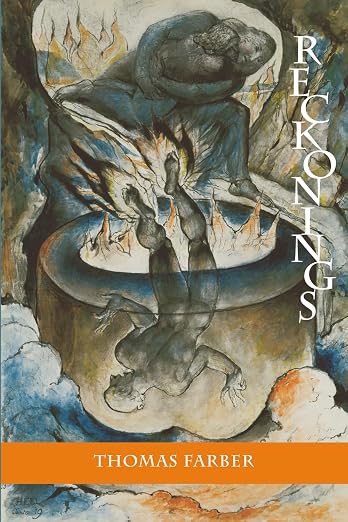 Similar to trompe l’oeil – to trick or deceive the eye: the images draw you in and consume you before you realize the demonic nature illustrated. Perhaps a slight metaphor of our present state of affairs and how we came to fine ourselves here. Not just a red state/blue state problem: we all share the blame and that is why it is imperative to determine how it all went so wrong.
Magickal Millenials: A review of The Hermetic Order of the Golden Dawn by Felix John Taylor
 Felix John Taylor achieves a grand academic sweep of the field. His Hermetic Order of the Golden Dawn: Magic Arts and the Occult Revival is a work of prodigious scholarship, tracing in minute detail the origins, the rivalries, the infighting inherent to magickal team building.
A review of Dreamboat by Jeffrey Skinner
We enter the collection meeting the speaker as he experiences a bout of insomnia during a river cruise in Germany. The Rhine River transforms into a pack of stampeding dogs of various breeds. Logic does not rule—the poems are untethered, capable of moving anywhere at any moment.
A review of The Design of Everyday Things by Don Norman
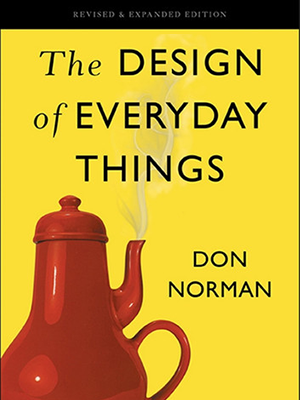 The book promises to speak to everyone but whether it does is a different question. Norman succeeds as a manifesto for designers, but falls short as a practical guide for everyone else because the examples he uses, the vocabulary within the guide, and proposed solutions to said designs are tailored to people with the power to change it – not the everyday people he claims to be writing for.
A review of In the Shadows of Service by Cynthia Hamilton Urquhart
 Urquhart allows the stories to unfold, tell themselves with few scattered phrases across the page. This technique allows the reader to inhabit the scene. Suspense and pathos are constructed line by line, slowly building as the reader begins to grasp the enormity of the scene’s significance, the weight of these life-altering moments.
A review of The Badge Between Us by Terrence P. Dwyer
 As a New York State Trooper, Terrence Dwyer spent more than two decades involved in criminal investigations. Now a university professor of legal studies at Western Connecticut State University and an attorney consulting on law enforcement issues and the author of Homeland Security Law: Issues and Analysis, Terrence Dwyer writes with real authority on the issues of crime and policing.
A review of The Frenchmen, or My Life in Theory by Emily Eakin
 As an undergraduate during those heady years Emily Eakin was caught up in the excitement. Her The Frenchmen, or My Life in Theory, part memoir and part history of ideas, is a lively look back at that time when critical theories largely imported from France seemed poised to make a clean sweep of American intellectual life.
A review of Oppression by Judith Skillman
 Judith Skillman’s Oppression contains language—rich, allusive, and whip-smart, filled with mordant humor—that is easy enough to parse. What makes the poems so difficult, so oppressive, however, is the profound and wrenching emotional weight they carry.
A review of Sad City by Craig Kite
 Kite is a poet, musician and actor and has worked as a journalist and in human rights domestically and all over the world. All of these experiences inform his writing and bring an authenticity, edge and poignancy to the work.