 Reviewed by H N Hirsch
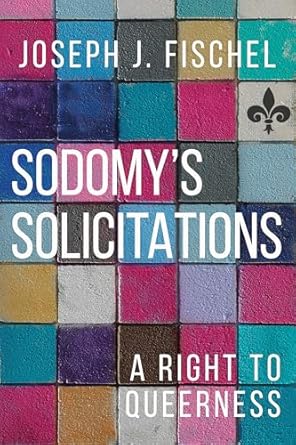
Sodomy’s Solicitations: A Right to Queerness
by Joseph J. Fischel
Temple University Press
June 2025, 300 pages, ISBN-13: 978-1439915851
Proposition 1. Relying too much on identity categories is a trap, a mistake. Not everyone fits neatly into the homo- and heterosexual binary, nor do all queers fit neatly into the categories of L, G, B, or T. Identities based on sexual behavior and proclivities can be constricting, limiting, inaccurate. We are all many things, even those accused of crimes.
Proposition 2. The state should stop policing blowjobs. . .and other sexual acts. Everyone is capable of having all sorts of sex—we all have certain body parts, after all—and where’s the harm in adults indulging in what the law calls “sodomy,” which is legal-speak for non-reproductive sex? The harm is in throwing people in jail, or threatening punishment, for sex. Sex is a normal human activity, and justice requires sexual freedom. We can build a politics around our common sexual capacities.
The first of these propositions has been around, at least in its most basic form, since Kinsey, and its elaboration has been one of the accomplishments of queer theory over its roughly thirty-five-year lifespan.
The second proposition, some of which is familiar and widely accepted on the left and in much of the sensible middle, informs the heart of this new work of scholarship, which elaborates and extends its basic insights with skill and plenty of evidence from concrete legal cases.
The book is erudite, playful at times, and well-argued. But whether these two relatively straight-forward propositions require so much theorizing and intricate prose is debatable, at least outside the groves of academe, where the author writes from a perch at Yale. One can imagine functionaries in the current White House looking at this book and immediately barking out orders to cut federal funding for New Haven.
But if high theory—and the true definition of “queer”—is to your taste, this book is for you.
Fischel takes his evidence from sodomy law and its deployment in Louisiana. His evidence is carefully presented and often fascinating, and the legal and constitutional analysis here is strong and thorough. But the focus on one state poses a problem.
Academic studies must be manageable, and case study is a completely acceptable methodology, but one that leaves the reader wondering whether the study’s conclusions are generalizable.
Fischel heaps enormous theoretical weight onto this one locality. Would the same conclusions flow from a comparative study of sodomy cases in, say, Maine, Illinois, Kansas and Oregon? Perhaps. But Louisiana has always been a cultural cauldron and somewhat unique—it is the only state, for example, where the entire corpus of civil law was adopted from the Napoleonic code rather than from common law. And, of course, Louisiana was part of the Confederacy and its racial history is tortured. It struggles with poor health care and limited access to quality schools.
It’s always wise in a case study not to lunge too far out over one’s skis. Here, the theoretical lunging is the main event, and, while racing downhill, Fischel makes arguments that some will find revealing and others will find problematic, including that registering sex offenders as well as laws against commercial sex are counter-productive and unjust, as are many laws against sex in public and even laws against the sexual abuse of animals.
Along the way, and even with its abundant insights, the book is questionable in some of its theoretical premises, especially in its desire to move beyond identity politics. It’s a simple fact that many individuals find identity labels, and the communities they create, liberating rather than constricting. For some, embracing an identity–“I am gay,” “I am trans”–is a hard-won and necessary declaration, a first step toward authenticity. It takes a certain degree of academic class privilege to criticize or minimize these categories and the political movements they inspire, for example when the author pokes fun at Ellen DeGeneres, who came out in 1997, long before other celebrities (and long before she acquired a reputation as an ogre). Mainstream role models do matter, at least outside the Ivy League. And, conversely, there really are criminals who can legitimately be labeled (after repeat offenses) as a “rapist” or “predator,” and the state has a compelling interest in dealing with them. Labels and categories are sometimes accurate.
Also troublesome is the author’s discomfort with theories of intersectionality, where his argument becomes somewhat convoluted. Too much attention has been given of late, he argues, to gender, race, and class, while sex—actual, messy sex–has tended to drop out of academic theorizing. Yet he also concedes in his case histories that (for example) it has been women of color, sometimes trans women of color–busted for offering oral sex to undercover police officers–who have often been the victims of unjust laws and harsh prosecution. In other words, the interplay of identities does matter in policing and prosecution—which is one of the point that theorists of intersectionality are making.
Both identity politics and theories of intersectionality are attempts to come to grips with a central political truth—that an individual’s perceived or self-proclaimed identity may often be the single most important factor determining their treatment at the hands of the state. Fischel certainly recognizes this, but wants to limit our reliance on categories and to squeeze more juice (so to speak) out of sodomy, and what he sees as its universal possibilities; we all are, or could be, sodomites. Fair enough—in the abstract. But theoretical arguments over how relevant certain sex acts should be to our understanding of “queer” doesn’t change the facts of daily life and the oppressions, major and minor, queer people (however defined) endure. Nor is much gained in the day-to-day world by the attempt to make everyone realize their capacity for “queerness.” Straight white men are not likely to accept a new, shared identity as sodomites, no matter how compelling the academic argument.
On the other hand, law reform would change some aspects of daily life for queers, and Fischel provides ample material to support it, even if you disagree with how far he takes some of his arguments. But law reform can be accomplished, and perhaps accomplished with more allies, without theorizing about the meaning of queerness and turning everyone into a sodomite.
Despite these quibbles and reservations, the book is a major addition to the academic study of sexuality. . .if high theory is your cup of strong French coffee with chicory root.
About the reviewer: H N Hirsch in Erwin N. Griswold Professor of Politics Emeritus at Oberlin College and the author of A Theory of Liberty: The Constitution and Minorities and the Bob and Marcus mystery novels.