 Reviewed by Kathy Prokhovnik
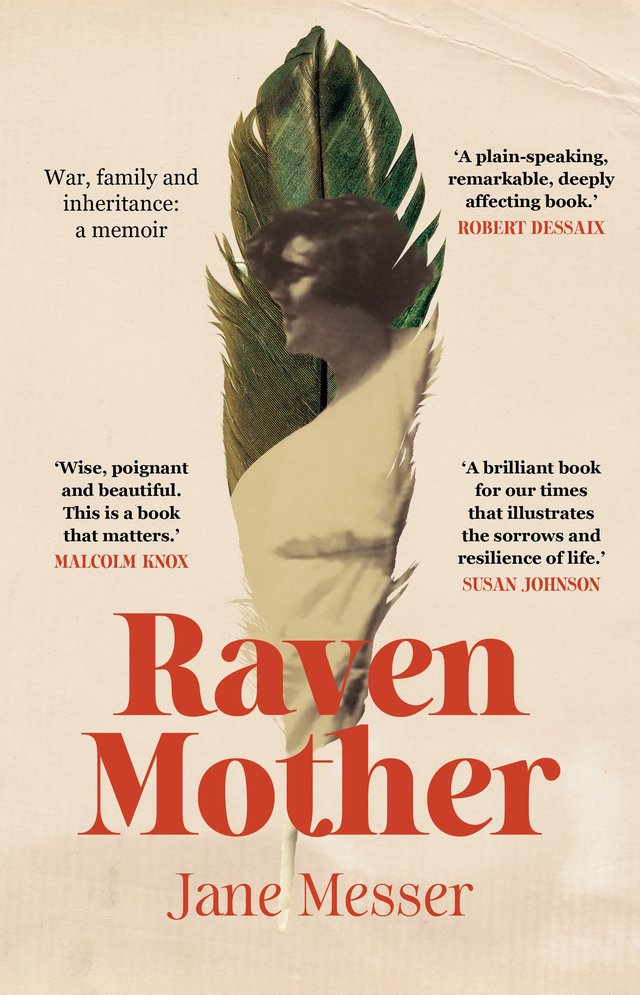
Raven Mother
War, family and inheritance: a memoir
by Jane Messer
NewSouth Publishing
ISBN: 9781761170638, March 2026, Paperback
 Mother Shadow
by Cynthia Banham
Upswell
ISBN: 978-1-7642397-1-4, April 2026, Paperback
 Fractured Motherhood: when love, trauma and parenting intertwine
by Maggie Walters
Blue Gum Publishing
ISBN-13: 978-0648603832, April 2026, Paperback
Motherhood is not a stage you go through. It’s a permanent state. As three very recent books show, the influence of a mother stretches through years, decades, centuries. Even when your child is in their 90s and you’ve been dead for most of their life, your child still wants something from you.
Michael Messer is now aged 99 but has always felt abandoned by his mother. In lieu of talking to her long-dead grandmother Bella about it, Michael’s daughter Jane Messer conducted a search across the places, times and circumstances of Bella’s life, and describes it in Raven Mother: War, family and inheritance: a memoir.
Born in 1893 in Berlin, Bella was the last of five children. Her family was Jewish but saw themselves as German. This didn’t stop them from being persecuted as Nazism took hold in the 1930s, and in 1935 Bella and her husband Willy took the drastic step of placing their two children, Ruth (born 1922) and Michael (born 1927), in an English boarding school. Bella and Willy emigrated to Palestine in 1937 and Ruth joined them there in 1938, but Michael was left in England to complete his schooling. He didn’t leave until 1946, joining Willy and Ruth in Melbourne where they had been since 1939. He hadn’t seen his father for 10 years. His sister was married, with a child. Bella stayed in Palestine, working as a social worker and as a corporal in Britain’s Auxiliary Territorial Service, and possibly having an affair. She sent her children loving letters but it was another two years before she rejoined the family.
Messer’s research reveals a mother who loved and wanted to protect her children but couldn’t dedicate her life to them. To her son, this meant a lifetime of feeling forgotten. Now, with the perspective of research, the pieces have been put together and Messer reports that her father can say, “But she didn’t abandon me, in fact she made sure I was safe.” Their conversation continues:
“But over time,” I continue in the same unhurried pace as the slow traffic, “we’ve talked about what I’ve discovered, so your ideas about her have changed. For both of us, we’ve changed through the process of me doing the book.” I’ve not put this into words with him quite like this before, or even to myself. We’ve both changed.
‘Motherhood’ is an archetype, an overarching sense of origins and nourishment that permeates our myths and stories. A mother isn’t just a woman. She’s a concept that all sorts of expectations are loaded onto. But just because it’s an ideal doesn’t stop people from expecting their real-life mothers – our themselves – to live up to its standards.
Cynthia Banham’s Mother Shadow: A meditation on maternal inheritance (Upswell Publishing 2026) was also prompted by the idea that a mother had not been ‘good enough’. Banham had always been told that her great-grandmother, Natalina, born near Bologna, Italy, in 1898, was an orphan. Unearthing her birth certificate in 2017, she discovered that in fact Natalina had been placed in a brefotrofio – a foundling home – by a mother who chose not to be identified. Banham’s first response was anger at the mother who abandoned her baby. She wanted to know more, compelled to understand why someone would do that.
Woven through the story of Natalina and her mother – a women whose name is unearthed through dogged research to be Ersilia – are Banham’s own raw feelings about her adequacy as a mother. Having lost her legs after a horrific plane crash her mobility is limited. When she determines to have a child, she is told that some countries won’t let her adopt because she doesn’t have all her limbs. As with many things she persevered, and with the aid of IVF gave birth to her son. She writes, ‘I understood how lucky I was, knew that I would give my life for him in an instant.’ Was it her own overwhelming desire to be a mother that led her to judge someone who seemed to have given up the miracle of a baby so lightly?
As her research advances, judgement gives way to understanding. She sees how she was holding ‘the mother accountable for all ills,’ how she was feeling judged and judging herself. She and her family travel to Bologna to dig up more of Ersilia’s story, and she starts to see why, in a land dominated by the Catholic Church, a young woman could be compelled to give up her child. As it turned out, she gave Natalina a better life than she could ever have provided.
Like Mother Shadow, the third in this trilogy of books about motherhood, Maggie Walters’ Fractured Motherhood: when love, trauma and parenting intertwine is shot through with doubt – will her past let her be a good mother?
Suffering terrible abuse from her parents as a child, Walters’ ‘young, malleable mind’ developed Dissociative Identity Disorder (DID) [or Multiple Personality Disorder (MPD)] to cope with the trauma.
A visit to the Philippines while she was at college ignited something new – she loved the culture and the people and she started to dream of adopting a Filipino child. She couldn’t give birth herself but when she met and married Tom, their joint desire to have a family turned the dream into something concrete to pursue.
Just as Banham needed to understand why her great-great-grandmother had abandoned her daughter, and Messer to understand why her grandmother had apparently abandoned her son, Walters needs to understand why her parents treated her as they did. Her motivation is very personal. She doesn’t want to make the same mistakes. Her children need to be safe. She needs to protect them, not betray them.
The process of adoption is brutal. She and her husband are subjected to multiple checks and balances and, just as Banham discovered her missing limbs may have been an impediment to adoption, Walters and her husband are told that their weight might affect their application.
While Messer and Banham do their research in libraries and archives, Walters delves into herself for information. She interrogates photos and pieces of evidence about her parents, forming hypotheses. In the end, there are no answers. ‘Questions remained; insufficient information meant no absolutes. But at least I had allowed myself to grapple with possibilities.’
All three of these books grapple with possibilities, throwing new light on old struggles. While all three writers feel, at times, that they’ve unearthed something that would have been best left buried, they all end with some answers, some discoveries, that justify the excavation.
All three of them find that the abandonment – the shadow side of the archetypal nourishing mother – is not the end but the beginning of a story.
Banham’s research reveals a mother placed in an impossible situation, gambling on the brefotrofio as the chance to give her child the best life possible – a gamble that paid off. Searching for and forgiving Ersilia also gives her the chance to forgive herself.
I had to piece together the shards of Ersilia’s broken, troubling story because I needed to learn what it means to be a mother, so that I might forgive my own maternal failings – and understand that sometimes the failings aren’t necessarily my own, but society’s.
Walters’ view on ‘abandonment’ is one of complete compassion, thinking of the mothers who’ve given up their children for adoption and given her the chance of motherhood. They’re her children now.
Their birth mothers had to hold in balance the knowledge they couldn’t provide for their child and, on the other side, love – a pure, unadulterated mother’s love wanting to always hold their child close. They walked into the government office (or orphanage), arms full of love, and left empty, holding only grief.
The act of writing – of researching, of spending long hours grappling with ideas and how to express them – changes writers of memoir. All three writers approach this possibility of change bravely. Not in the cynical, ‘Yes Minister’ sense of brave. In the genuine meaning of brave. They ask the hard questions, they go to the difficult places, and their answers let them come away cleansed of assumptions, finding new meaning and overturning old beliefs.
About the reviewer: Kathy Prokhovnik is a writer of fiction (long form, short stories, micros) and nonfiction. She is the author and director of Seeking Sydney, a ten-episode podcast. Her short stories have had some wins, some shortlists, some publications.