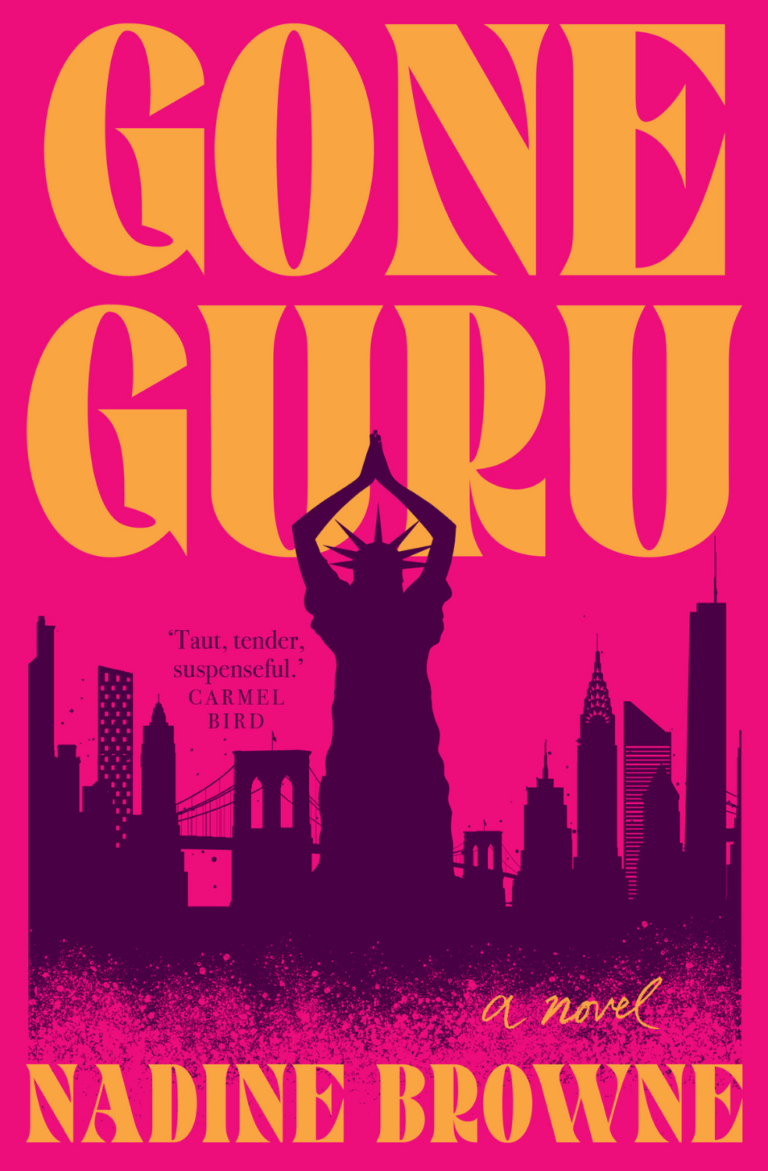
 Reviewed by Magdalena Ball
Gone Guru
By Nadine Browne
Fremantle Press
Sept 2026, Paperback, 312 Pages, ISBN: 9781760995560
It’s difficult not to like Noni Barlow, the quirky protagonist of Nadine Browne’s novel Gone Guru. Noni is a thirty-something year old Australian student in New York struggling with the fug of jet-lag. Noni has received an exclusive scholarship to New York University (NYU) with a dream of writing a memoir about her escape from her family’s Born Again/Doomsday cult in a remote Western Australian town called Kookynie. Noni, who never went to school, is not only jet-lagged, she’s also struggling with imposter syndrome, is desperately missing her Pomeranian-cross Bob. She is already running late on her coursework and has forgotten to take her anti-depressants. It’s no wonder she takes a while to notice that the soft-spoken roommate Vincent who she has sublet her Harlem apartment from has not been seen for weeks. When her neighbour, the landlady’s flashy daughter Merelis, comes knocking, Noni is soon caught up in the search for Vincent, who owes rent money.
The mystery of Vincent’s disappearance drives the narrative but Noni’s search for Vincent also provides an excellent “shit-hot” plot for the novel she’s writing. This makes for a rich intertwining of life and art, giving the book a meta-fictional feel as the book Noni is writing and the mystery she is trying to solve braid together. To add to the richness, Gone Guru follows many of the contours of Browne’s own life. Kookynie (you couldn’t make up a name like that) is a real former gold-mining town about 8.5 hours east of Perth. Browne really did grow up in a Western Australian doomsday cult with its own great disappointment, and she really did go to New York City to take up a prestigious writing scholarship with teachers like John Freeman, Martin Epstein, and Joyce Carol Oates, who, like the fictionalised Oates, really did call her memoir manuscript a ‘dead baby’. The first person narrative coupled with the author’s deep insecurities creates verisimilitude:
I had applied to the program because I was disgusted by how hard writing was. I thought it couldn’t be so. Perhaps I’d made some grave error and gone about things the wrong way. I’d somehow made it hard for myself, which I’d done with other seemingly benign things—turning them into a tortured labour. Coming to such an illustrious writing program, I hoped to find people who had made it easy for themselves, who had found some sort of loophole, who would teach me to enjoy writing again. (27)
In the course of her digging, Noni discovers that Vincent has an alter-ego as Brother Moksha, a YouTube guru with a big following, and a secret multi-million dollar bank account. She also finds Vincent’s eighty plus year old “uncle” on the lower east side, Danny Kronfeld, the “OG” of social work, another ‘real-life’ character. Browne dedicates the book to Danny Kronenfeld, her confidante while at NYU. Danny and Noni come to rely on one another in a very heart-warming way–we come to see Noni as Danny sees her: interesting, neurotic, funny, and kind. The whole book is wacky and fun and full of enough twists to keep the narrative moving quickly. Characters like Noni’s Dominican neighbour Merelis with her glitter-drop nails and leopard-skin clothing, her mother Maya, and the building’s superintendent Juander are funny and full of slightly chaotic charm. The writing professors at NYU are also the subject of some gentle satire, especially Joyce Carol Oates, who:
sat like an exotic bird at the head of the table, dropping names like she had too many to carry: ‘Last week, at a dinner with the Obamas’ or ‘As I was saying to Sandra Oh at an event last week’. She wore a lot of ‘evil eye’ jewellery which I knew was meant to ward off jealousy, though I thought the name-dropping might make it obsolete. (13)
The story is so easy to read and humorous, that it’s easy to miss how much ground Browne covers. Gone Guru manages to balance post-modernist reflexiveness with a fast-paced mystery. This is very much a book about the process of its own construction:
Instead of angsting over my memoir and how it was too sad, and too true, and too passed, I could just follow the trail of Vincent. It was a far more pleasant-sound trail to follow than inward, up my own sand dune of misery and self-loathing. In fact, what it was, I decided, was the path of least resistance. (74)
Gone Guru is also about many other things including identity, shame, friendship, and what really matters in life. At one point Joyce Carol Oates asks whether ‘the Australian’ knows who M.C. Escher is. The book itself has something of an Escher quality with its mise-en-abyme, nested story structure that keeps coming back to the premise of memoir without actually becoming a memoir. In spite of its clever unfolding, wry humour, and slick pace, there’s nothing pretentious about Gone Guru. It pulls off its pyrotechnics without ever feeling strained, overly scaffolded, or manipulative. Gone Guru is a real pleasure to read.