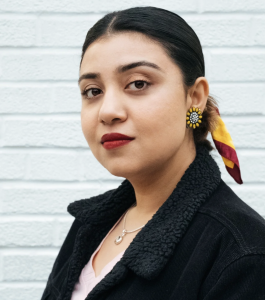
 Interview by Justin D Goodman
Your thesis at Kalamazoo, “Going Into Battle Wearing a Sari,” featured interviews with five Nepali women authors. I was struck by the fact that these were not only poets like Ujjwala Maharjan and Yukta Bajracharya, but the musician-poet Bartika Eam Rai and the journalists Shradha Ghale and Bhrikuti Rai. I know you’ve also explored writing nonfiction, often emphasizing on the political (you wrote about the Gen Z revolution for Brown History for example, and “Jackson Heights, Roosevelt Avenue” has the quality of reportage), so I was wondering if you wanted to talk about how you see poetry, music, and journalism intersecting in your work.
Growing up in Nepal, the only kind of writing that seemed normal, which was not even that normal, was journalism. I felt the only way to express yourself is through journalism. Even now I try to write some articles, but I always feel like the creative writer in me takes over. I guess the journalism doesn’t need to be that factual—there’s these different things happening and you can tell from your point of view. But the resistance to stay with the facts and not let my emotions take over is difficult for me. When I was interviewing them in my undergrad, I was going to be an econ major. I had a whole journey. Diane Seuss was my professor and she completely changed my trajectory. I was curious about the writers from Nepal, because we don’t have a lot…I mean, we have a lot, but women don’t get coverage and then they disappear. How do they find the space and time to even write? I was impressed that these women were able to do it, which is difficult in a society like that. I knew it would be like a poetry collection, but I wanted it to have some ties to Nepal, so that’s what I did. But the intersection, I grapple with it more now, and only at this age I’m comfortable. “This political thing doesn’t just need to be reportage.” Or, the only way to talk about it’s not just the history and the facts and the numbers. I’ve gained the confidence that I can do it in the way I want and that’s more natural. Even with music like Bartika’s. Her lyrics are so profound and she writes in Nepali. I’ve become good friends with her and she lives in New York. She writes great in English too, but listening to that kind of lyrics, it really moved me. They could just exist as poems and sometimes I need something to tap into. To go back to. I don’t think necessarily there a lot of poets or writers in English that helped me tap into that energy. Even podcasts or music videos helped me transition to that.
What do you feel is the connection between home and language in that way? In Women In Marigold there’s at least two poems, “घ्यु /Ghyu/” and “गुन्द्रुक /Gundruk” where you emphasize the, not untranslatability, but certain words remain because of the valence, like Aama and Hajurama. There’s a line from Ocean Vuong’s Time Is A Mother where he makes a lot out of Yêu meaning love, but also weakness. What do you see as the connection between that sort of longing, the absence of home, and your use of language. How do you connect those?
I often find myself in situations when I’m trying to either intellectualize or philosophize my emotions. It’s such an overwhelming thing. How do I ground myself? The desire is impulsively to find language to anchor myself. I don’t come from a culture where that’s a thing. Even in “गुन्द्रुक /Gundruk” or “घ्यु /Ghyu/” where my grandmother is involved in this super long, intensive, immersive process—that process is itself a language. That whole mechanism is a language which we don’t call a language, but I don’t know what else it is. It doesn’t have the word. I don’t think my grandmother ever said “now I’m going to make this gundruk.” If I do now, I always have this beginning, middle, and end. It’s this whole task. But, then, how do you involve yourself in this immersive task without looking at it like a process or language?
The first poem in the collection is about having to move towards something of intimacy in order to strike a balance, and, in the collection overall, there’s a sense of, almost, the impossibility of finding that balance. I’m struck by your phrase “ground yourself.” I know you’ve said this in your newsletter when talking about cooking and your maternal line’s relationship to the kitchen, but there’s a complicated relationship to femininity and womanhood in your work. In “Everything in the Universe is Made,” you break two sentences (for lack of better language) into the lines, “me manipulative. a woman.” This feels reflective of what I would call a fundamental cynicism towards being a woman running through the collection, most abundantly in the poem, “Girl-Sad,” whose full title is explicitly about this. In the context of “Everything in the Universe is Made,” about being gaslit by a man, hints at the artificiality of “a woman,” and is something that’s currently in the zeitgeist, thinking of Andrea Long Chu’s Females. How do you think through the feminine and its relationship to the political realities of womanhood as such?
Growing up in a patriarchal society, I’ve always had a lot of questions about the self. But, as a household, as a Nepali household, I’ve never had any restrictions. My parents are very liberal. But it’s impossible for it to not seep in the house regardless of how progressive they are because of the overall structure. There’s always this resistance. Leaving Nepal as a young girl and coming to America, I was very homesick. I was longing for home, and when you long for home it’s like “what do I miss about home”? My mom cooking or my grandmother cooking. These feminine things. If I’m craving for these traditionally feminine thing, am I moving backwards by wanting to cook or finding intimacy there or longing there? There’s this push and pull. I also feel that with romantic longing. I did my MFA in poetry, but then I did a third year where I took non-fiction classes. I was really interested in sharpening my writing, especially when I saw Leslie Jamison’s creative non-fiction. “Oh my God, you can be so emotional as a woman.” But then the way she would describe it felt like it had scientific elements to it. It felt mathematical, the way she talked about her emotions. One of my friends said every time we talked about boys, we have to talk about feminism. That’s what it’s reminding me of. I create this, and this is home and intimate, but is it moving backwards? Especially because I was asking my mom about this elaborate process of cooking biryani and she was asking, “are you eating alone? Who are you cooking for?” It doesn’t make sense to her. She didn’t do it. My mom has a master’s in biology. She’s a teacher, all of that. But she also has that traditional role to play in the household that she’s married to and I think it’s weird to her that I don’t need to do any of that. In situations like that, I end up questioning myself. “Is this not a marker of progress then? What is a marker of progress?”
Where do you stand on that? Because, again, it’s interesting how ambivalence plays such a major role in the collection. The poem “Dear America” is buoyant, and in “Where Will You Keep Dwelling” you describe “a girl made entirely of New York and chaos.” Almost jubilant about being in this place. But that pairs with the poem “Permit Yourself Anger,” where you describe America as “a grave with Wi -Fi.” So that throughline is interesting. Where do you stand on the concept of progress?
It’s so many layered things, right? America as a country, me being here, what I feel about it, what it represents globally…there’s complications there. But also cooking, me seeing a beautiful thing, I always have to do this work of stripping away my old notions of “I’m frying these onions and I love frying onions” then all of a sudden “oh my god I’m in this kitchen doing this traditional feminine thing.” It angers me that I always have to do this multi-layers of stripping. Just enjoy these onions. What do you mean there are people that are just able to do that? It’s a sense of betrayal of my old self, that if I do something like this I feel I’m betraying that person that tried to rebel. Part of me is like no, actually, I’m not betraying you. It’s also this desire to show somebody that they’re only seeing that I’m frying onions, but that’s the tip of the iceberg. Everybody doesn’t need to see the underneath thing, but if I don’t show it I’m not being true to myself. Always that impulse. Regarding progress, I’m still battling with it. Is sitting on my couch progress? Is watching the moon progress? Especially coming from a society where the boundary is so different. Also the monetary factor. Obviously, doing poetry, it was never a goal that I’m going to make money. But people who leave Nepal, my parents friends with their children, they’re not pursuing art and writing. They’re not pursuing poetry. They’re working tech or finance and making money. There have been times my parents asked, “so what does it mean”? Even for a book to come out, this is more a marker for progress than what it has been for the past so many years of me writing. The process is so invisible to them. Having said that, they’re still supportive. Just, lacking the language, it’s difficult for me to explain to myself to them. Coming from this communal society is even more difficult because I can’t say “you can think whatever, one day it’ll happen.” I feel I owe some responsibilities to show them. In Nepal at that time it used to be you either become a doctor or an engineer. It’s been a long way and I don’t think my parents expect any of that. Being in New York for all these years, being around all these artists, I don’t need to care about this marker of progress.
That’s actually a great segue. In your poem about collectivity versus individuality, “Nakedness Is A Truth, Not The Truth,” you pretty liberally switch between you and I. Which brings me back to the poem where you say America is “a grave with Wi -Fi,” the title of that poem being “Permit Yourself Anger.” The way in which you switch between pronouns very loosely, the “you” becomes the “I” becomes the “we.” Even in “Permit Yourself Anger,” it’s not just the voice speaking to itself, but also other Nepali diasporans. What do you see as the relationship between that collective cultural experience and your use of pronouns?
The “you” is a specific one. It’s navigating these situations or emotions, it’s turning inwards and the “you” is to me more than the readers. That intensity of questioning and confusion is so much that a self of mine has to step up. So “you,” as readers, might seem for them. For me, when I need it, it’s for myself. But then “we,” the collective, it always seeps in. In the newsletter I say I’m trying to have a private moment in the airport while I’m leaving the country and I see so many people leaving the country. The airport is chaotic everywhere, but in Nepal, in a lot of developing nations, it’s extremely tragic. It’s a lot of young people leaving. Sure, the more privileged ones are leaving to Australia or America for education, but a lot of them are going to Middle East. A lot are going to make money, but the working conditions are not fun. When they’re bidding farewell, it’s tragic. They don’t know what conditions they’ll be working in. Even though that’s not where I’m going, every time I see this mass departure it stings me. The conversation about youth leaving the country has been prominent in Nepal and I feel this sense of “do I owe a physical presence to my country,” especially as somebody who has had the opportunity to get an education. Do I owe something, coming from this community-oriented place? It’s difficult for the “I” to just be an “I” and not “we.” If it was just me leaving, it wouldn’t be as intense. But a lot of people are leaving. That accumulation is what intensifies that effect. Is this country only going to have old people at some point? But if I went back, would it be better? When I wrote that thesis, I did go back and always felt “I can’t be in this country.” And I still feel like that. But it’s been 10 years. I’m also seeing the other side. It’s not easy for me to leave, which I always thought it was. I switched my visa last year from student visa to O Visa, which, it’s kind of funny, they call it an “Extraordinary Visa,” and I had to show my writing to be “extraordinary,” to get the visa. But, as I was compiling the hundred pages of documents, it was weird. I was working hard to be in this country, which I didn’t think I would be. I think it’s that. I would be like “these people in Ohio are watching the TV,” but am I becoming the people in Ohio watching TV? Because of that, the “we” and “I” are different. The hero’s journey of Joseph Campbell doesn’t apply in terms of immigrant journey. The return is not always possible, the return can be halfway or temporary. The hero’s journey is such an individualistic concept. That hero is a lot of heroes, and that’s why it doesn’t fit in that narrative.
First off, congratulations on the federal government agreeing you’re extraordinary.
[Laughs] Thank you.
But I know you’re a spoken word poet, originally. In 2017, you won the QC Awards as part of the Word Warriors. And in 2019, the Kathmandu Post stated that spoken word poetry was blowing up across the country in the 2010s. So it’s interesting that what’s compelling you in this conversation so far is the political and social. I know in Nepal particularly, from 1979-1980, there was the Street Poetry Revolution with poets speaking to crowds on the street in an oratory style. I’m curious how you fit yourself into that tradition. Do you see this collection as an extension of your work as a spoken word poet speaking to the “you” that’s also an “I” and also a crowd?
Saying that there’s no extension would be a lie. How explicit is it or not is the bigger question, right? There were these two spoken word poets, Sarah and Phil Kay, who went to Nepal and trained a bunch of people. They called themselves the Word Warriors, and as a young person I was so fascinated by these Nepali kids. Spoken word felt so powerful and energetic and I competed in the competition and won. I’ve always had an inclination towards self-expression and at that point I thought “this is so cool.” These poems, I don’t necessarily see them as residing in the spoken word style. Maybe the performance aspect can get more people into poetry, and that’s cool, but I don’t think I’ve performed spoken word in a long time. I feel that’s a natural progression from that to this. I’m also currently working on a novel, so it’s a lot of movement happening in writing.
I would love to hear more about what you have planned for the novel.
Honestly, it’s kind of crazy. I had an agent interested after I got the poetry deal. Fiction, I genuinely believe, is my weakest genre. It was a few short stories I was experimenting with, I tried to like merge them, and he was interested. It was only 30,000 words and I thought “what? This is like an abandoned project.” I had gone to Nepal after I got the Extraordinary Visa for four months because “ok, I can come back now.” We talked over Zoom, he signed me and, I felt, “I have to finish this because I have an agent.” So that was also a big factor, that I had somebody holding me accountable. Doing poetry and transitioning to fiction is extremely difficult for me because I was not formally trained in fiction. Even nonfiction. I took classes, but having a plot, a beginning and middle…even writing so many words. But I developed it with an agent, so it was easy for me to have a bouncing board to ask “what do you think is not working” and he would give me feedback. That was really good. It’s been almost a year that I’ve worked with him. I submitted him a draft last week which I feel is almost done. I’m waiting to hear what he thinks. So I don’t know. I have some poems here and there after this, which was my thesis at Columbia, a part of my thesis. Obviously, I’ve changed things.
Congrats, that’s wonderful!
Thank you [Laughs] I hopefully will sell it. It’s always intimidating to me. Poetry is such a different journey than other genres, so I’m a little….
What about it is intimidating? Why do you think it’s your worst genre?
I always distanced it. Non-fiction, which you said my poems also have this non-fiction quality, it’s impulsive. I feel this urge, like it’s coming to me, the sentences that I’m writing. Obviously there’s editing and all of that. With fiction, I always distance myself from the people I’m writing about. Accessing myself is easier than building the world of these characters. Maybe I’m still yet to train the muscle, which I have much more this year than before, but the imagination muscle is harder for me to tap into then being creative with the experiences that I already have.
It’s interesting you say that because I see imagination in your poetry as grounded in sensory, not just personal, memories. For instance, the poem “Malekhu Ko Macha” is a very visceral poem that ends with “no matter how/smelly the mouth or how full of fragrance,//the same fried prawns go inside and all of our holes/smell like an ocean in a landlocked country.” It’s a wonderful expression of (calling back to your Aama’s cooking) your connection to femininity and the collective identity being not only what we consume but what is expelled from us after we have consumed. But it also reminded me of a line from Laxmi Prasad Devkota’s Muna Madan where he writes “touch beauty only through fragrance.” Your collection and that collection don’t have a lot in common, obviously, but the one thing between them is this sort of gothic imaginary. This sense of remembering something as lost or past. There’s this sense that imagination is connected to what you’re not allowed to touch, to contact. The throughline there is the relationship to love and intimacy as almost something removed. I don’t know if you necessarily would say that you’re trying to write something that’s happier, but it seems to me that externalizing yourself from the text is a different kind of process as regards that kind of imaginary.
No, fully. The connection with that line is so interesting. I didn’t even think about it like that. But externalizing myself is difficult. My novel has a lot of women characters and they’re all unhinged, and it’s coming from externalizing. It’s difficult with them. I’ve also observed people, the way they think, their conversations. Before, when I used to think “I have to create everything about this character,” what helped me is that I’ve seen these people. I’m fictionalizing them. There’s this woman in my hometown. Her daughter sent her this electric razor and said she has a hairy chin. She uses it in the morning and, it’s kind of crazy, you were living a middle class life in not even the capital city of Nepal and have these imported razors. Stuff like that, the sensory details. That’s at the center of my storytelling. That made me feel like this woman has to be somewhere, that she has all this technologically advanced stuff in this not so rich country sent by her daughters abroad. That’s been a lot of the stories, young people leaving, sending all this stuff to their parents. “You’re not alone, we are with you,” but they’re not really there. And the eerie part—this novel, I wouldn’t say it’s happy. It’s complicated. It takes place during a time when India had imposed a blockade on Nepal after an earthquake. A lot of Nepal’s identity has been, “it’s a landlocked country, it’s a landlocked country,” that’s what I’ve heard all my life. In my eighth grade social studies class we studied Nepal and I’m like “oh it has mountains” but you know before you’ve ever seen it that our country is known for mountains, that we are a landlocked country. That’s the primary definition. We had a revolution last September which was quite tragic, but when that happened, even talking to my parents, my dad would always say “India’s going to come and take over, China’s going to take over.” I don’t know if there’s any truth to that, but the psychological state of living in such angst…is this a normal way to live? And America is doing its own thing. It’s a third neighbor that we don’t even have. So the novel is about women, but also about the geopolitical situation of what it means to be a landlocked country. It’s not necessarily a happy novel. It’s also not necessarily a tragic novel. I’m interested in the abject. I have Mariana Enriquez’s book.
Which one?
A Sunny Place for Shady People. My friend gifted it to me for my birthday, so I’m trying to read it. But The Dangers of Smoking In Bed, I really like that book. I’ve read Samanta Schweblin’s stuff and I’m interested in the abject and horror, the way Mariana does it. I’ve been thinking about it for a next project, that I want to tap into the abject. I’m still trying to develop how to do it without making it seem like fantasy. I want it to be grounded how these authors do it.
I actually just recommended to my partner the novel Bomarzo. There’s magical realism but with a sinister undertone to the whole thing. It’s not an explicit thing. But it’s worth sitting with being landlocked and that connection to in-betweenness. Literally in between India and China, of course, but also, talking about insecurity—I believe, if I remember the history correctly, Nepal only became a formal republic in 2006.
Right, very recent.
And before that, I know that Manjushree Thapa has written about…
The royal massacre.
The royal massacre and a little bit, with Seasons of Flight, the Maoist insurgencies and the Panchayat era, which you’ve written about as well. So I imagine that plays a lot into the sense of in-betweenness that you can see just not in the idea for your novel, but also in the poetry itself.
Identity has been so ingrained with this that it’s difficult to remove ourselves from it. Even as a younger generation, talking about my novel, it’s borne from my arguments with my father. “We are such a poor country. What are they going to get from us?” But I understand it. I used to say, “people are being paranoid for no reason.” But there’s more to it. I got more curious about where this fear is coming from in my parents’ generation. We’ve been an unstable country. The Panchayat, the Rana regime. We’ve never been colonized, but we have our own stuff going on. Even post-democracy, before last revolution, there were a lot of people who wanted to bring the king back. I don’t think it’s going to happen. Most people don’t want it. But where is it coming from? A transition from monarchy to perfect democracy is impossible, so I guess we have to go through a shitty democracy before we move there, but I think people wondered “what is democracy doing? We’re still so corrupt, there’s no development.” They also felt a country’s identity only exists if a king’s identity exists. In democracy, people fear that nobody actually cares about this country. If somebody’s going to buy it, they’ll sell it. I don’t think that’s how it works, but people are always paranoid about the independence of Nepal because we’re so tiny. It surprises that we’re not part of India, or that we’ve never been. For us to stand alone as an independent country is crazy. Being in-between two powerhouses who hate each other is not a fun place to be. I was very young when the Maoist insurgency happened, when people used to say, “the Maoists are going to come. They take people,” schools would be closed because they would have protests, or there would be demands from different group of people. When it was passed, a lot of minority groups were not happy with the constitution. But there was also pressure for us to pass it because, post-earthquake, there was a lot of damage. A lot happened in haste. It had to be done and not done perfectly. And the recent revolution, people say Nepalis are chill and peaceful, which I think we are, but there’s also a lot of revolutions and questionings when they’re not happy. And with the recent flood—we’re trapped between India and China, but are the mountains also trapping us in some way? With climate change and the consequences we have to bear? People say “Nepalis are so resilient,” but what else are they going to do? What other option is there after the disruption, but if not to build? And writing this novel too, I felt the desperation. I’m interested in this psychological stuff. People who have studied abroad have gone back and tried to become like the recent new finance minister, but there’s always a lot of scrutiny. “You’re an American agent,” “you’re like Chinese agent.” There’s no trust at all.
It’s perfect that Bhanu Kapil’s advanced praise highlights the “grave with wi-fi” line, because in her collection Schizophrene she has a line talking about a passed down memory of gendered violence: “in the second room, in the city that the room belongs to, and it functions (the information) as a grave.” Whereas Kapil is doing a form of psychosociology, hence schizophrenia, it feels like you are trying to connect this to a sense of where the diaspora sit within a Nepal in a global context. That you said the mountains are “trapping us” is interesting too because it’s not just political realities, but a physical manifestation of, not necessarily a psychic state, but a sort of entrapment that is both broader and more intimate at the same time. How do you feel Nepal fits within that more global context?
The mountains and Buddha are the two national prides of Nepal—it’s this joke myself and a lot of young people have. We need to move forward, we can’t just cling onto these two things that just happened to be in Nepal. I’ve always resisted the urge to write about mountains because I’m tired of that being our whole identity. But this element of what happened…I might resist telling stories about mountains, but that’s our reality. When a glacier is melting, killing thousands of people, can I actually not talk about this? But the problem is the mountain as a spectacle or a background for the West to conquer. Leaving versus people there bearing the consequences of mountains is a different story. The advancement of technology abroad is crazy. Coming from Nepal, where there’s not the basic stuff in a lot of the world, coming here is difficult for me. I’ve been in this country for 10 years, but then the first time to find Wi -Fi in a grave is a crazy thing. What’s the point? Why is this here? I think how death is taken in Nepal. What you do there is different from how these tragic things unfold abroad, or in a country with more powerful technology. Of course I’ve Americanized. After being here, I’m more accustomed to this technology. There are these moments of rupture when something like this happens in Nepal, even when the revolution happened a year ago, it’s all of a sudden powerful and life-changing. It reminds me who I am. I’m in my adulthood. A lot of political revolutions have happened. But last year I was fully aware of what it’s like to see young people being killed fighting for a better Nepal and I’m here with a privileged life, questioning myself. What’s the kind of life I want to pursue? How do I find meaning in this kind of life? It’s normal to be desensitized after a certain time of being abroad, living a different, privileged life. But there are also moments of rupture where it strips away everything. A lot of people return back. People did after the revolution. Who has the courage to actually do it? It’s not always romantic, like the one poem where this guy kills himself in front of the minister [“Where Will You Keep Dwelling?”]. It’s not always the romantic idea of going physically back—but what kind of life are you going to live there? With the technology, I was thinking about climate change as a major factor for the glacier melting. America produces the highest number of carbon. In Nepal it’s 0.04%. A lot of the times people think that’s why it’s a poor country, but the forest area has doubled in Nepal and there’s been a conscious buying of electric vehicles. These kind of changes. Sustainability has been a big conversation, even before I even knew what it was. So being in America, I was going through my own role. Am I contributing, being here? In the carbon emissions, am I playing a role? It’s jarring to me to think about.
In your poem, “Poem,” you bring out this exact concern in terms of the value of being a poet, for lack of a better phrase. Is there a way in which you reconcile this for yourself? Because I know this is a very common experience, not just diasporic, but I know danez smith has several poems in Bluff where they express “in lieu of action, I wrote a book,” [“less hope”] and every poet, you know, the question always comes back to what does poetry do? What is the point of poetry? Even W .H. Auden has that famous line “poetry makes nothing happen.” [“In Memory of W.B. Yeats”] How do you explore that? Or, to invert Auden, does poetry make anything happen?
I totally have those moments. Starting from who do I owe my physical presence, it’s a central question of my life. Most of the times, surprisingly, I believe in the power of writing. I believe in the power of poetry. There’s also been times like this, with the loss of lives, where I feel extremely pessimistic. In the aftermath of this catastrophe I asked myself “what matters,” you know? I actually received my physical copies of the book a few days before and thought, “you have to make an unboxing video.” I had got on the video, the flood happened, and I was shattered, consumed by the news. After that I was questioning myself. What’s the point of sharing this book? I moved from “writing is extremely important” to questioning, because at that point all that matters is rescuing and rebuilding. Nothing else mattered. People were still buried under the ground. What is my poem going to do from here? I felt that this isn’t enough. I need to do something more. Writing is something I cannot stop doing, but I’ve been asking myself, what else? Is there anything else that I want to do and is there any other kind of impacts I want to create? Having said that, poetry is important. Writing is important to create a narrative. What I’m telling you about carbon emissions in Nepal and injustice in terms of climate—naturally the consequences of carbon emissions is moving across borders. America is creating the problem, but other countries are suffering. Who’s going to hold that accountable? Writing can help set your own narratives and there are few Nepali writers who write in English or write internationally. Writing is powerful in a way that you can tell your stories and people will listen to you. That itself might not change things, but that can lead to things that might change. So I do think poetry is important and is powerful.
That makes sense. That’s a lot of pressure to be under to represent the entirety of Nepal [Laughs].
I know, I know. And I don’t think I can and I don’t think anybody from any country can, but while writing this book I was representing a specific experience. That is the trap any writer from countries or places which are not represented fall under. That now anyone who’s never read a Nepali writer is going to read this and be like, “this is how Nepali writers write.” But that’s not true. I’m one of the thousands of people who write and you cannot judge a whole country’s literature.
Absolutely. Earlier you said the phrase, “who do I owe my physical presence to?” That is a great place to bring us back to, almost in response to, representing all Nepal. One of the things that I couldn’t help but notice in both the collection and in your newsletters is the sense that, while the nation, especially in Nepal’s history, is a thing that breaks apart and then reforms and breaks apart (sometimes literally, like the mountains), family seems to be far more stable and grounding. Even as there’s tensions, it seems like family, home, is a stable presence. I’m hoping you can explore your sense of homeness. Even that concept is fraught as in, I believe it was “Where Will You Keep Dwelling?,” you write “I live with all the possibilities of going home one day” but in the context of that poem it’s ominous.
It’s the same poem where the guy kills himself and, yeah, my family members are intense and complicated and I don’t think they want to say that. Growing up, that’s also your first time navigating these different layers of being human. It’s characters being very different, and I’m always flabbergasted. I’m a part of it, but I’m also a little distant, observing what is going on. I found so much profundity and depth and philosophy in the interactions or questions or arguments. When I go home there’s never been a time I’ve not had any sort of fight. But when I’m around my family, dealing with different obligations and emotions, it reminds me what it means to be alive. I grew up in a big family. I lived with my great-grandparents. My great-grandfather died in the same house where I lived. I was in eighth grade. You see this sense of mortality and aging. In New York…It’s so funny, I was saying to a friend that when I was younger I was more aware of mortality because I’m living in a city full of young people and energy. I don’t see a lot of old people but I saw an old man die in the same house when I was 14. My grandfather moved from the hills of Nepal to the plains for the betterment of his family, and there’s this idea that you have to give back to society, remember where you come from. My grandparents have always been “remember your roots” people. Maybe that’s why I have this guilt. I have a lot of friends from Nepal who say “I want this life.” I don’t see resistance or hesitation. But I’ve seen this from my family. They’re opinionated and complicated human beings, and sometimes it’s overbonding in the presence of my family members. That’s when I realized the complexity of life and how people navigate it. It grounds me, exactly like you said, even in all these tensions. Remembering that I belong here, there might be ups and downs, but this is where I come from, is a comforting feeling.
On that note, the title of the collection, Women In Marigold. In the afterword you talk about your hajurama, but obviously it’s “women,” it’s plural. It’s both your own personal family history and also a general “women.” So is there something distinct about maternal lines? Because your grandfather and father appears in the collection, but they tend to be secondary figures.
Fully. It’s never been a conscious decision, but subconsciously I find more richness and profundity in female figures or family members. They hold so much more wisdom, so there’s a natural inclination. Because there’s restriction in the society that, even with all these restrictions, you’re able to be you and there’s still beauty and sorrow and all these complexities in the way you’re living. That draws me naturally. I was joking with my family members about how I’m bad at giving gifts and I said “I can just write about you guys” and my brother said “you don’t even write about me” and I laughed. It’s true. Even my father and grandfather, I don’t really write about them. My sister who’s 13, every time I talk to her she makes me think. She’s so much younger than me and, again, I also have a brother, but somehow I’m much more drawn to the complications of my sister. Now she’s a teenager and the angst is there and she’s growing up in the same household I grew up in, so I feel it exactly. When she’s having fights with my parents I think, “I know exactly what that is.” It’s funny. When she was younger people called her Mansi instead of her name, and because they’re used to calling me and we have a big age difference, she would hate it. “Why are they calling me Mansi?” But I lean towards the feminine complexities and the different layers that they hold. I’ve always found it appealing compared to male members, even though there are interesting characters or people around.
I imagine they’re going to at least make some minor appearances in your novel.
True, yeah [Laughs]
But that’s delightful. It’s interesting you saw your great-grandfather die at such a young age and it didn’t leave, I don’t say didn’t leave any impression on you, but to go to your point about living in one household, my grandparents were mostly gone by the time I was around and even I think of them a bit, so it’s interesting that death hasn’t drawn out their presence in your poetry.
I think it does stay with me. I tried to write an essay about it and, even there, death is not as prominent. I remember my grandfather used to shave my great-grandfather’s beard because he was old. and in this mug of water there would be hair floating from when he would dip it. There are images that really stay with me, as a poet, and from the image I build a whole poem. That’s not always the case, but imagery is important. And hair too, I talk about in “Parlor.” So I tried to write about seeing that in one of my essays, but you’re right, I haven’t mentioned specifically the death. In “When Amma Doesn’t See Me For An Entire Year” I talk about Marigold petals and Hindus on the soul doesn’t die [“Gita says the soul was not born./The soul does not die either.”] I was thinking specifically about my great-grandfather’s death. But I haven’t mentioned him.
I know from some of your newsletters that you practice kathak, and religion in Nepal is complicated, predominantly Hindu with a small but major sect of Buddhism, with other things going on as well. So what’s your relationship to spirituality and faith?
Even being predominantly Hindu, the Hinduism in Nepal is different than Hinduism in India. It’s not that intense. When people would ask me “what’s your religion,” I became very aware when I came to America that your religion means something completely different. Obviously I’m a Hindu, but I don’t wake up and pray. I just celebrate these festivals. Being Hindu in Nepal, you could have been born to Hindu parents and you’re Hindu. You could celebrate festivals, you’re Hindu. You could go to temples every day, you’re Hindu. It’s a loose definition. Nobody teaches you religion, so we’ve never been taught what it is to be a Hindu. Coming here, when you say you’re religious it means sometimes you’re anti-vaxxer or more conservative. There are labels. I have to learn I shouldn’t say I’m religious because they’re going to think I’m xyz. Even Buddhism is intertwined. I go to the monasteries, we have holidays for Buddha Purnima and there’s a lot of respect, for all religion, but specifically Buddhism. You might eve find old statues where there’s a mixture of Hindu gods and Buddhas, so it’s more about being respectful. I’ve never felt intense. I wouldn’t say I’m religious in what people say is religious in America, but I love the festivals, the culture around it, celebrating different festivals. Going to temples and monasteries, I find peace in it. I do think a lot about faith as a country because people go through so much, and that’s something people hold onto to move forward. People have different like interpretations. I talk more about it in my novel. There are these different places where people feel energy and believe in Nepal never being under India or Britain. There’s other reasons. It’s not like I believe in those reasons, but I find it interesting. I’m curious that people believe in all these energies and Buddha or temples where you feel this energetic stuff. The statues they sometimes find under the earth that they worship, and there are all these mythologies. So I’m interested in the mythology and storytelling, how does it add more texture and layers to my identity as a Nepali?
I keep coming back to “Permit Yourself Anger” which starts in an almost folktale mythological register, “there’s a village in Nepal where kids carry firewood.” So it makes sense that that’s your connection to that cultural experience. In that vein, for people who aren’t familiar, could you explain Dashain? You mention it across your writing as an important Nepali holiday, but I feel like “holiday” is underselling its cultural importance.
It’s basically the homecoming of Nepal. Everybody goes back. There’s this rice mixed with red color that they put with some yogurt on your forehead, and the oldest people start with giving blessings. They hand you some money and it’s a blessing. I start with my house and go to all my uncles and aunts in the city. The act of putting the tika lasts for five days and then you visit different cities and see all your relatives. Growing up there’s a joke that everybody used to I’m going to become a doctor and at some age I had to say “I can’t be a doctor anymore. You have to change the blessing, It’s not happening.” [Laughs] There’s this warmth of going back to your roots and getting blessed by everybody. We eat goat curry and there’s kites and it’s in the air that it’s time for Dashain. And on the tenth there’s this ten days worshipping of Goddess Durga, which I think they also do in India. But the tenth day’s when we put the tika on. It’s a specific Nepali thing, I don’t think anywhere else they do it. Indians, I think they call it Dashain, but they don’t have this, putting the tika and the blessings culture.
In one of your poems you actually talk about stealing the tika from your amma, “On Saturdays. Amma Scolds Me.” It’s interesting to have that context because, first off, it sounds like, to a certain extent, Nepal, or at least the general town space, is almost itself a big house everyone lives in.
Yeah, that’s true.
But it also feels like this is symbolic for what you’re working through as a writer in general, the desire to claim ownership over your identity and those traditions, stealing the tika. You want to return it as you took it, but also claim it.
The tika is like the rice thing but also the little dots that people wear. That’s also tika. With my mom, it’s specifically the small one that we stick that’s also a symbol of when women are married. As a young girl, stealing that specific tika is this desire to be more woman-like. Or “let me see what bangles she has,” these decorations that women use. As a young girl that would be so appealing. Growing older, I also think I don’t want to be married, I don’t want to wear all these things. But there’s also this attraction towards this feminine stuff, but associating femininity with weakness. It’s this desire to rebel against it.
That’s funny since right now you’re wearing jewelry.
Being in New York has definitely helped me think “this doesn’t mean I’m weak.” Also being around other South Asian women and seeing how they have reclaimed it for themselves has been like helpful.
It’s an interesting contrast to your style of writing which is, at least in the American tradition, more associated with “muscularity,” I would say. These strong, certain lines that sometimes end the line, aren’t enjambed. And if enjambed, confident and unambiguous sorts of lines. By contrast, thinking of your mentor, Dianna Seuss, is the contrast between the Four-Legged Girl and Frank: Sonnets. The masculine is structured as boxed sonnets, and the feminine is jagged. So the contrast between your slow re-attraction to jewelry, which we often associate with something flashier, excess of some kind, and your tight lines is attention grabbing.
I love doing that, the tight linings and the confident endings or questionings. It makes me feel powerful and also, maybe, a way of balancing it out that I love jewelry, all the colors, but then in writing I can be more powerful. Which is interesting because there have been times earlier somebody read my writing and said, “you didn’t write this, right?” We hold all these different selves and sometimes it can be deceiving when you see a certain kind of self and you think “where is this coming from?” But I do find joy in the fact that you couldn’t see where this would come from. I’m capable of writing this, which you couldn’t detect meeting me.
One of the big things people talk about today is literacy and the inability to separate the voice of the poem from the author, and it’s funny because if you read Women in Marigold with the assumption that you’re getting a full picture of your life—you just aren’t, right? You don’t mention most of the male members of your family and, to your point, there’s this disjointedness between your presentation and what someone might take out of that. Which, again, is a major theme of your work, the obscurity of people, of the self. Is that clash of sense of self exacerbated by or emphasized by your experience of being in two different cultural spaces?
Personally I don’t feel a clash. Of course, I live different lives here and in Nepal. The Nepal time usually is shorter. Last year I went for four months because I wanted to stay for a longer time, but usually it’s a month. It’s funny because Dashein is at the end of October, and there’s a Columbia reading on October 21st. It’s an alumni reading series thing and that’s the day of Dashein. Right now, I’m not doing any full-time job, so I could have gone, but also I have a book coming out and I’ve worked hard for my career and I want to be here when I’m getting this opportunity. Next year I can always spend a longer time there. Right now I should be here, especially if I also sell my novel. That’s happening, but personally I don’t feel that much clash. It’s more complicated about how people perceive it. Even when I was when I’m telling you “I’m this and I’m that,” what I was thinking is if I say things like that to my friends sometimes they say “no you’re not” or “no you don’t do this.” Sometimes they’re right, but sometimes I think “you’ve not really truly seen that part.” Then there’s my mom. My mom would always say “you need to be serious, it can’t be so abstract.” I would wonder what she’s saying, she’d wonder what I’m saying—that I always this floaty, doing la la la, “life doesn’t work like that, you need to be practical.” But I need the floatiness and the dreaminess to write. For my mom to see that, she thinks I’m only that. But I have the serious parts she’s not able to see and, as a mother, there’s this desire to ground me. It comes from a place of “they are here for me now, but then am I figuring out my life?” It comes from care, but it’s interesting that she always sees me as floaty and dreamy and doesn’t see this. Is the self even a factual thing? It’s so much more fluid, it’s also a visibility thing versus feeling thing. Can I even give them access to all of it?
It’s funny since in your newsletter you talked about your your mom saying “get out of this kitchen and go do things yourself,” but then you have this thing that you’ve done…
Exactly. Thank god. Already have one book out, at work on my novel—something concrete [Laughs]
[Laughs] What does your mom, what does your family think of your career?
I’m sure they’ve read it, but I don’t think they’ve read it with that much time and depth and reflection. Honestly, I don’t know what’s going to happen with how they’re going to read my book. When I go home, I’m never treated as I’m a writer. And I kind of like it because in America, or I’ve been in Europe for five years, I did an MFA in poetry. I have a poetry book coming out. I’m doing greetings here. So much about being a writer. My visa, at this point, is about me being a writer. And this is too much. I don’t want to be legally tied to my writing. I want to write, but now it’s pressure. Legally being in this country is tied to my creative writing. And that’s a different space to be at. I came back from Nepal in January and the guy at the airport said “do you know what O stands for,” and I actually don’t know. He said “Outstanding. What are you outstanding in?” I thought, “what the heck? Am I saying to an airport guy who’s checking my passport that I’m outstanding in writing when I’m nowhere close to the kind of writer I want to be?” It’s weird, this whole concept. But when I’m home they’re like “what are you doing with your life?” Even my sister says “you don’t have it together” or “what is she doing?” I enjoy it. I’m not a writer, I’m just like this messy clumsy daughter who’s doing god knows what. I can relax.
I think, especially in America, there’s this tendency to find categories in which to fit people into, so it can be a lot. Especially on the legal side. Your ability to stay here is directly tied to output.
Exactly! When I had to prove I’m a writer I had my poems on poetry foundation I had to print, and I had to print what poetry foundation is, and I had to highlight my name in all the pages. I was so sick of my name. “What do you mean I’m highlighting my own name in every page because this random guy’s going to flip through it”? Whoever is deciding that I’m going to get this visa won’t even read my poems, you know? So that process was kind of crazy to me, but I’m here and I guess that’s the more important part. I had to also ask so many people to write recommendation letters, but they’d have to follow a specific format that the lawyer sent. Diane Seuss actually sent me the rec and said “let me tell you that I would never write such a bad rec to anybody,” as in language-wise it was bad. I don’t know what the template was. It’s 100% not well written, but she has to follow it because I need the visa.
Which is deeply ironic considering. [Laughs]
Exactly! She’s supposed to be a prize winning poet and I’m like, Diane, nobody will know you wrote this [Laughs]
How do you feel it’s affected your like your other creative activities? I know you’re working on the nonfiction pieces you’re hoping get published, you have the novel coming out…
I got three rejections this month and it humbles me and reminds me. Even though I have a book, I still need to be better. The novel, again, I’m surprised. It still surprises me that I finished a novel. It was not a part of my plan. I’m very thankful to my agent. He saw a vision. Finding an agent is extremely difficult and for me to get it right after I got a poetry book deal. I was a little lost in terms of my creative projects, but with him it grounded me. I’m nervous about the book going out because the way they sell it is so different than poetry. Would people be interested? Who will buy it and who will want this book to be out in the world? But, as much as I love poetry, fiction does something in a certain other way and this, not pressure, but, what you pointed out, there is this desire in me to write more stories about Nepal because I never had them growing up. Manjushree Thapa and Samrat Upadhyay, those were the only two writers I knew who wrote in English, so I feel this desire to have somebody to write those stories. I have to write because I’m extremely curious and emotional and I feel intensely, but, also, Nepal has so many amazing stories and I want to write about it.
You’ve also expressed in an interview with Debutiful that you wanted to see more Nepali culture representation in literature. To that end, Compulsive Reader would love to give you an outlet to talk about what authors, publishers, or publications you think our readers should open a tab in their browser right now to look into. Old, new, underappreciated, underrated, whoever you want.
I would recommend Samyak Shertok. I didn’t even know there were Nepali poets until I heard about him. He published this book called No Rhododendron. It’s from University of Pittsburgh Press. It talks about the Maoist insurgency a lot and it’s beautifully written. As a Nepali there were so many things that spoke more to me than maybe it will to a western audience, but I’ve met Samyak a few times and he’s a great poet. It’s so funny, my book was already in progress when I heard about him. I joked that we both have flowers in our titles and he said, no, he has none because it’s “no” rhododendrons.
Thank you for taking the time to talk with me about your work. I’ll leave you with one final question, and a light one. If you could have Women in Marigold translated into any language, which language would you choose and why?
Extremely difficult. I don’t know why, I’m thinking about Annie Ernaux a lot. Maybe French. I read one of her books in one of my classes and it was surprising to me how I was relating to it. She talked about this distance between her family: she climbed to a certain class because of her book and the distance between their language. I was shocked that, it’s not necessarily a class climbing thing for me, but there’s like a distance when you are a more mind-person and your family is not, or where you come from is not. There’s a sadness in the distance. I was really shocked I would resonate it with a French woman’s book, so I’m saying French. Maybe somebody in France would resonate with this book.
About the Interviewer: Justin D Goodman (they/them) is a writer based in Brooklyn, NY and a member of the New Haven Writers’ Group. Their work has been published, among other places, in Cleaver Magazine, Prospectus, and Prairie Schooner. You can find more of their work at JustinDGoodman.com