 Reviewed by Magdalena Ball
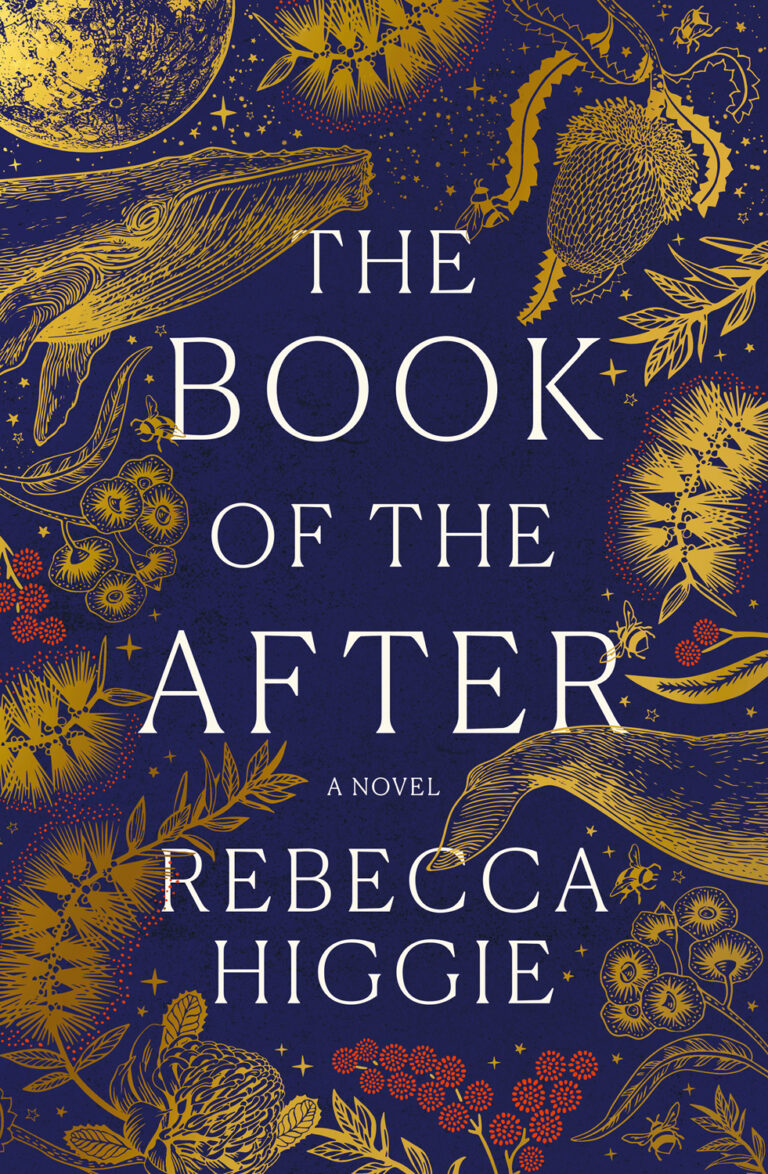
The Book of the After
by Rebecca Higgie
Fremantle Press
ISBN: 9781760996819, 560pages, October 2026, AUD$34.99
It is already ambitious to write a book that opens by introducing the reader to an afterlife existing in parallel to the living world. Bring in an historical, multi-temporal context, climate change, politics, semiotics, incorporate historical characters like Guy Fawkes and the whole gang of the 1605 Gunpowder Plot, young children dying of Cancer, space travel and a billionaire who resembles Elon Musk all while progressing an intense love story over 560 pages and ambitious seems like a major understatement. Rebecca Higgie’s new novel is indeed giant, grand, and ambitious in its scope, but it reads quickly, with a narrative that is character-driven and deeply engaging. The book opens with a ghostly Guy Fawkes, and his overall mission and how his history maps with the rest of the characters, story and timeline is one of the key drivers of the book. At times, his involvement feels a little clunky but it doesn’t matter, because the book is so expertly crafted and the other characters so interesting that Guy’s arc functions mostly as a novel contrast to the others as he wends his way through the story. To my mind the character who really drives the narrative is Eleanor Rigby, the ‘smartly dressed’ Prime Minister of Australia who is assassinated early on during a visit to the Cancer ward at a hospital. Other main characters include Negus Kebede, Eleanor’s Deputy Prime Minister, and Little Bee, another sick child, son of Queenie – a poster boy for the hospital. There is also “The Author”, a voice from the dead speaking to the living:
You will exist but you will not live.
No heaven or hell. No reincarnation or return. Not yet.
For this is not the End, dear reader.
This:
this is the After. (15)
Of course the Author is also metafictional, and as the relationships between the different characters in the Before and After shift so too does the reader and author connection. This is done without undermining the book’s underlying mysticism that pervades the book. The novel pivots around the “Book of the After”, a cult classic supposedly written by the dead and also the subject of Negus’ PhD. There is a book, and there is the After in this book. All of the characters move through different time frames, and different landscapes, the narrative woven in such a way that scenes happen and their meaning and connection are revealed later, with the book and its referent braided throughout. Making this all work in a coherent and deeply engaging way would be very difficult for most writers, but Rebecca Higgie handles it perfectly so that the revelations come more as ‘ah ha’ moments rather than clarification. Everything seems to make sense in the context and order in which it is read, building a story that is layered, complex and rich without slowing the pace in anyway.
While the time frame shifts regularly throughout the book, what we understand to be the ‘present day’ is 2049, critical of course as being right before the 2050 deadline to limit global warming to 1.5 °C, the ‘net-zero’ emissions commitment date of the Paris Agreement Goals. The climate is indeed warming and in what will be a spoiler to no one, widespread wildfires mean that the whole notion of net-zero which the government claims to have met becomes moot:
The terrifying reality was that humans had done so much damage to the environment that it, in turn, had become a force for climate change. (101)
Higgie does a terrific job of focusing in on the lives of Negas and Eleanor in particular and the ways in which the fires impact them, both in terms of their political roles, and in terms of the physical toll that the fires take on them, their lives and their relationship. Yes, it’s 2049 but it’s also today, as, even as I type, there are extensive and unprecedented wildfires in Europe, Indonesia, Canada, US, and South America with another dry and flammable summer predicted for Australia. The social fracturing of Higgie’s 2049 is very much evident in 2026, and the book raises important questions: What might be done differently in 2026? What is at stake? What is left if everything is lost? The backdrop of an all-too-real future against the past that led to it is so deftly handled in The Book of the After that what comes through most of all is a grand love story.
Love in all of its forms is the opposite of what is destroying the earth. There are many types of love evident in The Book of the After: motherly love, romantic love, friendship, love of the earth, Eleanor and Negus’ love of Perth and WA, and even Agape or selfless love, which causes certain choices to be made. I won’t give anything away here other than to say that The Book of the After is most certainly an epic, as beautiful and grand as Otto, the 24-metre blue whale skeleton from the Boola Bardip museum in Perth who features so prominently in this story:
something new in the memories of children who visited it, in generations who looked up, in those who feared it as an omen of things to come, in lovers beneath it stealing a kiss. Legacy. History. (188)
The Book of the After is a tremendous book which achieves its big vision. The book takes the reader into exciting places and new ways of thinking about the self and the world, engaging with some of the most pressing problems of our time, without ever losing its momentum or the pleasure of its story.