 Reviewed by James Mesiti
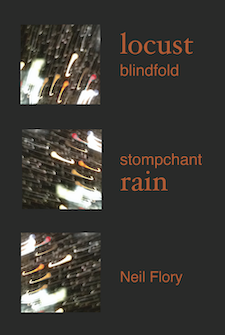
locust blindfold stompchant rain
by Neil Flory
Arteidolia Press
April 2026, ISBN: 9798988970293, 104 pages, Paperback
“Maybe sometimes things almos / t align for a / moment” wonders the opening poem of Neil Flory’s latest title locust blindfold stompchant rain. As its beginning suggests, the collection examines the idea of harmony so as to explore what can be made of the instances when the reconciliation between desire and reality is so close, but always unattainable.
In misalignment, parallel channels of expression and interpretation never synthesize and are continuously recycled. This creates a lyrical scramble where words “boil” (36) and then are forced to confront their own “weightl / essness” (63). That is, how they respond when exceeding the limits of representation and are removed from the chance to be inherently meaningful. Here, the only option that remains is to blow them up and invent new signs from what remains. This could be via the book’s enumerative form willing to juxtapose a wide range of elements, which include everything from brake fluid and pizza to bottlecaps and sudoku. Or, through novel word creation as a combative probing of the value of language and the structures that uphold it.
In both circumstances, the poems are loud as they bark, ring, and rattle at the turn of each page, creating “useless noise” (52). Musical terminology fills locust blindfold stompchant rain serving to counterweight this sensorial overload or becoming one more of its symptoms. In this context, silence emerges as the only true opportunity for respite. Even so, as the tenth poem of the book titled “chain.” indicates, it is never able to fully harmonize either. Although misalignment also never achieves resolution, it always gestures towards harmony as a goal that is never reached. Silence, sometimes “eternal” (39), sometimes “glorious” (65), falls outside of this paradigm. The poems must compete for airwaves in their flux from one heightened and “unsubstantiated / sforzando” (70) to the next.
For the author, the product is an “enchanting vomit” (49) that scaffolds while it also perforates deep into human consciousness. Within this destabilization, Flory’s speaker seeks dialogue or, at least, hopes that an interlocutor might be on the other side of their ramblings. Yet, the linguistic plasticity creates doubt over whether the poems are part of one big “parlortrick” (57) or are a final appeal to the ancients and their knowledge. The answer is twofold – they are both and they are neither. locust blindfold stompchant rain is a holy game of mirrors that does not exempt the speaker, who is equally exposed to the uncertainties of what the text can accomplish and / or signify.
Amid the shaded confessional and testimonial undertones, a doubling takes place with the characters that are stranded in misalignment’s threshold. They include: “that oldsleazyReaper” (30), “a scrubland / wanderer” (59), “the old man” that “finally decided to smash his old grandfather clock with a sledgehammer” (65), the “dumpster-eyed / professor” (68), “some sweaty / programmer in a basement” (78), and, as the last poem of the collection features, “a pack / of drunken ogres running full-tilt through the Louvre / through the Forbidden City” (96). These figures speak to the dual nature of not only the speaker but also lived experience. Precious stone can quickly become “fool’s gold” (54); an enticing sales item, a “bait&switch” (58).
So great is the risk of falling into allusions or alternate realities that even the role of the poet, often situated in the privileged position to navigate these mirages, is reconsidered. The last seven verses of “dimestore” incorporates the lyricist and their faculties explicitly:
so who says the poet’s a special giftedperception perplexing
pontificating chara cteranyway &before you finish the
question let me just sneakattack firebomb
interruption of no,
I don’t think that dimestore roadside touristtrap
thought
makes me a poet (74)
One of the great fallacies of poetry is to always directly associate the speaker with the author themselves. That said, in these lines, it is impossible not to feel Flory’s presence and a sense of admission and self-doubt. Is there no poet behind locust blindfold stompchant rain like “dimestore” leads us to believe?
Misalignment lends itself to these sorts of inquiries because of the incongruencies born between the dimensions it creates and their corresponding reflections. A few pages later in “the lens changes at surface partials.” this function is addressed more closely in the poem’s conclusion:
[…] &yes the lens changes every time at
surface partials but really not at the fundamental. &you know
there will be a last. but notyet now under broad questionmark
sky of this, regardless whatever may strike us falling from it.
&that. drink full. drink all immersing in the next immersion
image now fading, now leaping into view. (81)
Here, understanding the compositions through perception is recommended. It is nearly cinematic and tied to specific moments that are constantly unsettled and incapable of solidifying harmoniously. In one lens, the image of the metaphysical poet appears. In another, the weathered-down court jester.
In the case of the latter, the reader is moved to question themselves and whether their immersion renders them complicit in the mischief of the speaker-turned-charlatan or are they victims of the repeated (and failed?) attempts to save words from themselves. The answer is unclear. Clouded by the same ambiguities, misalignment’s perceptual freefall may not be all-encompassing. Perhaps there exists some force that can push beneath “surface partials” and instead constitute “the fundamental” (81).
This visual interplay guides the entirety of the work, making the reference to René Magritte and his iconic The Son of Man (1946) in the book’s last pages all the more notable. According to Magritte, painting allowed him to reveal poetic images as an act of oneness with the world. (“The art of painting, as I see it, makes possible the creation of visible poetic images…This meaning goes with the moral certainty that we belong to the World” (161). Magritte, René. René Magritte: Selected Writings. Edited by Kathleen Rooney and Eric Plattner, University of Minnesota P, 2016, pp. 161.) Part of his project was the distortion of laws of nature in the pursuit of new knowledge. In The Son of Man, motion and suspension, as well as ascension and descension, are at odds and the effort to discern is the central focus. (Gablik, Suzi. Magritte. Thames and Hudson, 1985, pp. 169.) It causes the speaker of locust blindfold stompchant rain to redirect the work’s enigmas towards themself in frustration, where “Magritte’s appleface” (92) is taunting.
Thus, the Surrealist materializes as a point of rupture where the disconnect separating intention, labeled a “backseat passenger” (6) early on, from realization is amplified. Images, when able to crystallize, are not poetic but untrustworthy. In contrast to the painting’s own uncanniness caused by its unnerving shuffle of authentic objects, Flory succeeds by splicing and resplicing through the sublime and opts out of pursuing the false promise it may offer.
In this way, his collection stands as the alchemist’s doctored recipe book that was sent to an old Yahoo email account and, (un)fortunately, went straight to spam. No elixir can be found amongst its siphoned-off syllables, only evidence that something, at some time was possible and perhaps able to transcend. For us, down below, we are left with a “junkedout” (14) language whose vitality remains in its formlessness and incessant, but very welcomed, reimagining. A microscopic poetic carried by acid rain, recited somberly in a gas station bathroom as our ears go blind.
About the reviewer: James Mesiti, a native of Albany, New York, is a poet and faculty member at Hamilton College, where his research focuses on transatlantic surrealism and intermedial poetics. As a writer, he has published two poetry books: one in Spanish Algo de nadie (Valparaíso Ediciones, 2021) and one in English petal / transport (Arteidolia, 2024). Most recently, he won the 2026 NeMLA prize for best unpublished fiction for his manuscript Unconsciously.