 Reviewed by Charles Rammelkamp
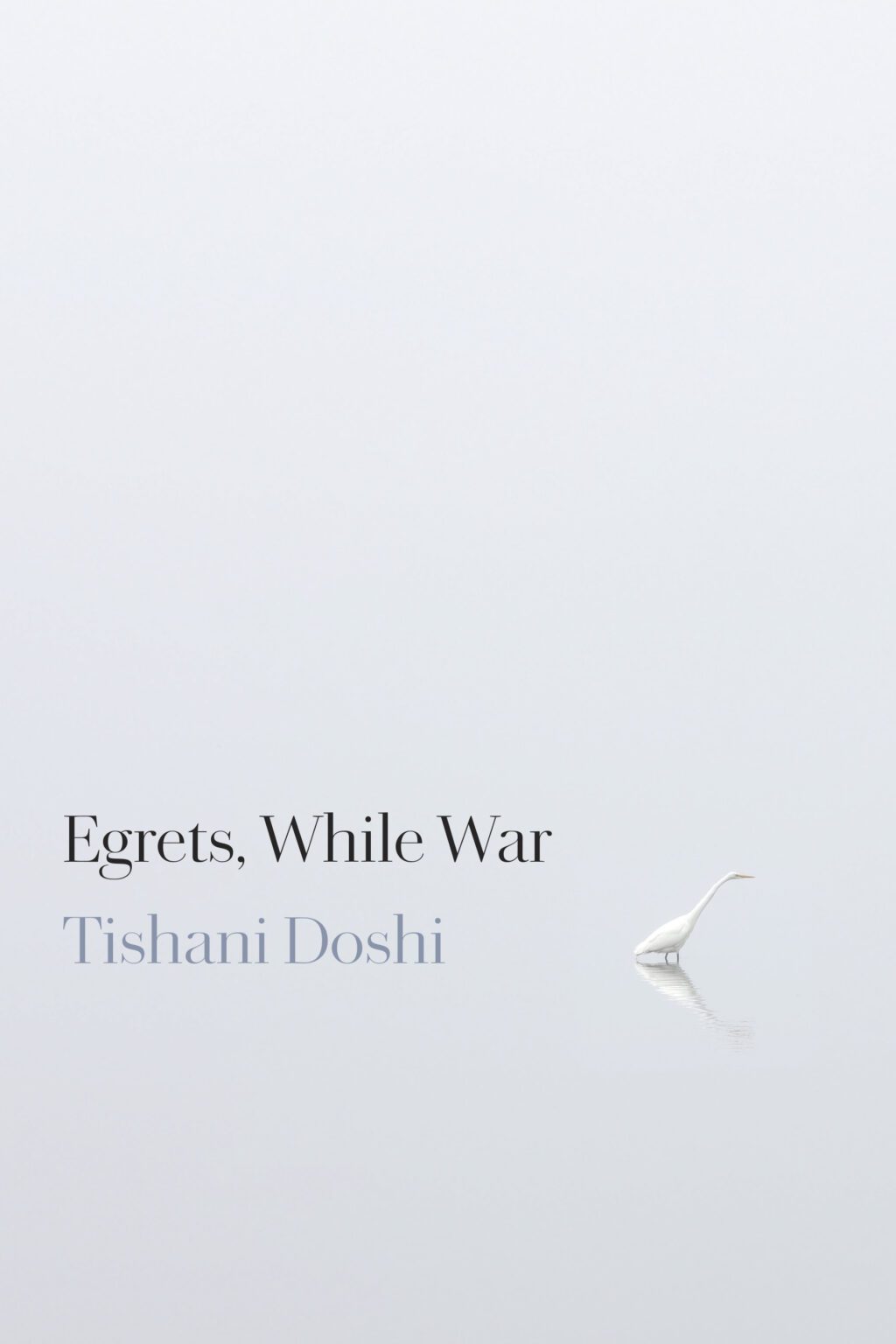
Egrets, While War
by Tishani Doshi
Copper Canyon Press
Sept 2026, $17.00, 96 pages, ISBN: 978-1-55659-735-0
In the title poem of her new collection, Tishani Doshi juxtaposes violence with timeless endurance, patient resolution with destruction, almost like a manifestation of Shiva, the creator/destroyer god of Hinduism. She writes about the ongoing “dirge of loss recovery / loss loss loss,” but assures us that “Our task is to march on.”
In “Sonnet for the Dodo, Written Jet-Lagged in Manchester as India and Pakistan Threaten War” (the very title tells you all you need to know about Doshi’s angst), she asks, plaintively, “What is this failure to endure?” Speaking to the Dodo, she asks, “how could you know you were the last you on Earth?”
Doshi’s love of life, her reverence for existence, is apparent throughout. The very first poem in the collection, indeed, is titled, “Amor Mundi,” in which she writes, “Darling,
I do not know how it happened that we found
a world to name and love, how this many-
drawered cocoon of longing grew,
but I want to tell you, the tree outside
our window has erupted with bright orange
goblets from which a pair of parakeets—
emerald-bodied luminaries—feed and feed.
There’s no mistaking her affirmation. Yet she mourns and celebrates, celebrates and mourns. How can she not? For violence and injustice are at the core of life, as she makes plain in “A Theory of the Origin of Language,” in which she writes about “Language and violence proceeding together,” for “once the words entered, / they were unstoppable, dragging dirt into the hallways / of our brains.”
Extinction and apocalypse are themes throughout Egrets, While War. In addition to “Living through the Apocalypse” and “De-Extinction Postcard,” the poems, “Sonnet for Martha, the Last Passenger Pigeon, Who Died Age Twenty-Nine at the Cincinnati Zoo” and its companion, “Sonnet for George, Martha’s Last Surviving Cage Mate” are, like the Dodo sonnet, occasioned by species that are no longer with us. But to bring the crisis home, deepen the tragedy, Doshi concludes the first of these two:
A father in Gaza, Martha, having walked miles in search of food,
crying over his dead child, Look son, I brought you biscuits.
The genocide in Gaza is a recurring concern, as we see in “The Albatross’s Sonnet to Western Civilization as the Madleen Sets Sail for Gaza.” The albatross is a symbolic bird from as far back as Coleridge’s “The Rime of the Ancient Mariner,” signifying guilt and sin, a heavy psychological burden.
What can one bird do, except show up in a poem or two,
hang around your neck as a symbol of your tyrants
and transgressions. Remember, when all of this was going on,
there were some who were homesick for the world
and what it could have been, and others who were silent.
“Post-Atrocity Statement” is a bitterly ironic poem that condemns this very silence, its implicit association with guilt. “We deplore these but also mourn those,” she begins, “These that were killed, those that died,” channeling the inoffensive wishy-washy nothings of government responses to tragedy. The poem ends:
We uphold the sanctity of saying
nothing. As ever, yours, etc.
“War Begins Again” is a poem written in response to the United States’ attack on the Shajareh Tayvebeh girls’ school in Iran in February, 2026, at the start of Donald Trump’s war of choice, in which over a hundred schoolchildren were killed, an atrocity that Secretary of Defense Pete Hegseth later defended. The poem ends on the powerfully sad image in which “A mother
finds a footprint of her dead child in the garden
a makes a shrine over it to keep the wind
from blowing it away. Oh, beautiful, beautiful
these hands are incapable of building monuments.
One of the epigraphs to Egrets, While War comes from Ananda Coomaraswamy, the Ceylonese philosopher, to wit, “Myth is either true or worthless.” Tishani Doshi channels Hindu mythology throughout the collection to underscore her perspective. Poems like “Sonnet for Two Birds in the Mundaka Upanishad,” “Sonnet for Mattamayura, the Drunken Peacocks: A Tenth-Century Tantric School of Poets, Who Were Neither Drunkards Nor Peacocks,” “Sonnet for Two Birds That Kick Off the ‘Ramayana’,” and “Seven Poems for Kamadeva, Who Is Not the Indian Cupid” all rely on Indian mythology.
Several of these poems develop Doshi’s thinking about desire as “prime mover,” a metaphysical force at the heart of life. She begins one of the short Kamadeva poems, “Oh churner of hearts, inflamer, maker / of desire.” In another, she writes “Desire / was the first seed of the mind.” “In Want of Wanting” and “Perimenopausal Desire as Fruit-Sucking Pink Underwing Moth” are poems that further develop this idea that desire is the essential life force.
This last poem is a “shape” poem on the page, as is “A Stupa for the 49th Year of Life.” A stupa is a dome-shaped Buddhist monument used as a sacred shrine that houses holy relics and is a symbol of the Buddha’s enlightened mind and the path to liberation.
But the most charming poem, to me, in Egrets, While War, is “My Welsh Grandfather Meets My Indian Grandfather on an Unspecified Mountaintop.” It is also the longest. These two characters, of course, are the father of Doshi’s father and the father of her mother.
how soft they are, these men,
carrying the past into the future
Future and past are likewise important, signaling continuity, endurance. “The past is the only / immortality we can claim,” she writes in “The School of Drunken Peacocks,” and in “A Story Is a Stepwell Is an Underground River” she writes, “ I am standing one-legged and alone
back in the place of origins. I keep making phone calls
to the past, saying, Hello, I’m here, I’d like to meet.
But the past regrets to say it is unavailable to meet
Someone is getting married, someone is dying. Life
Proceeds.
The poem ends with Doshi’s exquisite statement of the existential predicament that we all face. Her great-grandmother visits her, brings
me over the threshold. Of course you are home,
she said, Of course you are still a stranger.
You are where you’re meant to be.
And where is that? As she writes in the amusing, “Jeff Bezos Goes to Space and Becomes a Bhakti Poet,” “bliss is always described
as a kind of burning. We begin and end
with fire, Jeff, listen, if you can.
It’s not too late. We are aglow,
and the future is coming for us.
About the reviewer: Charles Rammelkamp is Prose Editor for Brick House Books in Baltimore and Reviews Editor for The Adirondack Review. His most recent releases are Sparring Partners from Mooonstone Press, Ugler Lee from Kelsay Books, Catastroika from Apprentice House, Presto from Bamboo Dart Press, See What I Mean? from Kelsay Books, The Trapeze of Your Flesh from Blazevox Books, and most recently, The Tao According to Calvin Coolidge, published by Kelsay Books.