 Reviewed by L Lois
Mirage of Burning Things
by Ryan Di Francesco
Parlyaree Press
May 2026, ISBN: 978-1-9612026-34-2, 38 pages
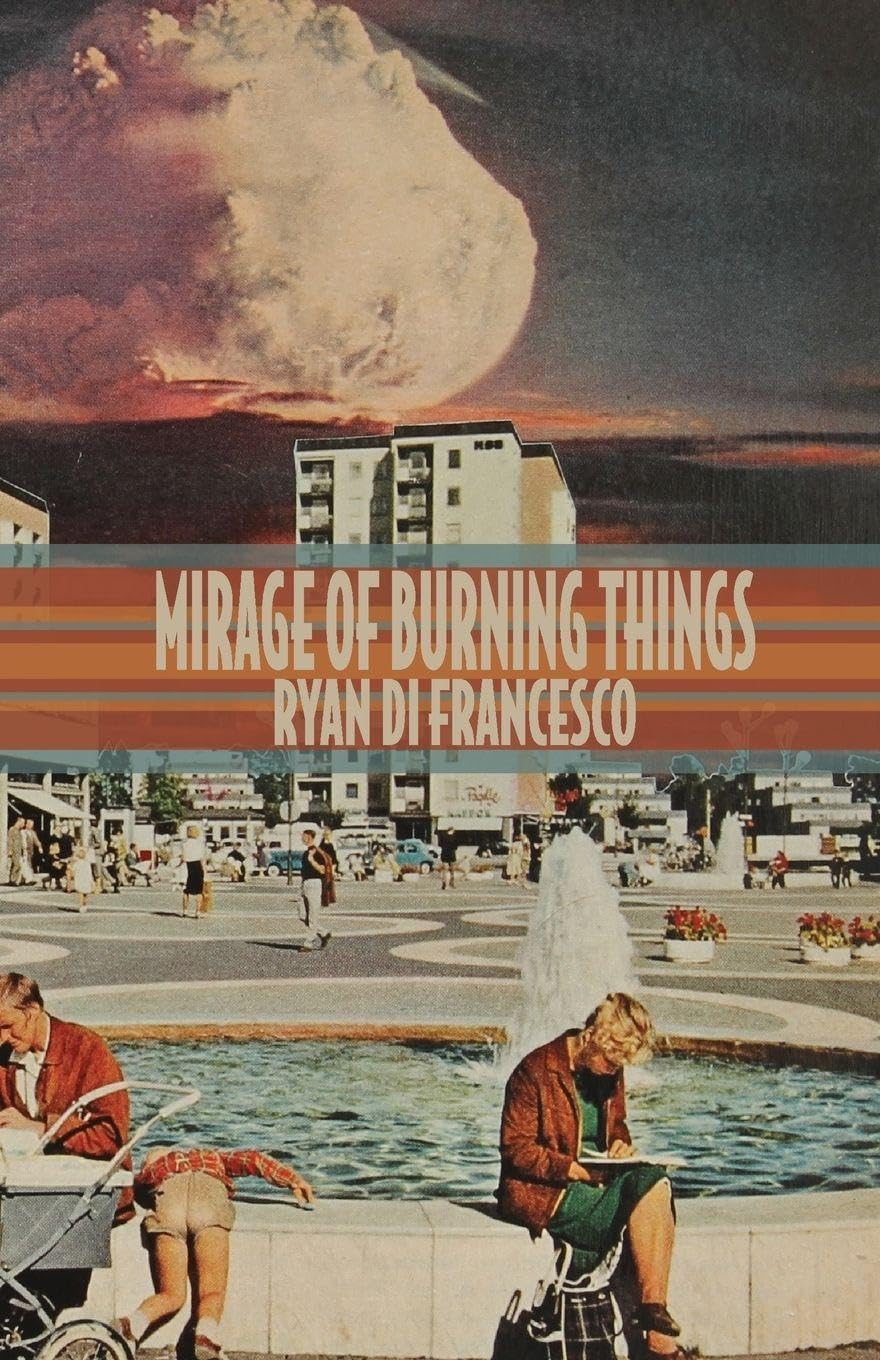
Within the exquisite cover art for Ryan Di Francesco’s Mirage of Burning Things, there’s a five-year-old boy in full glory. Picture a spouting fountain in a city plaza. Puffy white clouds form a nuclear mushroomed shape, but no one’s paying attention. A father tends to a baby, while his son dips his head into the fountain’s pool — a young woman on her lunch break reads her book while ignoring the boy’s antics. As a boy experiments with wetting his bangs, Di Francesco unpacks how we got here.
…pouring flesh / into a clatter / of morning hell…(“Sanity”, 26)
Urbanization tipped our global scales two decades ago, and Di Francesco has written a song of lament for the decline. The titular poem moves us from the violence of a city against its children to the narrator’s wistful desire for tenderness. But, therein lies the crux — the only tenderness that might penetrate will need to stab an urban dweller, an urban reader. This is a poetry collection that doesn’t tickle; it probes with a pin pricking.
THE FUTURE IS HERE / reads the sign / hanging from a dead pine tree…(“You Don’t Have to Go to the Movies to See the Horror”, 18)
Breezy two-line stanzas are filled with three-word lines. You can’t get poetry more succinct than this. No superfluous words and Di Francesco does away with needless punctuation and capitalization as well. We’re getting straight goods, from the philosopher and lover, the sociologist and archivist. It’s not pretty, but it sings. Fair, but dystopian. Brevity has its own syncopating beat. Questions and observations — poems asking the big ones. Why this city? Why this outcome? Why not love?
… / rivers / pressed / latched onto
me / them / in the open mouth of the caged / … (“Mirage of Burning Things”, 7)
Abandoned houses with abandoned people. Cold and rain. Juxtaposed children playing at recess. A solitary flower — or a stunning bunch of summer peonies. Which will we choose? Or, is the point that the flowers have already been picked, that they will die? It’s possible no one even notices.
trail of strangers // passing by / groomed / for tomorrow // wishing all / a nice day // until it’s not… (“All the Damn Way”, 14)
If the city removes itself from the tenderness of the lake and the swan, what is left? This poetry collection introduces you to the people who inhabit the city, whether they sleep inside a house or not. Some wander through a poem, some drink a pilsner, some sit before a computer screen with their anxiety, some are without a dollar. Some still have kind eyes.
Di Francesco builds a melancholy that borders on nihilism. An intentional automaton tone that reminds us it isn’t the city, but the system, that creates the suffocation. The poet’s arc sustains the tension — the city dweller can be distracted, but Groundhog Day won’t go away. In fact, it might all be meaningless.
In a two-part poem titled “Tenderness”, the poet explores how a relationship’s troubled, quiet unravelling is the same as urban decay. A slow erosion of what was once beautiful. Peonies in a vase on a summer table are something to curl up inside of — before landing in the bottom of the garbage with rotting fruit.
Di Francesco often fishes for similes, but his mastery of metaphor gives the collection its voice.
I lie awake with a mouth full of rocks. / The sky is dark. The ocean is violent. / I watch the waves crash. They make no sound. / I can’t spit the rocks from my mouth. / But I try. / I can’t choke on them either. (“3-5 AM”, 35)
If you’re looking for poetry that explores the dystopia we’ve woken up in, poems that remind us we’re all animals even when we write and dream, Mirage of Burning Things will be affirming, even as it releases you as disturbed as when you arrived. Parlyaree Press is winking, knowing we’re all on the platform, but the trains have stopped running. There’s water lapping the rails. We’re cooked — but why do we still pine for quaint ideas like home and love?
…I couldn’t care less / about shills // or efficiency // watching the swan / unfurl its wings // slowly / beating thunder …(“Efficiency”, 9)
About the reviewer: L. Lois lives in an urban hermitage where trauma-informed themes flow during walks by the ocean. She is pivoting into her grandmother-era, figuring out why her bevy of adult children don’t have babies, while prioritizing writing, publication, and arts-related volunteerism. Her poems have appeared in North Dakota Quarterly, The Brussels Review, Washington Square Review, Hanging Loose Magazine, Chiron Review, Poetry Breakfast, among other publications. L. Lois is an Associate Member of the League of Canadian Poets, is part of the editorial team at Quibble Lit, and freelances as a business feature writer and poetry workshop leader. A selection of her published work is linked at https://poeting.my.canva.site.