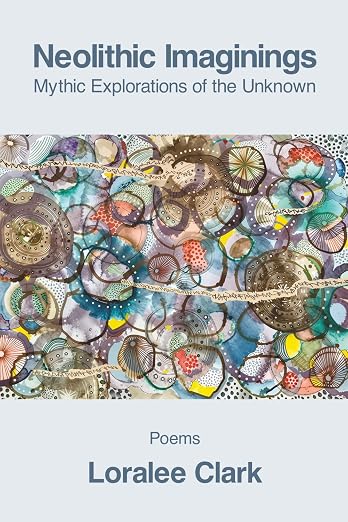
 Reviewed by Ann Chinnis
Neolithic Imaginings:
Mythic Explorations of the Unknown
by Loralee Clark
Kelsay Books
April 2026, Paperback, 50 pages, ISBN-13: 979-8901468241
I have often puzzled over how Neolithic structures were built; how humans situated the standing stones of Stonehenge weighing 25 tons each. However, I lack the imagination to contemplate how persons living in Neolithic times related to megalithic structures in specific ways: taking refuge, grieving, celebrating the arrival of spring or a baby, soothing their fear over natural phenomena beyond their control. The people of the Neolithic period in Europe, the final period of the Stone Age, were not literate and left behind no written record. All we know of them is from archaeological discoveries. In that context, Clark’s commitment in Neolithic Imaginings to journey into this landscape of stone in England, Scotland, Ireland, Wales, Turkey from 4,000 years ago to conjure their fears and longings is one of deep compassion and curiosity.
The prologue poem of the collection, “Sacred Shape”, announces the author’s commitment to explore beginnings and endings as revealed to us through the sky, the water, an ouroboro—metaphors for structures as liminal places: between life and death, hunger and satiety, sickness and health. “We read their patterns, find meaning, give directions, tell our ancestors’ stories to shape cultures” Clark’s collection places her speaker in Stonehenge, Swinside, Gobëkli Tepe among others. While strongly researched and historically accurate, her poetry never veers towards simple historical recounting, but remains vulnerable and emotionally connected. One way she achieves this remarkable emotional range is through her use of point of view. She employs an oracular third person to describe “holy geometry” when imagining how the structures speak to cycles: “This is the story of the people/who shaped their bodies as songs to be sung together, whole, as the moon grew and shrunk in rhythm,/stood in this place to converse with stars,/mapping the perpetual cycles of sky.” Elsewhere, she employs an intimate, tender first person that communicates her conviction that those who worshipped or lived within the stone structures are our emotional lineage: “..our bodies and the knowledge they contain:/a merry-go-round of generations that contain another kind of sweetness.”
Her toggling of lens from sweeping third person to first was an invitation for me to contemplate the permeability between life and death by placing me within a neolithic structure as part of a “we.” Clark’s use of chants also was an effective way to ground me in the landscape by allowing me to hear and feel the sounds of a collective in the reverberated off the stone structures: “Settle our spirts/ground us to place/hear the stars sing/through these stones.” These chants, in addition to their pleasurable musicality, were offered in a fable-like quality with short, repetitive lines, circularity and declarative language. The quality of myth married to deep specificity of detail renders the poetry accessible and immediate. “One tribe begins low, multioctave:/we mirror the stones.” Clarke also firmly grounded me in the structures by keeping her speaker embodied in the landscape. “We are a tidepool holding the tension and gradient/that comes with the inhale,/before the exhale—/..we find a tree with a wound, fingers prying its tacky blood,/ push the shards of stone into the resin and shape/small moons: waning/ waxing, full”.
Lastly, Clark probes how our budding human presence impacted the natural world and how the stone structures shaped the bodies of those that worshipped in them: “we mirror the stones/which mirror stars moving/ through our bodies,/our bodies moving through the air,/air through our mouths:/ we become the stars.” She profoundly cherishes the earth, and it is clear from her writing that she moves across it with deep reverence. Neolithic Imaginings is a call for us to do the same; to realize that we cannot survive emotionally apart from it. Clark’s gorgeous poetry is not, at its core, about stone structures. It is about trying to understand what it means to be human: how we grieve, seek comfort, look to nature for predictability. The stones seem metaphors for striving to understand things much larger than: “They practiced polishing their invisible fascia with the stars” This is a vast and ambitious collection which is totally imaginative and unlike anything I have read. After reading Neolithic Imaginings, I look at the night sky wondering about my place in that sky and my connection to those who stood full of hope among the stones, dwarfed by their immeasurable mystery and beauty.
About the reviewer: Ann Chinnis is the recipient of a Pushcart Prize, 2025 and the author of three poetry books: Poppet, My Poppet, I Can Catch Anything, and Love Song: Port & Starboard. Her work has been published in Sky Island Journal, River Heron Review, Gyroscope, Crab Creek Review, among others. She is a retired Emergency Physician and a leadership coach and lives with her wife in Virginia Beach, Virginia.