 Reviewed by Nicholas Summerfield
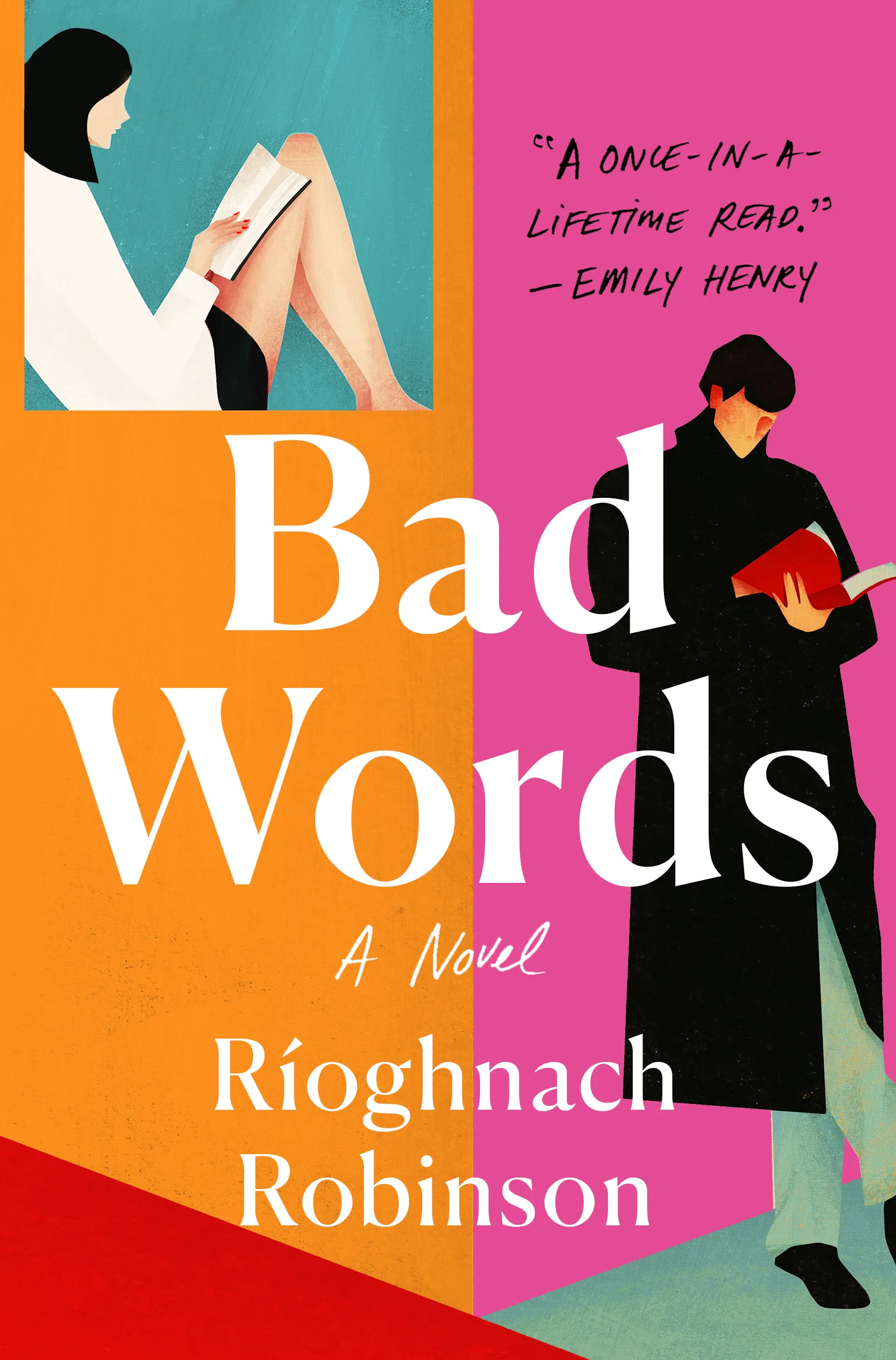
Bad Words
by Ríoghnach Robinson
St. Martin’s Press
ISBN: 9781250431295, Hardcover, Oct 2026, 400 pages
The hatred between rival novelists is as nothing compared to the hatred of novelist for critic. A novelist takes the contents of their own heart and offers them up, hoping to have them admired, understood, cherished. Yet where they wish for something like a faithful lover, the critic proves to be more of an investigative surgeon. Claiming to already know how the whole thing is thrown together, they rummage around inside and blab to an audience of allcomers whenever they find something wrong. They can mention a remedy knowing they themselves will never have to suffer putting it into practice. Or they might not prescribe anything at all. Who wouldn’t hate them?
But if a critic were to become a lover — what then? Such is the premise of Ríoghnach Robinson’s debut Bad Words, which sees easy-going, nice-guy author Parker Navarro slated by intense, introvert critic Selina Chan — twice — leading to a confrontation which is secretly filmed and then uploaded to the internet. An online feud ensues but, if you can read the signs that begin with the alluring description of Selina when Parker first sees her, knowing already that the enemies are going to fall in love will not have spoiled too much. Bad Words is a popular romance, but one set in a highbrow milieu.
And so it’s natural to anticipate how the interplay of highbrow and lowbrow might unfold. Selina’s review of Parker’s first novel relates postmodern tricks (‘six pages of footnotes! an interlude told in the form of an Excel spreadsheet!’) of a kind which are not manifest in Bad Words itself. But then when we read some of his work for ourselves — the story of a Selina-esque critic who is nasty to waiters before dying all alone years later — it is curiously flat. There is no drama or psychological insight, let alone the qualities of ‘the difficult or offbeat’ which we’re promised. The story still gets into The Paris Review. In a chapter narrated by Selina (Parker and she take turns), she concedes that he can craft fine sentences — but would an observation that he ‘makes a reader look… around them… with new eyes’ really make her, as we’re told she is, the most influential critic of her generation? Another author issues a riposte to a scornful review of hers, but it is not mordant enough to be entertaining. You start to wonder if Robinson’s novel will bring the pleasures either of literary or of popular fiction.
Yet, after the early chapters, these faults seem to trail off: not only does a zingy plot emerge, but a tension does in fact become apparent between the world of highbrow literature that the characters move in, and the work of genre fiction in which they have their being. This might be a risky game to play with Bad Words‘ potential readership, but Robinson does not shy from mocking chatty and crowd-pleasing innovations on supposedly serious websites, or from having Parker muse on the purpose of criticism. The book mentions a gamut of real-life authors: Sally Rooney and Colleen Hoover are at one end, but at the other stand the likes of Yasunari Kawabata and (in an epigraph) Dubravka Ugrešić. Perhaps this opposition is best encapsulated when Selina refers not to a novel about Millie Bloom, but a novel about ‘Millie Bloom, the daughter of the main character of Ulysses‘. Robinson knows that aiming for readers conversant with Ulysses could possibly alienate those who are not.
But Bad Words does not only have literary preoccupations and a literary setting: Parker and Selina’s relationship first thaws, then gradually hots up via the medium of literature itself. From the first, Selina propounds her view that criticism should have nothing of the critic in it, saying that she wishes to share her reviews but nothing of herself. This becomes something of a motif with her. Yet she comes to sense that, through having read them, Parker has seen what she is really like. For his part, when he seeks revenge early on it’s by penning that Paris Review story, but Selina’s self-possessed response shows him that she will give praise where it’s deserved: she is not malicious in the way he had thought, and he can begin to respect her. They are thrown together on a discussion panel, and he charitably speaks up for a novel she has panned, despite secretly agreeing with her. Later, she tells him not to apologise for his opinions, and he thrillingly realises that she wants to accept all of him as he is. The outwardly undemonstrative Selina is actually seeking openness. But then, even in the first stirrings of their feud, Parker imagined she ‘loved’ the things she read and that his work might lead her to ‘like’ him; just as easy to miss, she let slip that she saw literature as being based on ‘honesty and intimacy’. They achieve that intimacy on the page first then, finally, it makes its way into real life.
Of course, the other written medium through which things develop is the internet. As the feud begins, two factions assemble unbidden, all ready with diatribes for either Parker or Selina. Like so much actual online criticism, the mass of it is wildly ad hominem, and the remainder that is ad librum has nothing to do with whether the book is any good. (Admittedly that last sentence was typed from within something of a glass house.) But as Parker and Selina come to see the truth about each other, their partisans are still left baying. Parker’s main supporter especially is a likeable character, and you feel the quandary that he’s left in. Suffice to say that eventually there is a mass deleting of apps and, when it comes, it feels like a weight of idiocy being lifted.
Only one question is left outstanding. Who actually took the video of the argument that sparked the whole story off? But all else is resolved: the author-and-critic antagonists have been reconciled and, through literature and through literary criticism, they have been led to fall into each other’s arms. You wouldn’t get this from Barbara Cartland.
Hold on, though. I’m a critic, and I initially found fault with Robinson’s book, only to realise later that it shows fine qualities. Does that mean that I have to…?
About the reviewer: Nicholas Summerfield has written for The London Magazine as well as for Dream Catcher magazine, and was a film critic for the now-defunct Shock Horror.