 Reviewed by Magdalena Ball
Krank Fuss
By Andrew Upton
Puncher & Wattmann
ISBN: 9781923099814, Hardback, March 2026, 132pp
Krank Fuss opens with a son packing up his mother’s things. He finds a small leather suitcase “from another time” – a valise. Inside the valise are a pair of toddler’s shoes and an envelope with a German story written by his grandfather Rudi Spengler dedicated to his granddaughter Elizabeth, which the son decides to transcribe into English. The opening of the book sets up the story of a lame but philosophical chicken, the Krank Fuss of the title.
Andrew Upton is a noted playwright, actor and former artistic director of Sydney Theatre Company, and his skill with dialogue, subtext and ability to create nuanced and layered meanings is evident in Krank Fuss. Elizabeth, the mother who is lovingly addressed as an unborn child throughout the book by her father Rudi, takes on the real name of Upton’s own mother, Elizabeth, who, like his fictional character, goes by the name of Pattie. This small autobiographical inclusion not only adds verisimilitude against the fabulist quality of the story, but also reminds the reader that stories are always built upon other stories – the tale is coming through the lens of layered narrations.
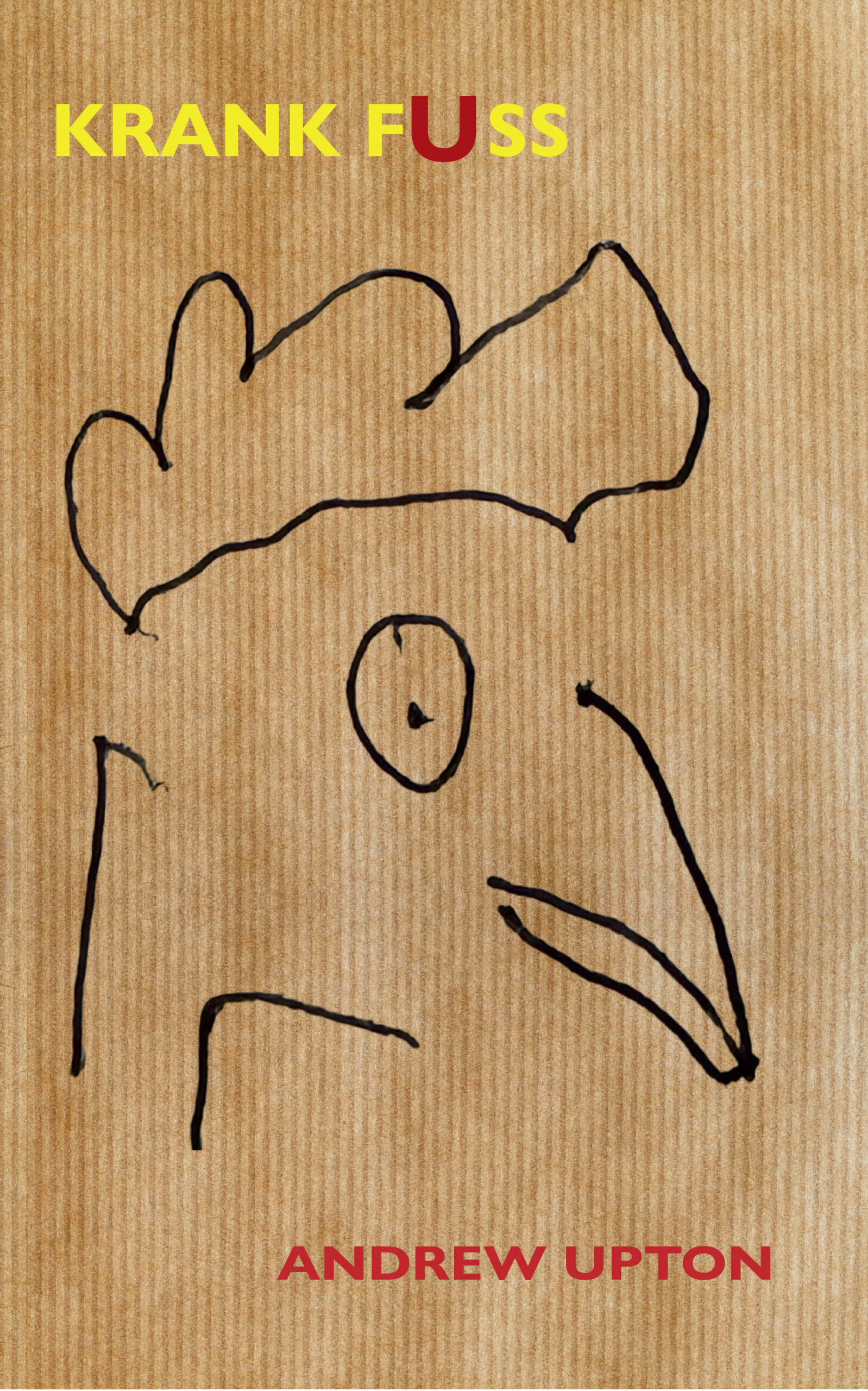
The story is set in Bavaria in 1938, and Rudi is a WWI veteran experiencing PTSD. He acquires Krank Fuss with a clutch of other hens from his nazi neighbour, Herr Schwitters, who wants to “Make Germany Great Again”. Like Rudi’s grandson, the reader understands exactly what that means in an historical context, and the parallel with modern day American won’t be lost on a modern reader. The initially charming tale of a chicken in search of meaning and her friend, the prophetic toad Gibby, has the feel of a children’s book complete with Rudi’s own naive drawings, until it becomes clear that this is not a book for children, but rather a serious story about war, peace, humanity’s stupidity, and the meaning of life.
As a character, Krank Fuss is compelling. Because of her deformity, the other chickens use her as a decoy for everything they think is dangerous, and peck her mercilessly. Herr Schwitters offers to kill her for Rudi, and offer which he declines. Krank Fuss has a particular way of looking at the world that is both deeply reflective while still being quite chicken-like. She vacillates between her desire to join in the collective life of the flock and, probably because of her leg and being ostracised, an uncanny prescience:
Forced out of joint this morning from the rest of the flock, Krank Fuss could see each bird as separate and each shift together and apart. She shivered at the remote strangeness of seeing coldly as opposed to the lovely caramel-blending of time and space in the sleeping-dream and the waking-dream of fitting in as she had on many of the previous mornings. (74)
Everything confusing or dangerous, including Rudi, is considered to be a ‘fox’ except for the tangle of wires and pipes that Krank Fuss deems to be an enormous spider. When Krank Fuss meets Gibby the wise multi-gendered frog-toad, the two bond over a juicy meal of wood-lice and philosophical talk. Gibby’s takes Krank Fuss under their metaphorical wing, and together they begin to explore the barn and the lives of other animals. After a bucolic beginning, what the two find is surprisingly dark, as animal and human brutality begins to mirror one another.
Everything was awful.
It poured. Lightning flashed and flashed, the thunder bellowed, the animals rioted and stampeded. Some calling out for purpose and clarity, most reacting in fear and terror, others tried to form small coherent bands, but they too fell in on each other as the storm bunched and heaved over and through them. (139)
Throughout the story Upton keeps the animal’s animal-like qualities while revealing the interconnectedness of their lives to those of the humans who both care for and use the animals, taking their young. In spite of a growing horror both inside and out of the farm, and Krank Fuss’ own growing understanding of the world she inhabits in and the ever-present nearness of death and destruction, the strangely humorous friendship between Gibby and Krank Fuss holds, taking on mystical qualities.
Though it has the contours of a parable, Krank Fuss provides no easy morality and the story is better for that. The way in which war looms over the characters in this story and the combination of wonder and horror of Krank Fuss’ growing knowledge of the world she lives makes for a vivid, engaging and thought-provoking read,