 Reviewed by Kathleen Bednarek
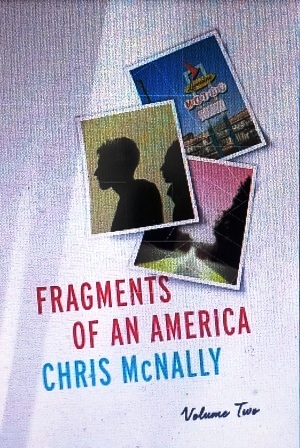
ragments of an America Volume II
by Chris McNally
Eye of the Falcon Press
July 2026, ISBN: 9798234089427, 80 pages
According to poet Chris McNally, he has aged twenty years in the past decade. That was since the first volume of Fragments of an America was released. McNally, who grew up in the America of the tumultuous 1960s, draws forth his personal biography from the very beginning with a Foreword that outlines his intent to blend close perspective with a macro-level focus. He attests to his relationship with his country: “It’s not a question of whether I love America. It gave birth to me as much as my mother and father did.”
One can immediately tell through the vulnerabilities captured in the collection that McNally is a heart-on-the-sleeve type poet. With this second volume, he chronicles the life of the worker across a landscape of American politics that lays bare personal grief alongside a public manifesto. He laments the fractured reality of the present day with deep moral seriousness. While the politics are pointed, they never come across as partisan screed. There is an observant distance and a palpable grief that does not overwhelm the collection; the poet’s angst strikes a balance and has a curious accessibility rather than a divisive nature. He turns his focus to the “unspectacular citizens”—ordinary folks, the underdog, and the prototypical everyman and woman whom he prizes as living monuments. The central part of the collection notably shifts toward the introspective and personal, embracing a romanticism that honors nature and the land with an aura of quietness, connecting with themes of ancestral belonging, tying to the larger heritage of the land itself.
Structurally, the collection is a fascinating hybrid. It shows a clear reverence for formalist traditions and rhyme schemes, whereas poems such as “Abraham” thrive in a narrative free verse regarding the tragedies of war told from both a Middle Eastern father and a western father’s perspectives.
Freedom to speak
Freedom to plow
Freedom to lay on your back
And watch the clouds meander
Past the seeded tip of grass
Bobbing in your teeth
Freedom to pray, or not pray
Freedom to reinvent
Why not, then, call it the Freedom States of America?
Why United?
Here is why:
Because if freedom is the flame
United is the torch
Bearing it aloft
Or it burns the house down (from “Reflections on Unity in 2017”)
Through distinctive character portraits I appreciated how the poems often drove me toward thought-provoking instances of commentary while addressing social justice concerns. There is a compassionate voice regarding poverty (as in “Thus Spake Sinatra”) and an insightful study of a woman down her luck (and patience) in “Hair” (She mistakes / Rage / for spine). In “The Bastards,” McNally inhabits the indignities of aging as we witness a veteran struggle in his final days before his deathbed becomes a runway from the pain of living.
McNally’s generosity of spirit leans compassionately even as a critical tone is pronounced elsewhere. In the poignant “A Reexamination of Exodus 7:3 in the Trumpist Fever,” he cleverly compares the sea of red hats at a rally with the hope that they “Will be parted for all eternity,” referring to Moses’ parting of the Red Sea.
Fragments of an America Volume II reminded me of Johnny Cash’s music—how the “Man in Black” fought for the downtrodden. McNally likewise occupies a similar space as a literary outlaw with a populist stance. His poems shine with clear portraits of those struggling physically, emotionally, and spiritually. There’s a fair bit of righteous anger for those “running the machine,” or the politics that suppress the ethics of honest living. Spoken with a voice both tough and tender, the collection has an edge to its heart.
McNally asks that we look more deeply at our fellow humans, our cultural institutions, and the land itself, while remembering the freedoms we deserve. I hope the next decade is a bit softer on the poet, and for his work, that his passion never dims.
About the reviewer: Kathleen Bednarek is a writer living in Pennsylvania. She holds an MFA from Wilkes University.