 Reviewed by Magdalena Ball
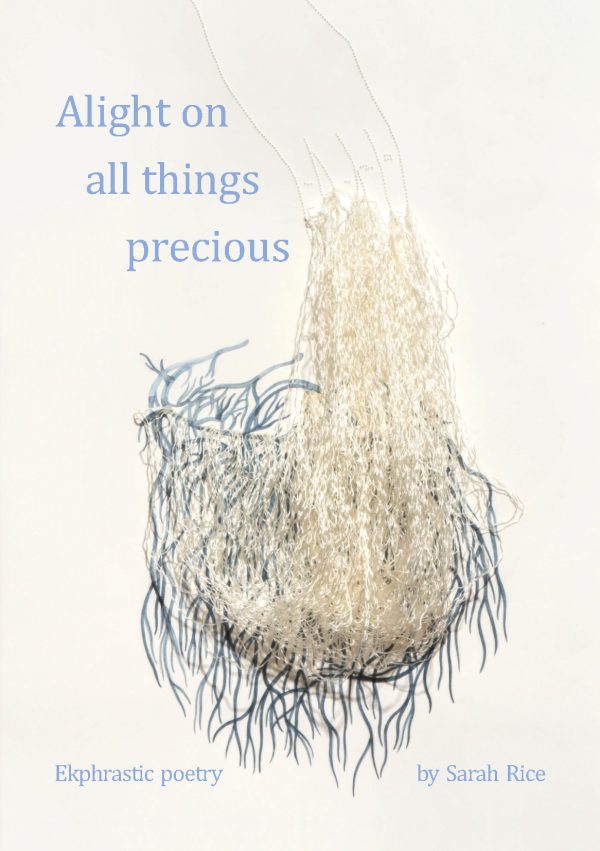
Alight on All Things Precious
By Sarah Rice
Liquid Amber Press
Feb 2026, ISBN 978-1-923657-00-7, softcover, 132 pages with 81 colour images
Lately I’ve been very taken with creative work that crosses disciplinary boundaries: art and poetry, philosophical inquiry and memoir, academic research and performance. Sarah Rice is someone whose work crosses all of those boundaries. Alight on all things precious is Sarah’s newest work, an collection of art and ekphrastic poetry written in response to a range of works including her own in a variety of mediums from painting to sculpture, ceramics, and photography. It’s a visceral and powerful engagement that goes beyond writing about art into an ongoing collaboration that co-creates different forms of meaning.
The work opens with an extensive preface that explores the subjective experience of art and poetry, especially when they are in conversation as they are here. This essay provides the perfect context for the work that follows, taking a visceral and synesthetic approach to the words and the images: “of the touching-touched – the way I am touched by what I touch, moved by what I move – matters of materiality, the matter of embodiment.”
Rice blurs the distinction between art forms and instead encourages the reader to engage across the mediums and think about the ways these forms speak to one another through structure, sound, colour, line break, light and shadow. The images themselves are varied, from the muted and softly lit interiors of Vilhelm Hammershøi at the very beginning of the twentieth century to Rice’s own photographs of trees or vibrant and layered multi-texture modern artworks, portraits from executed Bali 9 member Myuran Sukumaran, ceramic mugs and letterpresses, found objects, Lucy Quinn’s striking crystal glass images, and even jewellery. The way Rice combines the images with the poetry creates a two-way ekphrastic, where language not only takes its cue from the images but also creates resonances that change the way the image is viewed, adding in sonic elements, breath, and exploring light in different ways:
What
is that light-tipped tap
on the shoulder – light as hair?
Who’s there?
(The very outline of no-one) (“A touch of light (after Hammershøi)”)
I often found myself toggling back and forth between words and image, re-perceiving each through conjunction and the open-ended way in which the two mediums interact. This is how all ekphrasis should work, however, Rice’s knowledge of both art and language and the deliberateness of this collaboration makes this conjunction particularly powerful, as in “Dust Motes Dancing in the Sunbeams (after Hammershøi)”. The painting depicts slanted light coming through the door and the poem visually mirrors the slanting, while exploring linguistic notions of light in conjunction with sonics like assonance, alliteration and carefully placed rhymes to mirror the way the image hints at something beyond the frame – a ghostly presence – something that recurs throughout the book:
The thing about light
– Slanting light
Coming in askance
Is not so much what is revealed
In its narrow sight
But how it illuminates
Beyond its borders
How it raises the question
Rice’s artworks that follow are very different: abstract, vibrantly coloured, with layered textures and evocative landscapes that are enhanced and challenged by the words that follow. Many of these works incorporate music both through the use of sound elements in the poetry, through the readers’s own breath by deliberate line break and pause, and semantically by echoing the notations of music, with note-like circles and musical references that equate sound to sight:
The note I’d give would have the silver
gleam of space blanket come to the rescue
reflecting you back to you
on the cold side of the mountain
with its dark edge (“If I could have given you a note”)
Other poems in this section incorporate images of typographic elements and pottery in ways that encourage abstraction of the familiar through the blurring of vision or close engagement in the thing as object rather than use-case:
You are my eye floater fading
not fast enough for my liking
green still around the edges (“Vitreous syneresis”)
The poems in the “Appeal” section are somewhat different. Like the other poems in the collection they explore the connection between the visual and the verbal, however they also incorporate the grief associated with an impending death. Myuran Sukumaran’s exhibition “Another Day in Paradise”, created in the lead-up to his execution in Indonesia, bends time through the anticipation for an event that has already occurred. Exhibition and execution form an inevitable conjunction, with death and its converse, a longing for life, inherent in the art and words: “Drying is a lengthy business/dying far too quick” (“The Appeal of Paint: A Man Waits for his Execution”). Rice provides a complete visual of the Sukuaran’s exhibition and then follows that up with her own paintings of everyday objects – shirts with folding instructions, spoons, and coffee cups.
No one will know if the spoon was licked before it re-
entered the jam jar. And no one will call you to bed
and to the relief of sleep. The midnight hour must be
crossed alone. (“Routine rituals”)
These pieces are partly about entropy, but because they follow the Sukumaran pieces, there is also a tenderness in the depicted routines, all the mundane but lovely activities of life that will not happen again for Sukumaran, who crossed the midnight hour alone as we all must.
There is so much more in this rich and delicate book. There are filaments of grass being woven by hands, bits of crystal, and an iridescent shell necklace. The visuals and the poetry work in sync, a continual loop of re-creation. My favourite part of the book is “My father’s portrait” which uses Lucy Quinn’s kiln-formed sculpture of the same title to explore love, loss and death. At first glance, Quinn’s sculpture is cold and obscure. It’s a thick black frame, with black glass dripping out of the side, melting into a blob, but under the gaze of the poem that follows, the piece becomes a deep meditation on what changes under pressure, an exploration of a relationship that continues long after death, the way the mind perceives and explores:
Sometimes you arrive like a sudden storm
or stay like a stubborn thought
Have you outgrown this frame
Are you climbing out
There’s a pivot in the book here that charges the rest of the book with notions of loss and grief but also transformation. The work is intellectual and earthy at the same time, with Rice’s philosophy doctorate well utilised here, hinting at epistemology, existentialism, metaphysics, ethics and aesthetics, often metapoetically exploring how meaning is made and what it means for us to be making it, but there is also a visceral exploration of what means to come from the earth and to return to it. There is a clear progression from Sidney Nolan’s Holocaust paintings (“There are ghost in the ground again/As there always are”) to Hannah Bertram’s work with dust (“A slow sedimentary sinking”). These poems continue to return to the father’s death, his illness and burial as it moves from the vials of dust to opaque panes of decorated glass:
I look for you in the pots and pans, in your silver-
strapped watch. I don’t find you in the glass-
y-eyed photographs, or in the jar of dust.
I find you now in the Garden. (“A.E.R. (after Hannah Bertram)”)
We come back to Lucy Quinn’s art – a circling back to the absent father under a shroud – but also to breath, and to what it means to be alive, carrying ghosts:
Don’t die
Don’t die
Don’t ever die (“Shroud (after Patsy Payne)”)
Alight on all things precious is a broad compendium of Sarah Rice’s exceptional work. It’s both visually beautiful and emotionally arresting. Taken collectively, the work has an inherent life of its own in the internal conversations that continues to transform, leaving the reader with a thread that charges the many absences we carry with presence:
the art of holding tight
the unpicking of a seam
here
and here
I’ve left
a thread on your shoulder (“Interwoven (after Patsy Payne)”)