 Reviewed by Matt Usher
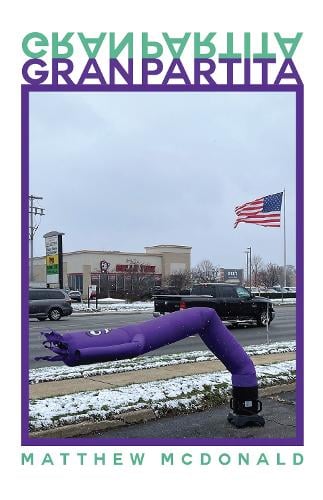
Gran Partita
by Matthew McDonald
Moist Books
Feb 2026, Format: Paperback, ISBN: 978-1-913430-21-4
To labor in classical music in the modern world is to struggle against the currents of modernity. Many are the symphonic ensemble or philharmonic that have ceased due to a lack of funding and interest. Moreso for the volunteer groups that rely on Renaissance-style patronage.
Gran Partita is a postcard from a rare place, a musician cum poet’s work, or rather a series of them. It ranges around the world as well as within the mind of a creative.It is an eclectic collection that bucks strict theming, opting instead to name its sections after classical movement forms that have a rough correlation, but allow for expressive musicality.
Accordingly, we begin with the prelude. It touches on prose and originality, as well as the difficulty of living up to what was. In As Sad as If You’d Lost Your Favorite Rolex: Some Thoughts on the Use of Metaphor in Musical Interpretation (you can see what I mean about eclectic) we go into the cliche accoutrements of writing about music: “horizons, sunsets, sunrises. The night, the sun, the moon. Dusk, dawn, mountains. All forms of water, all kinds of weather”. We also have a nod to Edward Said, apropos as a writer and concert-trained pianist. From him we get the term orientalism, a term evocative of place and feeling. Prelude is rife with uncertainty and doubt, the attendant clouds on any serious creative.
Next comes scherzo, meaning joke, roughly. They’re short pieces (though Chopin’s scherzos could range around ten minutes performed through). News From Worryland is a scattered collation of thoughts and the shallow roots of the traveler. These thoughts later become fragmented: “His botany friends didn’t say goodbye. French exit. Passive egression. Expecting gratitude is not the same as wanting it.” Scherzo is appropriately filled with shorter pieces, but the prior is a Chopinesque longer one. We see here one of the poet’s favorites, wordplay.
Elegy I follows. The book’s eponymous poem has its own movements, meditating on financial struggles through the travails of the inventor of the Mason jar and the penniless death of Mozart. In this movement we also have the first instance of a novel flair of the collection, an inserted postcard of a place evocative of the poems. This one is from The High Line and The Whitney in New York. The accompanying poem is about envy, and one wonders what the meaning of the postcard to the poet is. The first Elegy is an interplay of performance and life, undercut by a tight jar breached by death.
After that we have Elegy II. The standout of this movement is Ghost Variations: Short Notes on Memory in Music. It’s named after a piece by Schumann just before he was sent to an asylum. McDonald is strong when he flexes his broad knowledge, working it cleverly into more general reflections on life. “We sometimes need music to tell our bodies how to break down.” Coming through prevalently here are the hard-won lessons of prolonged engagement with music. The second Elegy digs into grief and impermanence of place, feeling, and life.
Capriccio comes next. In Notes on the Ageing Process there’s : “Music is what numbers sound like when they take on physical form. I read that in China the word for four sounds like the word for death. In many elevators on Earth, especially in China, there’s no thirteenth floor.” To my knowledge this is a bit of a misstep, as it is the fourth floor that is elided, as you might think. The same goes for Japan, inheriting as it did the Sino-alphabet. Otherwise the poem shines, McDonald drawing upon raw experience and deep reflection. Capriccio has some comedy to bring levity to heavy material: thoughts of growing older and the condensing of something of greater scope into a single event or idea.
Rondo in seriatim. McDonald touches on translation here through the prism of Basho and haiku. “Translators are generally in agreement on the first and third lines but it’s in the second line where they really let their synonomic hair down.” Music itself is a form of translation, or maybe transliteration, of ink spots on a page into transcendent human expression. It’s something this poet would know well, and one sees the metaphor being implemented. Rondo is about the vagaries of art and the imperfection of life, the uncertainty from before shining through in the sense of always just missing the mark.
We close, appropriately, with coda, the escape rope from the final repeated musical sequence. Playlist explores inversions: “I was just trying to unwind. I did more winding, got more wound up.” Here we have more musical notes, the variations in BPM for Fast Car. BPM is beats per minute, the tempo of a piece of music. McDonald frequently changes up tempos, using spaces and prose-poems to vary the contents of the collection. Coda calls back, as it should, both to the earlier poems but also to the poet’s life.
Gran Partita is hard to summarize. It should rather be approached as a comprehensive log of experience with all of the scattered ideas of a life looked back upon. Pick this up if you like offbeat poems, eschewing form and meter (a bit odd for a classical musician, but maybe it’s a relief from that strictness) for a flow of consciousness thoughts-as-they-come. It is strongest when it echoes the author’s life, weakest when it reaches outside of that to occasionally light learning. Gran Partita is worth your time if these ideas and themes harmonize with you, or if you like biography in your poetry.
About the reviewer: Matt Usher is an agender, highly neurodivergent writer and musician who likes poetry, tabletop roleplaying, trading card games (mtg and ygo), and professional wrestling. They are based out of Brooklyn with their two partners in a happy polecule. Most of their works are short stories but it happened that their first credit was in literary criticism. If you want to reach out and/or contact them regarding their reviews or stories (please do), you can find them at https://bsky.app/profile/mattusher.bsky.social