 Reviewed by Maya Cheav
Identifying the Pathogen
by Jennifer Militello
Tupelo Press
February 2026, 132 pages, ISBN-13: 978-1961209442
Jennifer Militello opens her hybrid collection, Identifying the Pathogen, with two epigraphs on sickness and health; one from ABC News in 2020, shortly after the coronavirus disease was declared a pandemic by the World Health Organization, as well as one from Edward Bulwer Lytton, nineteenth-century politician and writer, which is written below:
Refuse to be ill.
Short and striking, the epigraph sets the tone for the book, one of persistence despite circumstance, one of pushing beyond human limits despite suffering. To some, Edward Bulwer Lytton is considered the worst writer in history due to his convoluted prose. From 1983 to 2024, there was a notable literary contest hosted in his name, in which the winner would be awarded for writing the worst opening line of a novel. Militello’s epigraph is a shortened version of Bulwer Lytton’s entire quote, which in full is, “Refuse to be ill. Never tell people you are ill; never own it to yourself. Illness is one of those things which a man should resist on principle at the onset.” It feels poignant that Militello’s version of Bulwer-Lytton’s quote is more succinct, a choice that aptly mirrors the themes of the collection.
New Hampshire Poet Laureate, Jennifer Militello, takes us under her excising knife in her latest work, Identifying the Pathogen, an exploration of illness in the body and gender inequity through the life of Anna Morandi Manzolini, an eighteenth-century anatomist and artist, as well as via Militello’s own personal accounts in essays.
Anna Morandi Manzolini and her husband, Giovanni Manzolini, were partners in art, science, and education, a pair of researchers working and teaching out of their home in Bologna, Italy. In her lifetime, Morandi Manzolini dissected over a thousand corpses, making great contributions to science and the study of the human body. Manzolini was fascinated with the male form, something not commonly studied, as many scientists focused on female anatomy. Many anatomical models created during this time period, largely by male scientists, depicted a woman’s body as inferior to that of men. Morandi Manzolini’s work was one of the few that combatted this narrative.
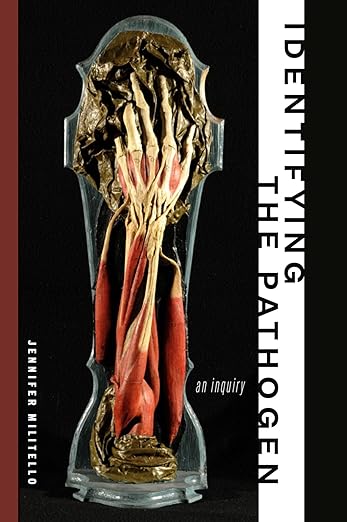
The book’s cover is a model of forearm muscles carefully crafted by Morandi Manzolini with beeswax and tallow. Dubbed the title “the lady anatomist,” Morandi Manzolini modeled a slew of poised hands, peering eyes, open mouths, peeled-back placentas, and babies after birth.
Identifying the Pathogen is vivisected into three sections, all beginning with various descriptions of Anna Morandi Manzolini’s life paired with notes from Morandi Manzolini’s anatomical notebook. The sections have multiple clusters of essays and prose, each given space to breathe with several blank pages between to allow readers more time to digest Militello’s words. Many of the works that appear in this collection are titled with parts of the body: philtrum, pericardium, blood/the heart, traits/the eye, etc.
Militello’s prose in the collection often comes in short sentences, often exact and to the point, mirroring Morandi Manzolini’s scientific approach. Each word is carefully chosen, meticulously, as there is little room for error. We see this in pieces like “the lab” and “vision.” An example of this in the latter is noted in the excerpt below:
Close your eyes. The horizon will sigh. The horizon will cease to exist.
Militello parses several autopsy reports and wax portraits throughout the collection. Each one is titled with a “/” at the end to denote a separation from Militello’s titles and Morandi Manzolini’s visual art that the pieces are based on, as remarked by Militello in an interview with WaterStone Review, published in the fall of last year. The first “Autopsy Report /” in section II of “Identifying the Pathogen” is an essay on Militello’s own experiences, remarking on when she accidentally broke her son’s cello, in which a cello is not just an instrument but an element of nostalgia and a vessel for her own pursuit of learning something new:
A cello is a pew, a cello is a crucifix, a cello is a river in which one could submerge, inside it is a place of worship where sound can resonate, a voice echo, a lament vibrate, inside it is a church.
“Wax Portrait of a Marriage /” is one of the wax portraits featured in Identifying the Pathogen. Its language is gothic and harrowing, appropriately reminiscent of a body falling apart, slowly crumbling under the pressures of time:
My marriage builds a ship into a bottle bit by bit and pinches tobacco from cigarettes and mimics a corridor foul with perfume. Its haunt like hemlock in the gut. In the night I can hear it hum as the pump turns on and the water draws up. It floats in me like a misplaced tooth, curls in my chest like a conch.
During their marriage, Anna Morandi Manzolini’s husband became deeply depressed. At one point, he was so debilitated that she became the sole provider for her family, working tirelessly to make ends meet. He died from liver corrosion and dropsy of the chest, which is now known as pulmonary edema, caused by excess fluid accumulating in the lungs.
After her husband’s death, the finances of Morandi Manzolini’s household plummeted. Despite asking for additional financial assistance from the University of Bologna and gaining support and praise from Pope Benedict XIV, Morandi Manzolini struggled to make a living wage, as it was commonplace for women to be paid less than men during this time period. She found herself deep in poverty. In order to have enough money to put food on her table for her and her eight children, Morandi Manzolini gave up her oldest son to an orphanage. Only two of her children survived long enough to become adults.
The last piece in the book, titled “the circle museum,” feels like both a prayer and a shout into the void. Morandi Manzolini’s suffering was avoidable, largely resolvable with an equitable salary, but was held firm in the hands of men in power. The injustice Morandi Manzolini faced as a woman is not singular to her, during her lifetime and beyond, and “the circle museum” does not fail to acknowledge that.
The momentum has a noose like falling far against the wire. Like a barb that keeps its terrible groove coiling with corrosion:
Let there be __ to build for us what we cannot build. A finger of bourbon and
a working-class kiss.Let sin be converted to the down with which some waterbirds line their bodies.
Let our spiritless heart sacs contract. Let the arrow take wing.Let the organs be raw, robotic. Let the random be a mercy to rabbithole down.
Let us find brothers in the heap.
Militello’s use of the “__” in this piece is purposeful, yet expansive. “__” is used sparingly throughout the collection, only appearing in one other piece titled “vivisection.” Here, it allows the reader to fill in the blank themselves, to find hope in whatever way they can.
The piece’s title is likely in reference to the Museo Palazzo Poggi in Bologna. The wax models Morandi Manzolini created also included portraits, two of which are on display in the museum: her self-portrait and one she created of her husband. Morandi Manzolini died nineteen years after her husband’s death, at the age of sixty, but in her models and portraits, Morandi Manzolini lives on, preserved in turpentine for all to see.
Inquisitive and morbid, this body of work breathes new life into the corpse of Anna Morandi Manzolini, a woman largely forgotten by the march of time. Militello preserves Morandi Manzolini’s cadaver with the utmost precision, refusing to let the world forget her and all women alike who have persisted in the face of systemic gender injustice. If you’d like to read Identifying the Pathogen yourself, you can purchase it from Tupelo Press, The University of Chicago Press, or Amazon.
About the reviewer: Maya Cheav is a Cambodian-American writer from Southern California and the author of three poetry chapbooks, LYKAIA (2023), TAN’S DONUTS (2025), and BY-THE-WIND-SAILOR (2026). Her writing has been featured in Stone of Madness, ALOCASIA, Scapegoat Review, The Weaver, Across the Margin, and elsewhere. Her work has received a Best Small Fictions Nomination. She was a top 10 finalist for the 2023 Palette Poetry Chapbook Prize, guest judged by Danez Smith, as well as a 2024 Tin House Workshop alum, under the faculty mentorship of Roy G. Guzmán.