 Reviewed by Charles Rammelkamp
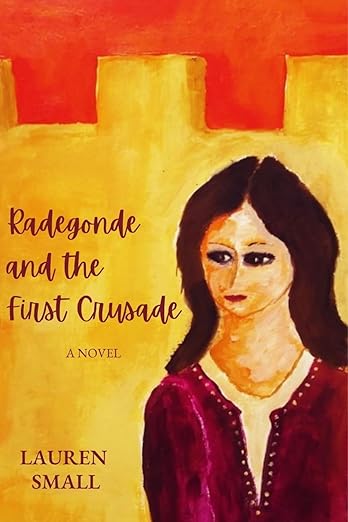
Radegonde and the First Crusade
by Lauren Small
BrickHouse Books/Stonewall
Feb 2026, $30.00, 368 pages, ISBN: 978-0-9794252-8-8
Midway through the novel, Lauren Small writes, “All that spring, in the year of their lord 1097, official Christian armies arrive in Constantinople, traveling under the command of French nobles, who seek to liberate Jerusalem from the rule of infidels and so earn for themselves eternal life.” That is the historical backdrop of this romantic tale of idealism, fanaticism, and devotion which begins in a remote French village where the protagonist, a girl named Radegonde, is doing her best to protect her younger brother Marcel in the horrible circumstances in which they find themselves – impoverished, tyrannized by a brutal drunken father in a region recently wracked by the plague. It’s February, the cruelest month. She is fifteen years old when she leaves home.
Radegonde and the First Crusade spans four years from the time Radegonde leaves home to the bloody conclusion of the novel. Lauren Small vividly brings the time to life while spinning a tale of one young woman’s struggle with faith. At the Council of Clermont at the end of 1095, Pope Urban II issued a call to arms that would result in the first crusade – the People’s Crusade – and the capture of Jerusalem, liberating the holy city from Muslim control. Related in the present tense by an omniscient third-person narrator, the story focuses on Radegonde, both her interior struggles with faith and sin, forgiveness and love, and the outward challenges she faces.
Having just rescued her younger brother from the wrath of her drunken father, for whose death, when he stumbles and falls to the hearth, crushing his head on the stone, she feels responsible, Radegonde flees to the nearby church with Marcel in tow. She encounters a group of people gathered around a fire, and there she encounters the charismatic Herault, a farmer turned preacher, who enjoins the gathering to accompany him to the Holy Land. “The end of the world is nigh,” he declares. “Join me in Jerusalem.”
With no other viable options, Radegonde, desperate, decides that she and Marcel will join them. Crucially, she also meets and is befriended by Adinah, an African woman who has escaped from slavery and is trying to get home to her native land. Adinah takes Radegonde and Marcel under her wing, protects them and teaches Radegonde how to defend herself. She calls Radegonde mon petite oiseau –her little bird. A couple of months into the journey they are joined by an idealistic monk named Thiebaud, who becomes Adinah’s lover.
Up until they reach Constantinople, the ragtag group of “crusaders” shrinks and swells, to as many as a hundred followers, as they make their way through France and Germany, generally propelled by Herault’s idealism and promises. “Inside my cloak is a letter from God,” he tells his followers. “It came to me from the heavens. He bids you come to the Holy Land, to Jerusalem, his city.” (Adinah dismisses Herault. “He is a dreamer,” she cautions Radegonde.)
It all that comes crashing down four months into their journey, when they reach Mainz, in Germany. There, they encounter the evil Peter the Hermit, a zealous anti-Semite who provokes a pogrom in which hundreds die, including Herault. And Herault’s letter? It turns out that, Wizard-of-Oz-like, it’s a blank piece of paper with which he cultivated the faith of his followers. Certainly Radegonde’s commitment has been crushed; she feels like a naive fool. Small writes: “Radegonde doesn’t speak. What is left for her in Jerusalem now? She no longer believes in Herault’s promises of love and forgiveness. The letter from God was blank.”
But she has also met Yonatan, a Jewish man whose family is wiped out in the Mainz pogrom. She falls in love. This is when Radegonde and the First Crusade really takes off. They won’t reach Constantinople for several more months, but Radegonde decides to accompany Yonatan to Jerusalem, to which he feels compelled, as a Jew, to “return”. His plan is to become a vintner, while studying Torah and obeying Jewish law. Thiebaud still maintains his Christian ideals about love, and Adinah is still determined to return to her home, and indeed, she is now pregnant with Thiebaud’s child. Radegonde’s younger brother Marcel, however, has been swept up in the violent zealotry and leaves with an army led by the savage Christian zealot Count Emich. We never see him again. But the four companions bond and, though they form their own little family, for protection they join the larger band of pilgrims headed for the Holy Land.
Lauren Small takes us on a harrowing journey that includes more pogroms at the hands of Peter the Hermit, looting and pillaging (Ratisbon, Belgrade, even Constantinople). But for several months, in the Jewish enclave at Pera, outside Constantinople, they thrive as guests of a generous benefactor named Batya. Radegonde converts to Judaism. She and Yonatan marry, and Adinah has her baby, a boy she calls Abraam.
And then, wouldn’t you know it, they follow those Christian armies as they plunder their way across the Levant, wreaking havoc in Nicaea and Antioch and Ma’arrat al-Numan, where the Christians even resort to cannibalism, cooking and eating Muslims. They endure the hardships of travel across the Anatolian plain and Taurus Mountains. After the horrific battle of the Valley of Despair, as Radegonde calls it, a bloody clash between Christian Franks and Turkish soldiers, in which people on both sides are slaughtered, Small shows us the grim reality of the pilgrims’ trek:
It is the height of the Anatolian summer. The soil is white and dry, the landscape buckled by rolling hills. Dust storms blow, coating the travelers with a fine yellow powder, filling Radegonde’s eyes with grit, drying her mouth….Her lips split and bleed, heal and split again.
It is in the aftermath of the battle of the Valley of Despair that the group of four (five, counting Abraam) meet up with Zehra, a haughty Turkish princess who, though at first hostile (indeed, Small introduces her to the reader disguised as a knight holding Thiebaud at knife point, threatening his life), joins them for the rest of the journey to Jerusalem. Zehra hopes to find her soulmate Sebastian there. Sebastian was sold into slavery by Zehra’s father, who opposed his daughter’s choice for a husband.
After the tragedy of Antioch, which involves Thiebaud’s delusional obsession with the Holy Lance, the companions join a caravan of Turks to get to Damascus and there join a caravan of Egyptians to get to Jerusalem, some three years after Radegonde’s initial departure from her French village.
But it doesn’t end there! Small has other harrowing adventures in store for the reader, including Radegonde’s pregnancies, right up to and beyond the fulfillment of Pope Urban II’s vision of “liberating” Jerusalem. Radegonde and the First Crusade is both dramatically exciting and historically informative. Moreover, it contains a potent message about religious fervor and fanaticism that feels relevant to contemporary faith allegiances and the fervor they inspire.
About the reviewer: Charles Rammelkamp is Prose Editor for Brick House Books in Baltimore and Reviews Editor for The Adirondack Review. His most recent releases are Sparring Partners from Mooonstone Press, Ugler Lee from Kelsay Books, Catastroika from Apprentice House, Presto from Bamboo Dart Press, See What I Mean? from Kelsay Books, The Trapeze of Your Flesh from Blazevox Books, and most recently, The Tao According to Calvin Coolidge, published by Kelsay Books.