 Reviewed by Magdalena Ball
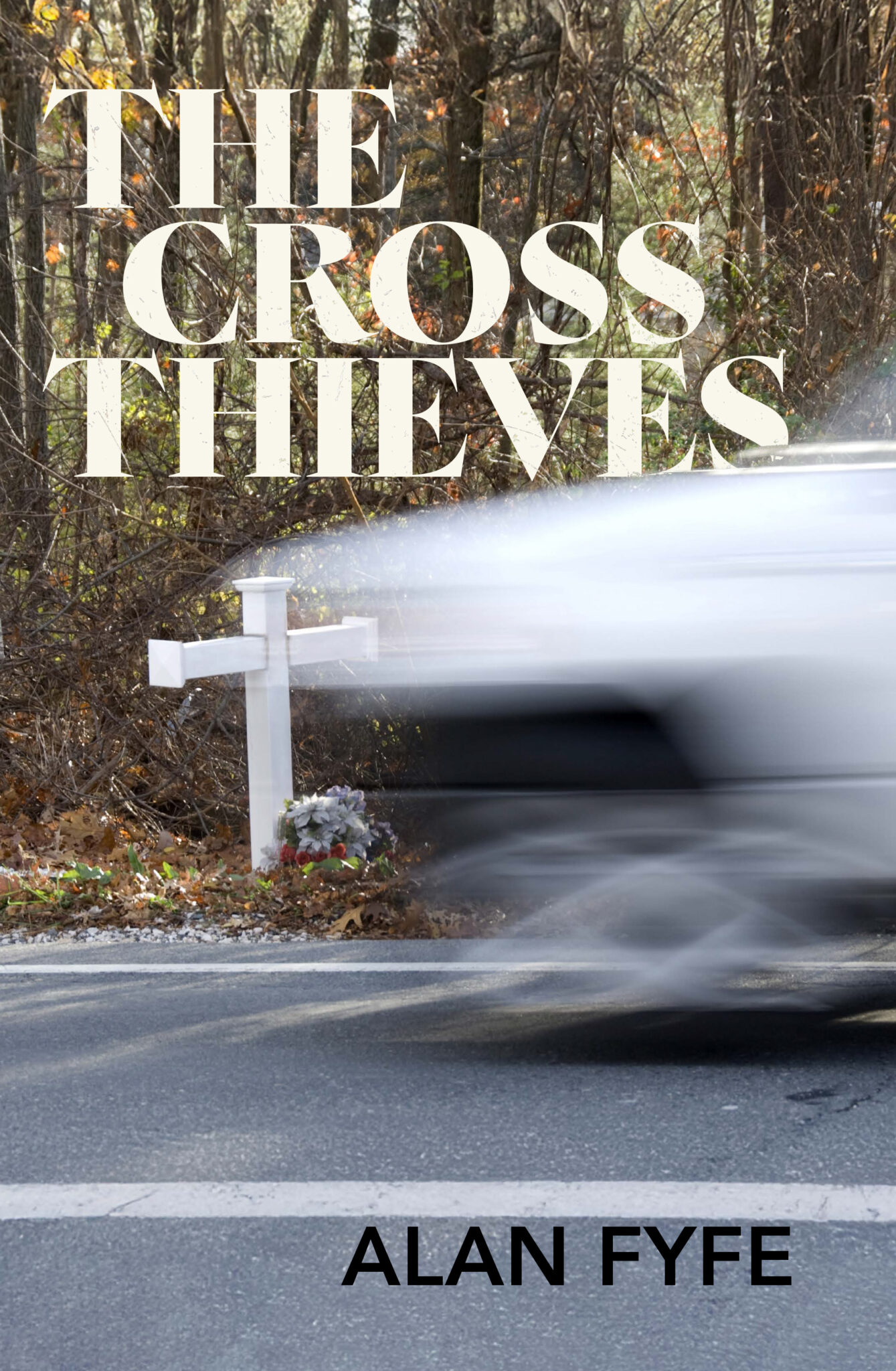
The Cross Thieves
By Alan Fyfe
Transit Lounge
ISBN: 978-1-923023-56-7, Paperback, 220pp, March 2026
The Cross Thieves is the second novel in Alan Fyfe’s Peel trilogy, following T, which shortlisted for the TAG Hungerford Manuscript Award and the International Chaffinch Press Manuscript Award. Fyfe fans will recognise the setting and some of the characters and themes, not only in T, but in Fyfe’s 2024 poetry collection G-d, Sleep, and Chaos, which won, among other things, the West Australian Premier’s Book of the Year. The Cross Thieves is self-contained and you certainly don’t need to have read T or G-d, Sleep, and Chaos to enjoy or follow the book, but if you are already familiar with the spaces and people in the book, it’s an added bonus to go deeper into some of Fyfe’s singular characters and to expand the terrain.
Garcon and Peloton Hagar aka Gark and Pell, are two “skinny, hungry” brothers living in an asbestos-laden squat in Mandurah, the major regional city of the Peel region in Western Australia. When we first encounter the brothers, they have just returned from the funeral of a friend of theirs, Lilly, who one gave them a good meal. Gark and Pell are unlikely heroes, but it’s hard not to root for them given how downtrodden they are. The Cross Thieves is their story, following their strange quest over the course of a single night as they try to get revenge, closure, and above all, find some food. It seems like a simple plot and it reads that way too – the story progressing with as much rough humour, energy and forward thrust as a Guy Ritchie film, but Fyfe is a master storyteller and there is a lot of depth deftly embedded into the book. There are two separate narratives in addition to the main story of Gark and Pell. The first is the metafictional voice of the narrator, who not only provides us with the main story but also occasionally addresses the reader, reminding us to pay close attention and read with heart:
You and I value things without needing a monetary signal to enhance the presence of those things in our lives, so we can’t be too surprised at Lilly’s enthralment in her pastime. Or maybe not everyone does, not without the price tag for witness. That might be a matter of having the right kind of heart too. (115)
It’s clear that this narrator is a soft touch, in spite of some of the harsher goings on in the book. At various points in the book the reader is reminded that they are part of the story and have an important role to play:
You and I are together inside a comfortable room the height, width, and depth of a page. I can try to manipulate you into having the heart I want you to have by telling you that kind of heart is the right kind. But you get to pick what you believe and what you value. You’re alone with that choice as much as I’m alone when I decide to tell you about these skinny boys. (100)
The second narration is a series of letters between sisters Ellie and Moll Hagar, Gark and Pell’s mother and aunt, who are navigating their relationship through multiple traumas. We know that Ellie is already dead before the story begins, though she continues to exert her influence through her epistolary voice and in the way she is talked about by the characters in the book. As with T, Mandurah is both harshly and tenderly drawn, the contours of the city forming a map. Fyfe creates a “big, folding paper sheet with everything laid out” of Mandurah and the boys move along that map trying to escape from the dangerous Stanley brothers with a metal memorial cross on their back that they’ve stolen (hence the book’s title). The relationship between the brothers is depicted in non-sentimental shorthand as they care for one another, for example Pell saving half his potato for Gark or feeling bad when he goes to food before checking on him. Fyfe writes about their struggles with unflinching empathy:
The thought of food in their turning guts was physical, mental, and spiritual. A nation made utterly material. A sensation not unlike nausea accompanied a singular focus on spending the money on sloppy, gravies meat. Jaws clenching and unclenching in unison.” (106)
A third narration is the story of Joshua and Bella Chord and their Noble Shepherd Ministry. In a book of despicable characters Joshua stands out for being particularly repulsive, though he is well intertwined with the other characters in ways I won’t divulge other than to say that it’s twisty. These multiple story threads and narratives are written in a chiastic or ring composition form which is more or less invisible aside from the letters that label the chapters, but the structure gives what could otherwise be a complex and potentially disparate book a perfect coherence as it repeats locations, themes, patterns of text and ideas.
I would be remiss if I didn’t mention my favourite character in Fyfe’s Peel universe. That is the Xavier Zwicky, aka Gulp, a Jewish poet, musician and methamphetamine dealer who takes a mild liking to the boys. Gulp is already a ghost in T but he’s alive and busking in The Cross Thieves. His frantic songs, rough sense of justice and poetry on the go are a chaotic delight to read:
Mice, mice, mice fighting through the night, and big cats stalking, padding, hissing. Two brave mice. What a fucken scene, lads. What a fucken high concept carton you’re in. Must be art. (132)
The book is full of dark humour woven through what might otherwise be some intense and gruesome scenes. Lilly is “Philately’s last champion” and even offers to buy some stamps from the boys as a charitable gesture. The wretched Joshua gets off Jefferson Starship’s worst song (the bane of my adolescence) which has a simultaneous calming and ‘energising’ effect on Joshua. Dougie the “well-known problem drinker” who keeps the bar stool warm at the The Boathouse Tavern (a real place if you Google it), is also a classical pianist who, even when too far gone to speak, is able to play complex classical music with “an animation that couldn’t be called anything but rapture”. Dougie’s music is so powerful that it actually makes Gark want to live to see his brother experience life. The book is full of beautiful, funny, often tragic contradictions that are so well woven into the fast-paced plot that at times you have to force yourself to slow down to appreciate them. The Cross Thieves is a terrific book, full of gritty violence and desperate characters, but also infused with a tenderness that borders on transformative.