 Reviewed by Matt Usher
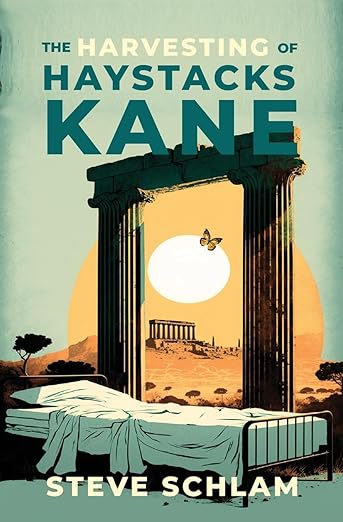
The Harvesting of Haystacks Kane
by Steve Schlam
8th House Publishing
March 2024, 348 pages, ISBN-13: 978-1926716701
Six foot eleven. Six hundred ninety nine pounds. Such was the peak physique of the Irish-British wrestler known as Giant Haystacks, ersatz Loch Ness in the states. He had a fame commensurate to his stature, alongside fellow super-heavyweight Big Daddy, with whom he both teamed and feuded. Something about giants clashing draws the attention of crowds. These titans would tour the island demonstrating their strength and surprising agility for their size. They were household names from their matches on television.
Professional wrestling is a very interior profession. It derives from carnival attractions where those in the know needed their own patois to communicate when marks, or the audience, might hear and catch wise. So it is that a work is what happens that’s planned to convince the marks, and a shoot is when something is happening as it seems. You get wisened up to knowing the difference once you’ve gone through traditionally demanding and nigh-abusive training. That makes you smart to the business. Within the context of a work, a face, short for babyface, is the good guy, whether he’s a hometown hero with an unblemished mien and flashy but fair moves, or a giant that dishes out vicarious justice to wrongdoers. The heel is the bad guy, the lowdown cheater, cruel and cunning, who will do anything and everything to win. In the old days, and more rarely now, these divisions happen around ethnic and religious lines. They represent the ethos of the crowd.
Haystacks Kane, shoot name Herschel Cain, is the subject of The Harvesting of Haystacks Kane. He is six foot even, six hundred seven pounds, the extra seven for luck. The author Steve Schlam in some ways undersells the giants that stride the squared circle (wrestling ring) in terms of height. Haystacks is wisened up by his mentor and erstwhile exploiter, Maury, and has a surprisingly gentle bout of training (Ole Anderson would never) to get him smart to the business. His career never has the trajectory his hopes traced; he never gets the highest honor of a championship title. In pro wrestling, as a shoot, these are given out to those who draw the best crowds or have earned the respect of their peers and bosses. Haystacks is a draw with his impressive size, but is most often a jobber. As in doing the job, just the job, and taking the loss to make his opponent look good.
That is to take this book in the middle, and the story long before the beginning, however. Schlam opens with Haystacks laid up in the hospital on an IV drip and totally immobile. We’re not long in learning that he’s in that condition because somebody shot on him, engaged in a shoot, started hitting him for real. This is rare in the world of works and angles. People have died over it; Korean-Japanese ex-sumo hero, Rikidozan, shot on Masahiko Kimura, of the Kimura arm-lock that beat the inventors of Brazilian Jiu-jutso, the Gracies. A bold move to say the least. It’s largely considered apocryphal, but there’s a long-standing rumor that the yakuza killed Rikidozan over this. More mildly, it’s sometimes dished out as punishment for those in disfavor or simply results in blackballing from the business. Haystacks, however, doesn’t have the clout of a top star or the deep roster of friends that might see him avenged. His is a lonely stay, only a few to visit.
This novel is billed as Joycean, and so does it begin with freeform sound associations in the same manner as the opening of A Portrait of the Artist as a Young Man. Kane is deep in his cups of pain, opposed by painkillers, and a mind that we learn later is predisposed to wander. He is out of sorts, trying to put together what brought him there; he almost learns again from the haze of amnesia what happened to him. In the twilight of thought, Schlam writes in long, run-on sentences, strung together by liberal use of punctuation. The ideas are taken as they come, immediate and aligned with Cain’s thoughts. This, too, is like A Portrait, everything in an intense first person. But moreso does it resemble Finnegans Wake, a story told entirely in the bottle of a dream.
We gradually learn, in the mists of his condition, of Herschel’s character and foibles. He’s innocent and full of a naive good intention toward the world. He hardly even reacts with anger to his aggressor. He is a lepidopterist, which put me in the mind of Vladimir Nabokov. It wouldn’t be amiss in the ambition of matching one master to invoke the spirit of another. Details show research, or perhaps a well-worn love, for wrestling. Beyond the concept of work and shoot, we hear famous names like the Memphis territory for wrestling, which produced the lengthy career of “The King” Jerry Lawler, or the famous Gorgeous George. Memphis loved Lawler, and Schlam might just love him, too.
One key to exploring this book fully is the often lapses into yiddish, apropos to the frequent setting of New York City. Some you might be able to grasp at a glance, but to fully understand Herschel’s Jewishness and that of his family, you’d need a working familiarity or a translation guide. Here, too, an allusion to Joyce – in his Ulysses he chose a Jewish man as a protagonist, a decision questioned by many narrowly-thinking readers. Among other reasons, the Jew is an outsider everywhere, suiting Leopold Bloom and Herschel Cain alike. They may be of their environment, but they will truly be seen as of it, Ireland in one case and traveling the American states in the other. Even if the yiddish washes over you, it’s important to keep in mind as you learn more about Cain and his family.
We learn much of his family over the course of the early book: an impermanent father, a strict and abusive mother, and an old before her time sister. Life is unsparing with them: father leaves, mother is hit by a car, and sister takes her own life. As well, an early crib-death that never left their mother’s mind. Just as he is ignored by his coworkers, Herschel is abandoned, too, by his community, even his Rabbi who mispronounces his mother’s name at her funeral. Complicated would understate Herschel’s family life; his father and mother are distant, mother we learn overfed him in a manic attempt to make up to her son cut short, and sister is forced by circumstances into sex work. Myrna is spared little as, even in his innocence, Herschel lusts after her. This we see in many places in the novel, a pervasive incestuous impulse.
This does lead into a blemish of the novel. Women are credited with little in the way of agency and morality. I tried to keep count, and I can’t recall a single woman whose breasts weren’t described in unnecessary detail, except maybe a sex worker in the epilogue who features for two pages or so. One might offer that this is the perspective of Herschel Cain and not of the prose; chapters alternate between his view and those others in his life. His mother happens to spend some time in apostrophe meditating upon her own. She is credited with the prevalent elevated diction of the novel, but perhaps not with self-respect. Sex work is to be ashamed of, and an unfortunate coda features a sex worker speaking in slang that is somewhat less than respectful or accurate. One mustn’t speak for women; an author must try. More respect is due.
Indeed, Herschel does display the lust of Andre the Giant, painting a lewd trail along the road as is contentiously common in his line of work. Those who observe think he treats the women tenderly, even forgoing orgasm in favor of helping them reach theirs. This is complicated, however, by his (eventual) ex-wife, who has her own chapter where she looks to Valentino, the same man who would shoot on Kane, for comfort. The betrayal is mutual, and neither quite recover from it as their paths diverge, only for a brief reunion in the hospital where he is unable to speak to her. The prose is unique here, each line led with a hyphen that serves to punctuate a nervous string of unidirectional statements, a varying number used in gaps to display her hesitance. Here her lust is engaged with in the frame of Ulysses, Shirley enflamed by what we must assume is the lengthy masturbation soliloquy of Molly.
Schlam is tastefully sparing in his use of textual tricks and uses them to good effect; it suits both the purgatorial state of Herschel as well as the state of our deuteragonists. Elsewhere we see shorter sentences with more punctuation breaks, a mind less wandering and disorderly than Cain’s. There is also a companion to the immediacy of the first chapter, a string of sense-impressions that follow a life lived externally. Toward the end are tricks of the arrangement of text on the page, of spacing and paragraph breaks.
To return to Joyce, Schlam toys also with Joyce’s oft-used, especially in the more exploratory Ulysses, of wordplay and portmanteau, bridging the traditional written word with the impressional interior life which is much less interested in external coherence. An example is the fruits of divorce, alimony, in Herschel’s thoughts allmymoney. His manager Maury already fleeces him and Shirley muses in her section on her semi-guilt for taking Herschel for all he’s worth. So this might indeed carry the meaning further than the more mundane term. It is nowhere near as frequent as Joyce at his most opaque. This isn’t a mark against the novel, however; as much as we could say that few, if any, could match Joyce, even fewer could find an audience for baroque experiments in language.
In what might be a little too manifest an allusion, Shirley tells Herschel in her desperate flood of words that she is reading Ulysses. The novel is billed as Joycean and those who will appreciate that designation fully have already reposed their minds upon it. A more subtle allusion, which may simply be a coincidence, was something that to my mind was evocative of As I Lay Dying. Herschel is given a fish in what seems consolation at the scene of his mother’s death, a natural companion of Faulkner’s famous chapter opening with a fellow departed matron, “My mother is a fish.” This may not be a reach, as no more than two pages later is a memory of his father quoting Faulkner in another venue. There is much to truly appreciate in this book, as it is in conversation with a slew of authors far beyond those immediately apparent. It is informed by a long tradition.
Much of the influence can be traced, at least past the Irishman Joyce, to authors like Faulkner who spoke to Americana, the unique nature. Herschel became a wrestler because he wants to travel, and we see vignettes of the places he visits and the character of different places in the US, particularly the south, most directly seen in the character of a disk jockey who interviews him. A tic shared by many characters is to list brand names and other impedimenta as a way to communicate meaning; all of the signifiers that are ground into Americans everywhere.
Though the year is not stated, this novel also engages with the racism of the south, particularly seen through Herschel’s seeming immunity to the phenomenon as well as a fellow wrestler, a black little person. Another historical note for wrestling: black fans weren’t allowed in all seating, relegated to the balconies, sometimes called the crow’s nest. This must have been before the time of Sputnik Monroe, who refused to perform until the venue desegregated, which has been credited with a chain of such happening through the south.
Schlam’s engagement with blackness is mixed: a black perspective is given, black stereotypes are acknowledged, but, with the single black character, he does engage in those stereotypes. Impossible to truly assess a group of one, but that in itself is notable.
The author does not miss wrestling’s long history of racism. Countless gimmicks, or wrestler’s work personas, are heels because they are othered. Foreigners were almost always heels simply because of that fact, and it was rare to see a black wrestler who wasn’t forced into many of the usual stereotypes. This is not excepting South Asians, Native Americans, and many others. Worse, in wrestling’s ugly past, many a white person would masquerade as one of the previous. Haystacks wrestles one, and it is accurately treated as something that was simply accepted at the time.
What may be a mission statement of the novel comes late: “You can see how it begins, then, the lifelong fascination with love and death, the death of love…” All of the narrators love, love to love, and many die or are not far from its embrace. Many of Herschel’s loves die, excepting his love to travel and, most of all, of butterflies. A frequent characterization is that he’ll drop everything to go after one, or to shift a conversation entirely to them and to his collection. It may even be his greatest love, one that survives all of the others.
This novel is to be approached as a challenge to the reader’s ability to juggle allusions, elevated diction, and experimental prose. Schlam’s work is approachable, but from the start it is unashamed in its tasking with the reader of reading something both technically complicated but also dense in allusion, morality, and meaning. The brave reader will be rewarded with a novel that packs an impossibly replete amount of meaning and rococo prose into its just over three hundred pages. You don’t need much knowledge of wrestling, just a willingness to engage, and perhaps a thesaurus and a translator on hand. It is a very American tale of a singular individual who was broken upon the rocks of a country whose freedom is often most liable to be the freedom to fail. Read it slowly and appreciate the Joycean double-meaning of its language. A close reading is not only recommended, but required.
About the reviewer: Matt Usher is an agender, highly neurodivergent writer and musician who likes poetry, tabletop roleplaying, trading card games (mtg and ygo), and professional wrestling. They are based out of Brooklyn with their two partners in a happy polecule. Most of their works are short stories but it happened that their first credit was in literary criticism. If you want to reach out and/or contact them regarding their reviews or stories (please do), you can find them at https://bsky.app/profile/mattusher.bsky.social