 Reviewed by Mark Massaro
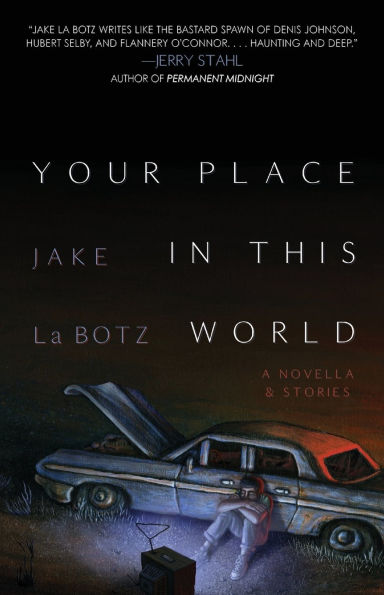
Your Place in This World:
A Novella and Stories
by Jake La Botz
Cornerstone Press
ISBN-13: 9781968148393, Paperback, April 2026, 208 pages
Your Place in This World follows lives teetering on the edge of tragedy, moving forward only by fleeting sparks of hope among people society has long abandoned. Jake La Botz writes with a bruised, musical lyricism, capturing revelations that arrive not through grand redemption but through small, fleeting graces. His stories linger in the aftermath of failure, curious about what it means to find beauty, dignity, and purpose amid addiction, poverty, and social abandonment in Chicago’s forgotten neighborhoods. La Botz does not romanticize poverty or misfortune; instead, he demands on showcasing his characters’ humanity. In his pages, addicts, thieves, and prostitutes balance between circumstance and choice, showing how an unforgiving world can consume a person entirely, leaving some unrecognizable even to themselves. Despite focusing on life’s relentlessness, La Botz’s comfortable prose hums with quiet tenderness, highlighting how his characters find resilience and dignity that persist.
The title piece follows thirteen-year-old Steve Bardo, the son of Ernie, a drug-addicted father who drags him along on petty crimes and drug deals throughout Chicago. Living with his father and his prostitute girlfriend, Steve subsists on whatever money, favors, or luck the adults can scrape together, absorbing a way of life built on survival rather than stability. When Ernie is eventually incarcerated, Steve is thrust into precarious independence, drifting between homelessness, hunger, and the same addictive patterns that shaped his childhood. La Botz captures Steve’s natural attunement to survival through subtle insights that might elude others. Steve explains: “In a cupboard, I found a hardened jar of instant coffee, an old bag of rice, a can of navy beans, some flour, and a little brown sugar in a Tupperware. I know how to cook that stuff and make it taste like something” (34). Even navigating dangerous, gang-affiliated blocks, Steve remains keenly observant: “There were two empty narc cars parked on our block when I got there. By the light dusting of snow on them, I could tell they hadn’t been there long. Probably busting that small-time dealer, Leon, I thought” (33). Forced to grow up fast, Steve embodies the resilience and cunning required to survive in a dangerous world.
Amid this endless chaos, Steve discovers a rare point of steadiness in his obsession with local bluesman Diggy Nubbit, listening to his music for free at the library when he can’t track the old musician down as he plays for change on the Chicago streets. In a life defined by instability and inherited damage, artistic expression slowly becomes Steve’s salvation, offering a glimpse of a self beyond the relentless cycle of struggle. After first hearing Diggy’s weary blues, Steve explains: “His songs were still echoing around like they did in that dirt lot off Maxwell Street, only instead of brick walls, they were bouncing around my head and chest” (24). This initial encounter leads Steve down a path where he encounters unlikely mentors that contribute to creating something hinting at stability and aiding in his coming-of-age. With playful shifts in perspective, relaxed slang, and time jumps, La Botz wields his novella like a well-tuned guitar—entertaining the reader while weaving music into a thread of universal connection. In this way, Steve’s connection to artistic creation becomes more than escapism; it is a fleeting grace that allows him to glimpse dignity and hope in a world otherwise marked by survival.
While the title story centers on survival learned too early, the collection’s next story, “March 15th,” turns to mistaken identity and the quiet terror of being reduced to accusations. Told from the perspective of a narrator repeatedly detained by Chicago police, the piece exposes how poverty, appearance, and circumstance collapse individuality into suspicion. La Botz presents how routine encounters with authority grind fear into muscle memory. He writes, “The idea of going to prison for a crime I didn’t commit had been a fear of mine as a youngster. A common fear, I had assumed, for guys like me who grew up poor in Chicago…” (106). Rather than relying on melodrama, the story builds its power through accumulation—revealing a gripping mediation on mistaken identity, unresolved trauma, and the way the past continues to echo into the present.
Elsewhere, La Botz’s collection moves from rural Idaho to the suburban mall and into the domestic sphere, exploring belief, identity, and the damage that people carry forward. In “Mashed Potato Time,” the farmer’s quiet field is upended by pop music and apocalyptic visions, a collision of desire and doctrine that leads to exile (or vindication) when rigid belief distorts genuine salvation. “Mall Doors” captures a subtler interior dislocation, as a narrator drifts through a consumer space where upbeat songs, sales pitches, and fleeting human contact only heighten his grief. “Pierce” traces generational trauma, showing how a father’s cruel punishment—stripping his son of his name—shapes identity. Across these stories, La Botz examines dislocation and longing, revealing characters struggling for connection in systems—religious, commercial, familial—that fail them.
Jake La Botz—Pushcart Prize nominee, actor, and musician—turns the reader’s attention toward those whom society so often ignores: the drunks, gamblers, thieves, and addicts whose lives unfold on the margins. In Your Place in This World, he renders their struggles with empathy and lyricism, showing their resilience, dreams, and the quiet dignity that persists despite societal condemnation. These struggling characters are us—marked not only by circumstance but by the way the world labels them. They are the flawed friends we slowly lost track of when life took over; family members who stopped coming around years back. In this collection, La Botz treats readers as equals, sharing stories with the intimacy and honesty of a friend recounting what they’ve witnessed after time away, and in doing so, he illuminates the human heart in all its flawed and luminous complexity. I always appreciate when a writer is daring enough to give voice to those living outside mainstream culture—a rare and necessary act of empathy that feels increasingly uncommon these days.
About the reviewer: Mark Massaro earned a master’s degree in English Language & Literature from Florida Gulf Coast University, and he is currently a Professor of English at a state college in Florida. His writing has been published in The Georgia Review, The Hill, Los Angeles Review of Books, The Master’s Review, Newsweek, The Colorado Review, and many others.