 Reviewed by Luis A. Estable
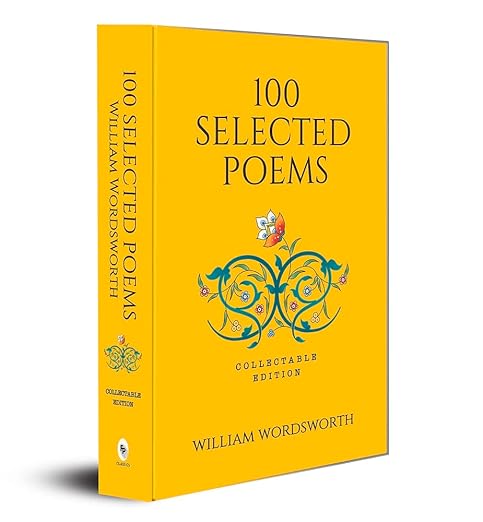
100 Selected Poems:
Collectable Edition
by William Wordsworth
Fingerprint! Publishing
Reprint 2021, 608 pages, ISBN-13: 978-9387779242
When reading Wordsworth’s 100 Selected Poems one finds that this poet truly deserves the title of “the greatest Romantic.” His poetry is an enduring testament of that great honor, and this is seen through excellent and profound poems such as “We Are Seven,” “Lines Written a Few Miles above Tintern Abbey,” My heart leaps up when I behold, “ “The Solitary Reaper.” Here in these poems from the naïve and yet wisdom reply of a little girl to poems about nature or nature poems we see what William Wordsworth does so well: Mixing passion with poetic excellence, displaying poetic mastery in simple diction to give the profound and remarkable through verses that show beauty and mean something and provoke thought and entertain at the same time.
William Wordsworth is the master of the simple. Through the medium of accessible language he shows how the sublime can be achieved using common language. His poetry surprises and delights us through the display of beautiful phrases, meaningful diction, well-rhymed lines, good organization. This is poetry that can be read repeatedly and does not fail to touch the reader.
One criticism about William Wordsworth is that he wasted some of his precious gifts writing poems about nature or nature poems that did not serve any of the big problems of humanity and his time. Another criticism is that the language of most of his poems, though simple and accessible, is not the language of country folks of his time or any time. No shepherd ever talked in that manner. Some argue that Wordsworth should have used his poetic genius to address the real problems, pains, situations of his time instead of having used much of his time writing poetry, though pleasant to read, which failed to capture the real picture of his time. With so much going on, perhaps it would have been better if Wordsworth had spent more time writing about the pangs of the time and not so much ink on poetry that wasted his genius with fun, lighthearted poetry.
But one could protest and say that that criticism about William Wordsworth is unjust or at least not completely justified. Yes, the nature poems are light, but many of them are more than just poems about nature and touch upon many of the aspect or situations that were going on during his life. A poet does not have to make so explicit for the reader or critic to see what he or she is touching on if they know how to read his or her poetry. Many of the so-called nature poems are the laments of the people and situations of his time and address the same things some critics accuse him of neglecting. A poem does not have to have the word ‘War” in the title to be about war or touching that subject. Though nature is a focus, Wordsworth’s poetry explores the troubles of humanity and the world as they were in his time and are still today. To limit his work to sites focusing solely on the countryside is a mistake.
Overall, I think it’s fair to say that William Wordsworth is one of the greatest poets of the English language and his position as a key figure in the history of English letters and world literature is secure. His poems are about many things – not just nature. 100 Selected Poems belongs in the library of anyone who loves literature, full of some of the most sublime lines ever written.
About the reviewer: Luis A. Estable has been a poet for more than twenty years. He writes sonnets, songs, haikus, children’s verses, limericks, and free style poems where he pays attention to diction, mixing wisdom and delight, the goal of poetic composition. To him, poetry represents the most beautiful and compact expression known to man, and he believes there is a clear distinction between prose and poetry, and that the aim of the poet is not to confuse or mix the two. He is also of the belief that criticism is part of the writing life and forms part of literature. His advice to young and want-to-be poets is to accept it as an essential part and learn from it. He lives in Spokane, WA, likes reading, listening to music, going for long walks, and of course writing poetry. His book Religious,Ten songs and Thirty Sonnets is available wherever good books are sold.