 Reviewed by Luis A. Estable
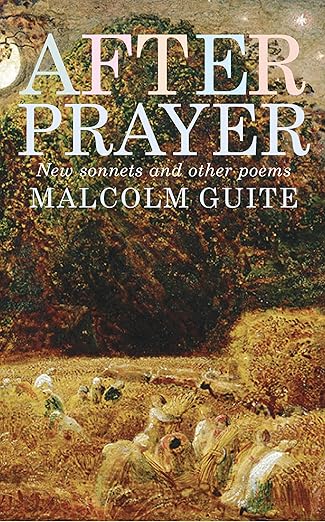
After Prayer
New sonnets and other poems
by Malcolm Guite
Canterbury
October 2019, Paperback, 128 pages, ISBN-13: 978-1786222107
After Prayer, New Sonnets and other poems by Malcom Guite is a book of poetry divided into two parts. “Part 1 After Prayer: A Response to George Herbert” starts with the writing of twenty-seven sonnets that are a response to Herbert’s famous poem “Prayer.” Here Malcom Guite shows his good understanding of this poem when it comes to display what he thinks each line of this poem means and the poetic diction of the lines. He, Malcolm Guite, writes a sonnet for each line of the poem which demonstrates how well he develops his arguments creating poetry that is excellent both in substance and structure.
“Seven Heavens, Seven Hells: A Sequence for the Spheres” is also part of the first section of the book, and it is based on the seven traditional planets from the Moon to Saturn. As the name indicates, Malcom Guite shows a heavenly and a hellish part of each sphere; thus, each sphere has a heaven and a hell part. The better and more significant poems of the first section of the book are the twenty-seven sonnets that Malcolm Guite writes based on each line of the poem “Prayer” by George Herbert. These poems show Malcom Guite poetic competence and his ability to make meaningful and poetic the lines of these poems based on George Herbert’s poem.
“Part II Lost and Found” has poems about place, ritual, writing including seven poems from ordinary saints and some sonnets. In general, this part does not show the poetic quality in terms of diction and substance, and argument that Part I clearly shows, but still the poems are good and have some merit as poetry; though, they are less impressive in poetic power.
The appeal of the book as poetic material has its good points: Good poetic diction, deep thought, formal structure, well developed themes, knowledge of the subject matter, good organization. The weaker points are these; Malcolm Guite does not seem to be a gifted rhymer or one who can rhyme without any difficulty giving perfect rhymes. There are uses of half and close rhymes, and this shows that Malcolm Guite is not a master rhymer, and one who goes away from perfection to make the lines of the poems work or to be able to make the wanted point. But in some poems, he exhibits the ability to rhyme well. One can also see that there are lines that do not flow so well, and it seems that he is working a bit hard to comply with the meter and foot. But it is to be admired that he has chosen a fixed form, and one can find places where a good flow is achieved and poetic music is heard when one the lines are spoken out loud.
In conclusion, Malcolm Guite’s poetry book gives a good reading and there is no doubt if judging only by this book that Malcolm Guite is a talented poet who has put together poems that are worthy of being read by any poetry lover and even by those who do not care much for poetry. Any reader would find some poems worthwhile in this collection. The book is religious in nature, but this should not keep anyone from reading it given its poetic quality.
About the reviewer: Luis A. Estable, poet for more than twenty years; writes poetry in several styles: sonnets, songs, haikus, children’s verses, free style poetry. Thinks that poetry is the most compact and beautiful expression known to man and that criticism is part of the writing life, and that there is a clear distinction between poetry and prose and the two should not be mixed or confused. Likes reading all kinds of books, composing his poems, listening to music, going for long walks. Lives in Spokane, WA and has a book out titled Religious, Ten Songs and Thirty Sonnets; has degrees from SFCC and EWU.