 Interview by Kristina Marie Darling
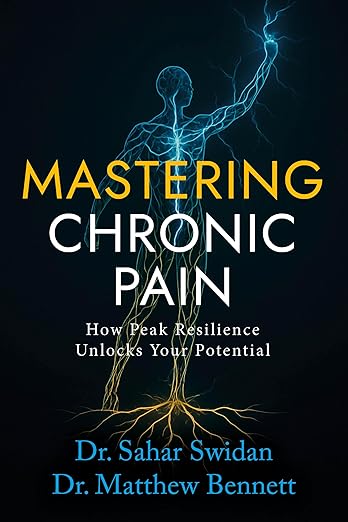
KMD: Mastering Chronic Pain does a masterful job of distilling complex medical and scientific information into eloquent, readable prose. Can you speak to the importance of empowering readers in this way?
Matthew & Sahar: We’re not interested in helping people just “deal with” their pain—we’re offering a real framework to treat it. That’s a crucial difference. This book is about tools and strategies that actually help rewire the systems driving chronic pain.
Too often, people are told their pain is something they’ll just have to manage indefinitely. But through our work, we’ve seen that with the right understanding and interventions—biological, psychological, and social—people can experience true healing. Not every case is the same, and not every path is linear, but the body is incredibly adaptable. When readers understand how their brain and body are working together—and how they can influence that process—it unlocks a path forward that’s about change, not just endurance.
 KMD: As experts in the field, what would you say is the biggest misconception about chronic pain?
Matthew & Sahar: That it’s just “pain that hasn’t gone away yet.” People often confuse chronic pain with long-lasting acute pain. But they’re fundamentally different. Acute pain is tissue-driven and protective—it’s your body’s alarm system. Chronic pain, however, is about system-level changes. It involves the rewiring of the nervous system, changes in brain function, hormonal dysregulation, and immune activation. It’s not just persistent; it’s transformative—and not in a good way unless we intervene with intention.
People assume if you’re talking about the brain, you’re dismissing the experience. But it’s the opposite. Understanding the brain’s role allows us to treat the pain more effectively, not less.
KMD: You are both accomplished physicians and highly sought-after speakers. What motivated you to add “author” to your already substantial lists of achievements?
Matthew & Sahar: Honestly, we weren’t setting out to add “author” to our bios. We were trying to extend our reach. In clinical practice, you can help one person at a time. But through a book, we can reach thousands who may never walk into our offices.
We initially wrote a book for clinicians, but the moment we realized patients needed this information more, we knew we had to shift. This book became our way of offering people a roadmap—something they could return to again and again as they navigated pain in real life.
KMD: How did you first begin collaborating?
Matthew & Sahar: We met over 15 years ago through A4M. Sahar was teaching a lot of pain-focused courses, and I (Matthew) remember sitting in the audience thinking, “This person is tracking exactly with how I think.” After her talk, I walked up to her and said, “I’m about to be your favorite orthopedic surgeon.” That was the start of what’s become a deep professional and personal partnership. Over the years, we kept finding ourselves answering the same questions, challenging the same myths, and sharing the same passion for giving people something more than just another prescription.
KMD: What advice do you have for nonfiction writers who may be interested in co-authoring a book with a friend or colleague? What makes an effective collaboration?
Matthew & Sahar: Two things: shared vision and mutual respect. A co-authorship works best when both people are committed to the same mission but open to each other’s perspectives. You have to be able to challenge each other without defensiveness and constantly return to the question: What’s going to serve the reader best?
We brought different experiences and disciplines to the table, but that made the writing stronger. Collaboration works when both people are willing to listen deeply, not just write together.
KMD: What are you currently working on? What can readers look forward to?
Matthew & Sahar: We’re developing workshops and digital resources to help people implement the Peak Resilience Method. The book offers the blueprint, but people often need help putting it into action. We’re also staying close to the chronic pain community, listening to what people still need—whether it’s deeper support, coaching, or tools that fit into daily life.
Our long-term vision is to make this updated model of chronic pain care accessible, regardless of where someone lives or whether they have access to elite care. Everyone deserves a map that actually works.
About the interviewer: Kristina Marie Darling is the author of thirty-two books, including Look to Your Left: The Poetics of Spectacle (Akron Poetry Series, forthcoming in 2020) and DARK HORSE: Poems (C&R Press, 2018). She currently serves as Editor-in-Chief of Tupelo Press and Tupelo Quarterly, an opinion columnist at The Los Angeles Review of Books, a staff blogger at The Kenyon Review, a contributing writer at Publishers Weekly, and a freelance book critic at The New York Times Book Review.