 Reviewed by Robert Rosenberger
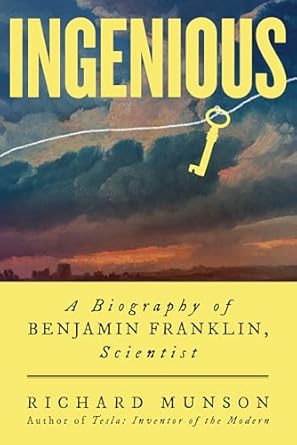
Ingenious: A Biography of Benjamin Franklin, Scientist
by Richard Munson
W. W. Norton & Company
ISBN: 978-0-88223-0, December 2024, 256 pages
It can sometimes be amusing to see the different ways that biographies of the founding fathers justify themselves. What differentiates this or that new volume from the shelves of books that we already have? When it comes to the lives of the people who started the United States of America, what hasn’t already been said?
One common strategy that I always think is kind of funny is when biographers claim their work is necessary for rescuing a founder from the fate of being forgotten by history. For example, Joseph Ellis’s excellent 1993 John Adams bio, Passionate Sage, argues that its subject “remains the most misconstrued and unappreciated ‘great man’ in American history.” Ron Chernow claims early in his celebrated biography of Alexander Hamilton that many commentators worry that justice hasn’t been done to Hamilton’s legacy, noting that, “He has tended to lack the glittering multivolumed biographies that have burnished the fame of other founders.” Even Hamilton the musical, building from the Chernow biography, purports to save its protagonist from historical neglect: “His enemies destroyed his rep. America forgot him.”
However, if you are going to do a biography of Benjamin Franklin, then you’ll need a different justificatory strategy. Your subject is simply too famous to even pretend that you’ll be saving him from obscurity. Still, you’ve got options. One move would be to cast your famous subject as someone in need of rescuing from the weight of their own reputation. For example, the Preface of Gordon Wood’s 2004 biography promises to “reveal a Benjamin Franklin who is different in important ways from the Franklin of our inherited common understanding.” Or as Walter Isaacson puts it in his biography from 2003, “the lessons from Franklin’s life are more complex than those usually drawn by either his fans or his foes. Both sides too often confuse him with the striving pilgrim he portrayed in his autobiography.” (Biographies of George Washington are faced with this same challenge, and thus often have a stated aim of releasing their subject from the stereotypes encased within marble statues. As Alexis Coe puts it in her marvelous 2020 book, You Never Forget Your First: A Biography of George Washington, “Every biographer humbly endeavors to break Washington out of his sepulcher—by proceeding in almost the exact same way as the one who came before him.”)
For the book Ingenious: A Biography of Benjamin Franklin, Scientist, Richard Munson has come up with a promising entry point. The book plays double duty. It offers a concise and approachable full Franklin biography. And it does so through an emphasis on Franklin’s accomplishments as a scientist.
If you’re new to reading about Franklin’s life, then Ingenious works as a serviceable starter bio. (The title refers to one of Franklin’s favorite words to describe those he admired.) Munson’s style is straightforward and readable, and he has a good eye for what is important and interesting. The central thesis is that Ben Franklin’s role as a scientist—that is, as a careful investigator, experimenter, and endlessly inquisitive explorer and tester—is a core part of his identity. Munson writes, “We need to recognize how experimentation and reason pervaded his entire life, as well as acknowledge that his scientific discoveries surpassed pragmatic inventions” (6). So, the book proceeds with a special emphasis on Franklin’s scientific achievements, as well as science’s constant place in his life, throughout his travels across the world, through his rise as a printer and businessman, and through his life as an inventor. This scientific mindset, Munson argues, additionally organizes Franklin’s political work through the Revolutionary War, during which Franklin skillfully used his prestige as the world’s most famous scientist to help secure aid from the French, and after which Franklin contributed to establishing the US national government. Stretching perhaps a bit, Munson writes that, “To Franklin, the United States was an experiment, and the Constitution was a set of hypotheses to be tested, and adjusted, over time” (196).
Munson insists that recent coverage of Franklin in both journalism and popular biographies has tended to downplay Franklin’s achievements in science (and he names several culprits). More than merely a tinkering inventor, Franklin’s contributions to the study of electricity were fundamental to the field, yielding essential new experimental results, and coining many new terms for theorizing these phenomena that are still basic to our understanding today. (Concepts such as “positive and negative charge” and “battery” are all Franklinisms.) Some of the best chapters of Ingenious are those which go into detail about Franklin’s scientific explorations, including a useful early chapter on his contributions to the study of electricity and heat, and an interesting one on Franklin’s late-life thoughts on hot air balloon science and his evidence-based skepticism of then-trendy Mesmerism healing techniques. Honestly, I wouldn’t have minded if the book went deeper into the details of Franklin’s scientific explorations.
Ingenious’s focus on Franklin’s lifelong work as a scientist and inventor, combined with the book’s overall concision does have one drawback: it leads to an underemphasis on Franklin’s accomplishments as a writer, activities that often showcase some of Franklin’s distinctive personality traits, such as his beguiling playfulness and irrepressibility. These intriguing and appealing (and presumably to some, exhausting) characteristics perhaps come across more clearly through Franklin’s lifetime of work writing stories, parodies, almanac aphorisms, political commentaries, bagatelles, and satires, than through his scientific work. Still, some of this incorrigibility crosses over into his science, as Franklin often translated his discoveries not only into useful inventions, but also fun demonstrations and parlor tricks. And Ingenious does of course include discussion of Franklin’s biting parody of the stuffy and affected style of science writing associated with academic societies, one in which Franklin postures as if submitting an official (and pun-filled) proposal for a study on how to stop farting so much.
Throughout this biography, Munson makes clear that Franklin’s scientific engagement with the world is a perpetual touchstone. No matter where he is on the planet—striving in his early life in the states, representing the states in England, working as a wartime ambassador in France, or traversing the ocean in between—Franklin is continuously scientifically inquisitive, continuously meeting and corresponding with other investigators, continuously inventing, and continuously devising and refining experiments. For example, while covering Franklin’s time in France, Munson writes:
Science was never far from Benjamin’s mind. He coauthored a report on lightning conductors for the Académie des sciences, prepared pamphlets on Native American language and orthography, composed a history of the compass, and described how atmospheric pressure could further cut smoke within his stove (165).
This highlights how things like his iconic work on lightning rods and the Franklin stove were not one-off inventions, but lifelong pursuits, returned to and refined over and over, both for the technical international scientific community, and for the practical benefit of the public. (By the way, this passage is also a curious one. Franklin wrote a history of the compass? If so, then I’d like to see that. Munson’s citation in this passage is to Stacy Schiff’s acclaimed 2005 study of Franklin’s time in France, A Great Improvisation. There, she writes that Franklin, “indulged in spirited discussion of Native American language and orthography, to which he added an aside on the history of the compass” (278). As far as I can tell—and I could be wrong—it appears that Schiff is referring to this 1781 exchange of letters. So, I guess Franklin’s thoughts here may have been less like pamphlets, and more like correspondence with colleagues on Native American spelling, with a short digression into compasses.)
The book concludes with a refreshing final chapter in which Munson drops the third-person posturing of a historian, and speaks in his own voice about what it has been like to write a Franklin biography. As he notes, the task is multiply tricky. You need to contend with the fact that Franklin himself was an unreliable narrator of his own life, often writing in character or with an agenda, which was even the case for his Autobiography. You also need to contend with the fact that historians themselves write with agendas, and that, as Munson nicely details, Franklin’s reputation has changed over and over through the years.
Through it all, Munson makes a compelling case for the relevance of Franklin’s life for the troubles faced by the United States today. He writes,
As a vocal set of modern-day activists reject science and dismiss facts, Benjamin’s life highlights the importance of verifiable analysis. As some jurists impose their (originalist) view of the Constitution, he—literally an originalist of the Constitution—insists that knowledge and laws evolve with changing circumstances. As zealots impose their religious beliefs, he makes the case for tolerance. As partisans increase their stridency, he shows the value of compromise and civility. As censors ban books and limit debate, he defends printers and free speech. As autocrats seek to centralize authority, he demonstrates what local associations can do by themselves (206).
It can often be hard not to be crushingly disappointed by the distance between the ideals of the United States and our contemporary reality. The history of the founding era provides a helpful perspective not because this distance was any shorter back then. But because it was one of the periods in history that there were at times explicit, iconic, and impactful debates over the country’s core ideals. Franklin’s life provides one of the best entryways into the era. Every generation needs its own Franklin biography. Ingenious is a worthy entry into this procession.
About the reviewer: Robert Rosenberger is a professor of philosophy at Georgia Tech. His books include Distracted: A Philosophy of Cars and Phones, Callous Objects: Designs Against the Homeless, and the forthcoming Against Frog Dissection: The Materiality Argument.