 Reviewed by Charles Rammelkamp
Tumbling
by Elizabeth Cook
Mariscat Press
Oct 2026, £9.00, 40 pages, ISBN: 978-1-0667096-0-1
Elizabeth Cook begins the poem, “Silly Old Moo”:
Her lonely heart’s
an unmilked udder.
It swings low, ungainly
under her, grazing the ground
as she plods.
This may be the most heartbreaking image of lonely wretchedness in a collection largely devoted to grief and the feelings of bereavement that come with losing a partner. Elsewhere, in the poem “Sheet,” it’s the bedsheet drying on the line, “billowing, the wind punching it / so it lifts and hollows,” that brings on the overwhelming “desolation” as the laundered sheet, smelling of scented detergent, has erased (“rinsed”) “our friendly fragrant fug.” In “Blizzard” it’s the intimacy of being in bed with her partner, a tenderness taken for granted after years but no less valued, that kindles her anguish, her heartbreak, as she almost palpably feels its absence:
Now you are gone, I smother
the air with incontinent love talk.
At lights out I tell you
my love and again on waking;
again and again I tell you the same
story and the words look to me
like small blue butterflies or a blizzard
of kisses. In their incessancy
they tenderize the sky…
The poem, “Sprawl,” expresses a similar sentiment:
She’s the sprawlingest bed-fellow said the maid
of the Duchess of Malfi. That am not I. I keep
on the whole to my lane. Except sometimes in sleep
I sling my right leg and arm sideways across the bed
in engulfing embrace and then, unopposed, wake
to find that you’ve gone. Not gone for a pee
or down to the village on your bike for the paper
but always, irrevocably, gone.
“Skinny Dip,” likewise addressed to her late partner, contains the memory of an intimate, carefree late-night naked swim, and you feel her sense of loss, that which can never be recovered:
Remember that night
when the bars had all shut
the promenade quiet the sea tonguing
the sand with a rocking breath
and we stepped from our clothes and swam out
with no destination in mind?
Similarly, “Smoke without…” contains the cherished memory of working their land together. “Coming back to the house from the shops / I’d look for you….” He’d be working the garden with a spade or watering the apple trees. Now that property is neglected – “the grass / is so high and the fruit cage is bursting / with nettles and thistles.”
“Next time” is another poem addressed to her late partner in which the poet proposes that they spend their next life together in Sicily, “on that eastern coast / near the beach we walked to early / each morning.” It’s another memory of happy times together, the sort of reflection that jumpstarts grief but at the same time provides some solace:
Remember when the gate
to the grove was unchained
and the farmer, who was watering,
stopped his work to invite us in and opened
orange after orange for us
with his knife, so that we left
sticky with juices, our arms full
of more fruit than we were truly able to carry?
The final lines of “Who is so safe as we…?” sums this all up:
I thought I would still be the me
that I was when you lived when
you died. I could not then see
that your death would bereave
me not only of you but of me.
There’s a wide range of emotion expressed in Tumbling, as in the title poem when the speaker recalls being with her siblings at their mother’s funeral. They play with words together, and a kind of mirth brings the survivors together –
Feu notre mère: ‘our late mother’. Despite his degree
in French, the idiom was new to my brother. We tried it out
in Mum’s car (now the orphanmobile) as I drove
us three orphans to the emptying house. Feu ma mère.
Feu Feu we repeated, stepping aside from the gulf
of its meaning as we practised the shape
and the breath of it. Feu like ‘phooey’, or ‘footling’.
‘Fie on you, death’. Let’s blow you out
with a puff like the one that disperses the fragile
globe of a dandelion clock.
Cook remembers her family again in “Oiling the Tortoise,” a memory of being a child and the discovery of a pair of tortoises that she and her siblings fed and pampered. “Ptolemy and Persephone we called them.” Every few years they would re-discover the tortoises, pamper them. Similarly, “2025-1936 Saint Mary’s Church, Eastbourne” is a fantasy “memory” of the poet’s parents on their wedding day –
Oh the adventure of it!
The courage! The huge, flying
hope of it, and everyone cheering as you exited
the church, laughing as you duck
the deluge of confetti.
“Greats” is another family lore poem about her Great Great Uncle Tom once socializing with Charlotte Brontë.
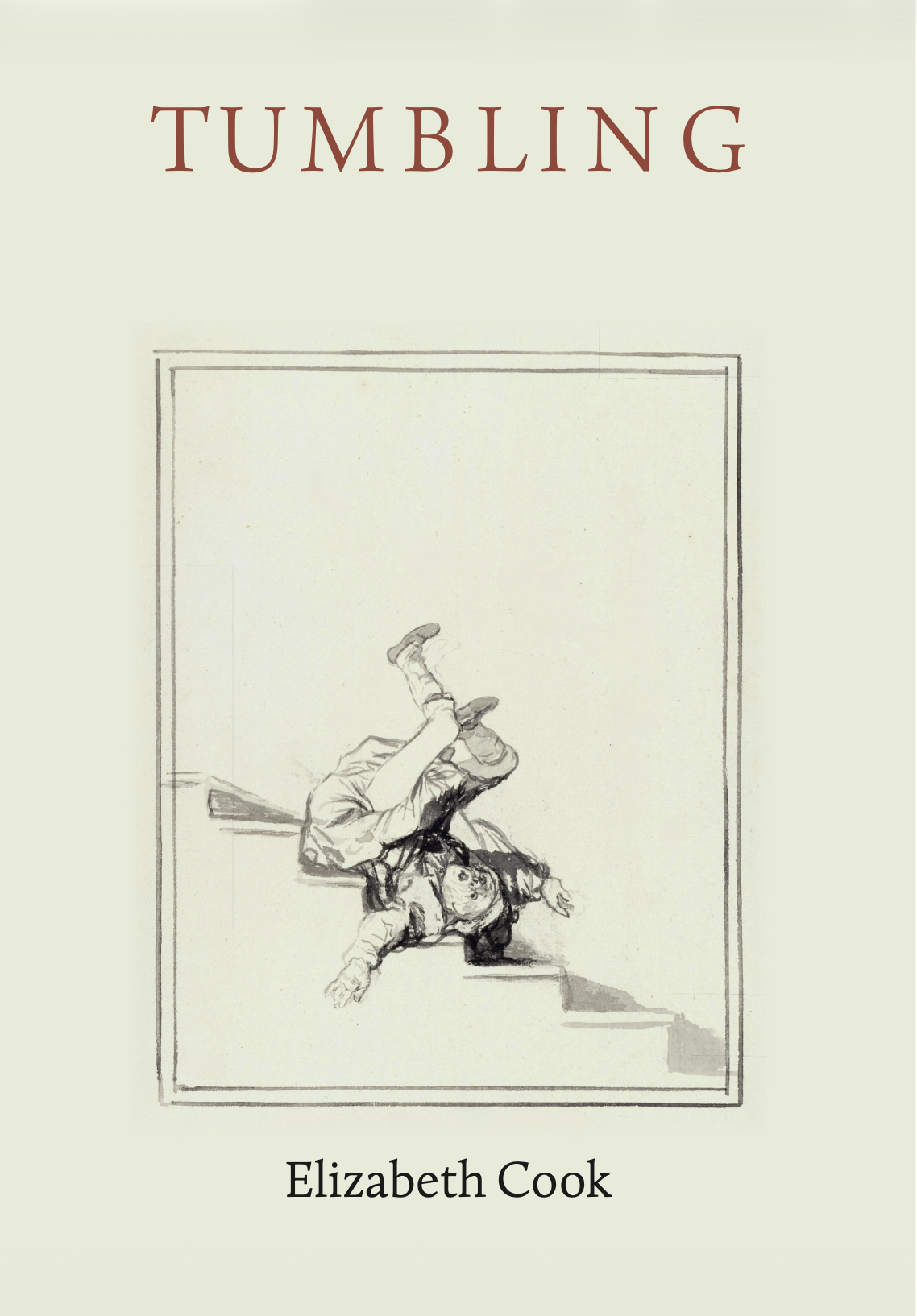
The effect of Tumbling is cathartic, a kind of healing through grief and memory at work. There’s loss, yes, but there’s also a kind of immortality and comfort in the memories. Just as the cover of the book shows what appears to be a circus acrobat tumbling down a flight of stairs, an image of fun as well as possible injury, so the collection ends on a poem called “Balloons,” about a man selling balloons in a public park. The balloons are the sort of things that appeal to children, of course, but at the same time the man “feels their tug”:
the tug of his jostling, busy, beloved dead
wanting to be more free, wanting, perhaps,
to lift him from his feet and take him.
About the reviewer: Charles Rammelkamp is Prose Editor for Brick House Books in Baltimore and Reviews Editor for The Adirondack Review. His most recent releases are Sparring Partners from Mooonstone Press, Ugler Lee from Kelsay Books, Catastroika from Apprentice House, Presto from Bamboo Dart Press, See What I Mean? from Kelsay Books, The Trapeze of Your Flesh from Blazevox Books, The Tao According to Calvin Coolidge published by Kelsay Books, and most recently Casual Mysteries and Aperçus published by Blazevox.