 Reviewed by Erica Miriam Fabri
Pirouette
Uche Nduka
Lithic Press
October 2026, ISBN 978-1946-583-505, 204pp, Paperback
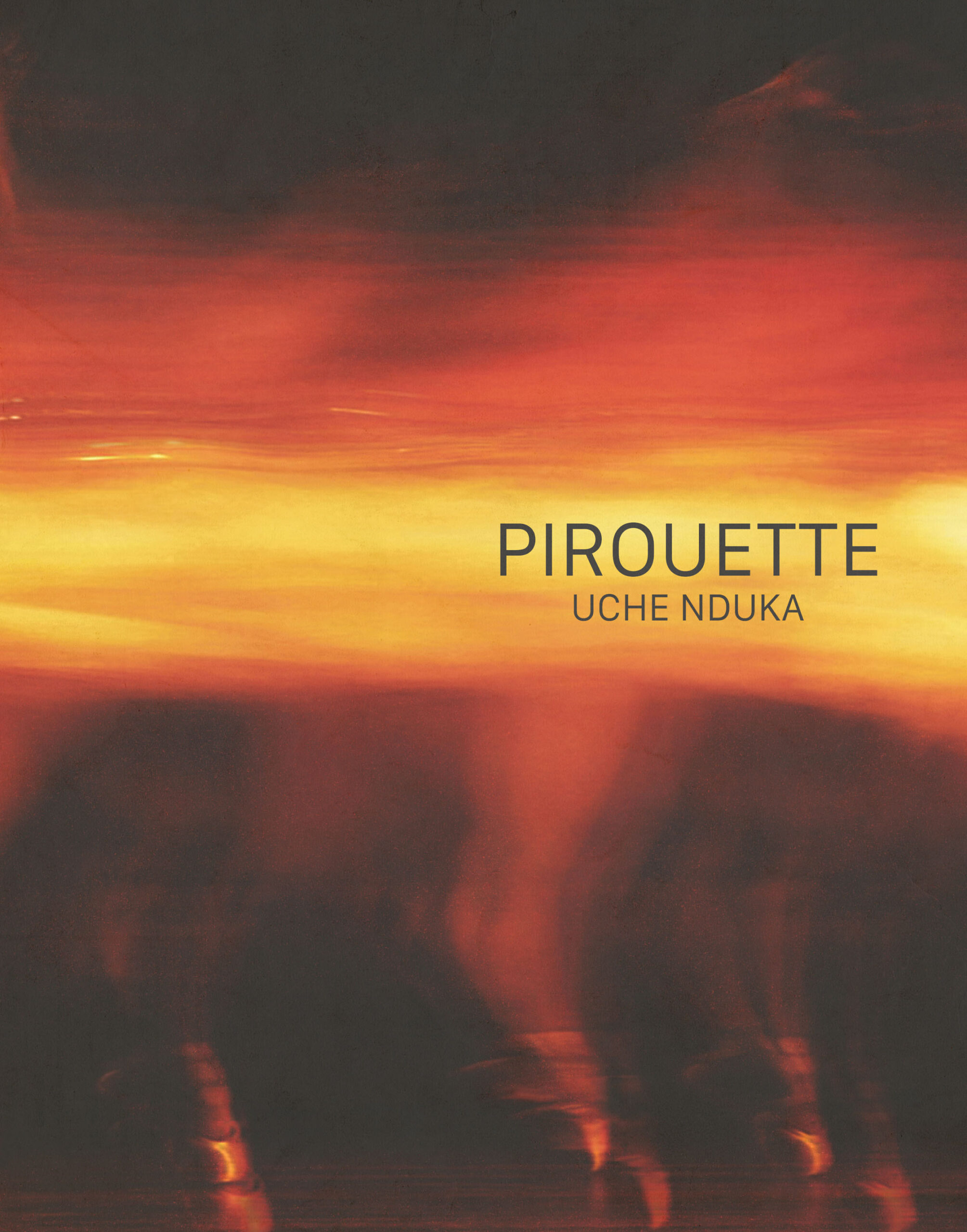
Uche Nduka’s newest collection of poetry, Pirouette, from Lithic Press, is a visual masterpiece even before the book is opened. The cover and shape of this printed volume are an artful introduction to what is inside. I want to first talk about the structure of the book. There is no table of contents. The poems have no titles. Pirouette is 198 pages of poetry that, like a pirouette, spin with the force of a tornado,while simultaneously presenting themselves as the most elegant act that a body can make.
The first 100 pages of Pirouette contain longer, larger poems. Each piece often lasts for five or more pages and frequently uses long and, at times, prosaic lines. The pages are dense with text. There is very little white space left over.
Then, as if emerging from a loud and tumultuous tunnel, halfway through the book (at page 108), the poems become very small. The line breaks are fast and several poems are made up of only three or four lines. In this second section of the book there is not a single poem that is bigger than the palm of a small hand. The book’s structure is one example of Nduka’s variety of style and depth of craft.
Nduka’s poems in Pirouette can take on epic proportions. His work can overshare and explode into a stream of consciousness that is as lush and dense as Ginsberg’s Howl, filling page after page and leaving nearly no white space. The poet ponders the past:
Or maybe language shutting the door on us. Or our photographs that refuse to
remember us. (86)
He reaches a place of desperation that seems to be at the edge of a cliff:
And even if God appears here now I wouldn’t have a single thing to ask of him. (92)
Then, in a flash, you turn the page to read poems that are slow and delicate:
When you open the window
You find another window
And another window
After that (136)
His poems can scrape mud from alleyways, and can pronounce ecstatic pleasure as joyously as Rumi’s most elated verses:
Make love to me in Igbo. (41)
This movement between excess and restraint makes Pirouette a breathtaking read. Nduka can move from the chaotic to the precise, without seeming to lose the intensity of his voice:
To risk the ridiculous
in pursuit of the profound? (84)
The settings of the poems are just as expansive. Amtrak waiting halls, Brooklyn, a plantation, Nigeria, a barbershop, “in the tangle of the bird-paths” (92). He quotes other poets. He brings houseplants to life. These poems are an archive of experience, recounting of every last bit of this world: steaming city streets, cafes, the thick of nature, a bubble bath, the wrath of politics, the dungeon of war, the dignity of sex.
When his voice is arrogant with certainty, the reader can trust that he is telling the truth:
When death came calling
I told him to f*** off (156)
Uche Nduka is a prolific poet. This is his sixteenth book of poetry. How does he manage to accomplish so much? The secret may be:
To make love with the left hand
And fight with the right. (139)
Just as the ballerina’s body revolves continuously during a pirouette, Nduka’s mind seems to be an ever-turning wheel, circling the essential questions:
Even in this 62nd year
Of my life
I have not learned
Any better
How to live. (126)
About the reviewer: Erica Miriam Fabri is a Brooklyn-based poet. Her first book, Dialect of a Skirt, published by Hanging Loose Press (2010), was a finalist for the 2011 Paterson Poetry Prize and included on the list for: The Best Books of 2010 at About.com; and the bestseller lists for Small Press Distribution and the Poetry Foundation. Her second book, Morphology, (2025) was the winner of the Write Bloody Publishing Jack McCarthy book award. Her work has been published in numerous literary journals, magazines, and anthologies and she has worked on projects as a writer, editor, and performance director for The New York Knicks, Urban Word NYC, HBO, and Nickelodeon Television. Her poetry has been featured in multi-media formats for short films and television commercial programming. She has been awarded a writer’s residency at the Omega Institute and has been a featured and/or visiting poet and performer for numerous art festivals and outreach programs including drug rehabilitation centers, prisons and hospitals. She teaches Performance Poetry and Fiction Writing at Pace University, as well as Essay Writing at Hunter College and College of Staten Island for the City University of New York (CUNY). She is also a Freelance Photographer, a New Yorker, and a Mama.