 Reviewed by Magdalena Ball
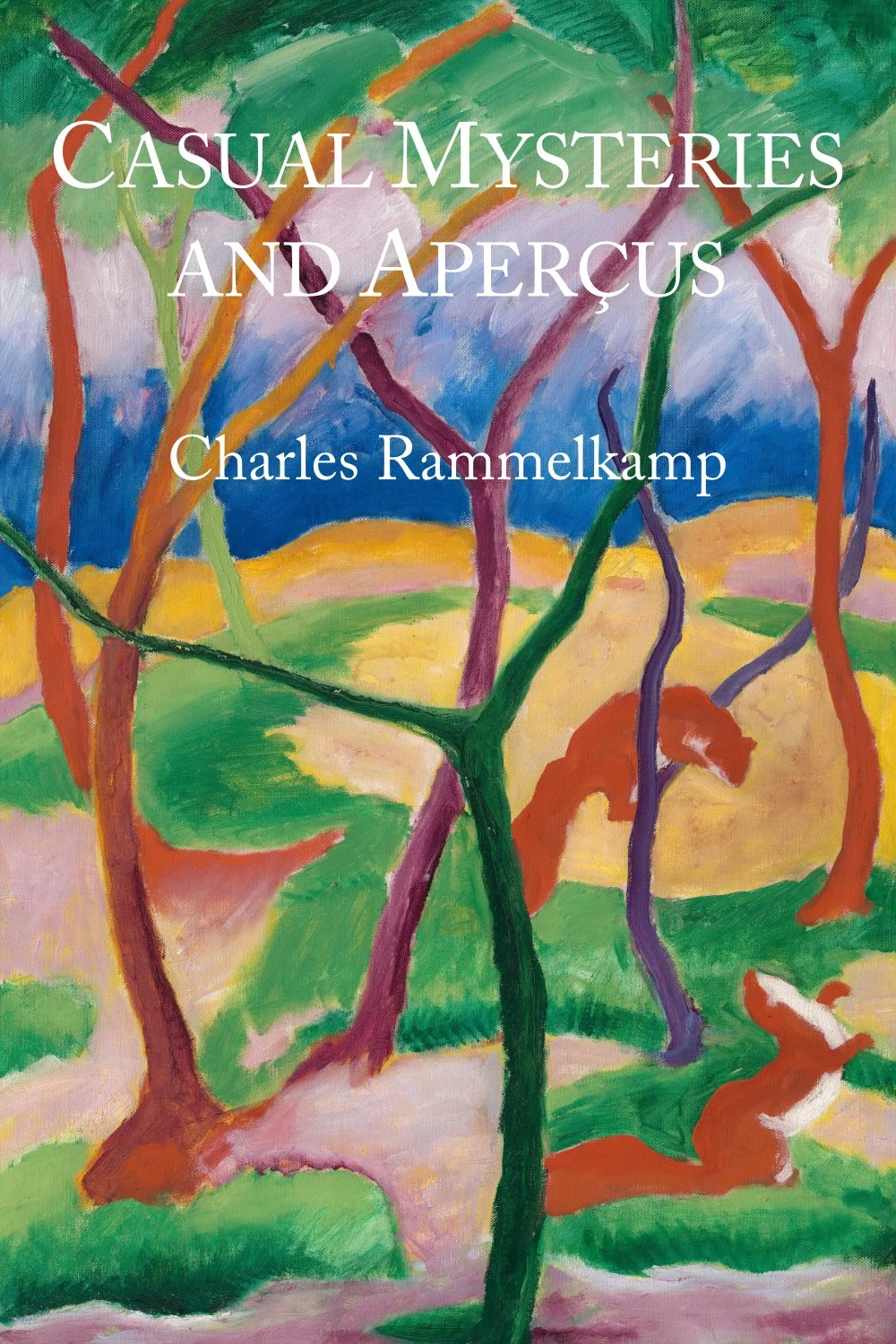
Casual Mysteries and Aperçus
by Charles Rammelkamp
BlazeVOX [books]
Oct 2026, Paperback: 356 pages, ISBN: 978-1-60964-548-9
The thirty-one stories in Charles Rammelkamp’s new fiction collection Casual Mysteries And Aperçus are both self-contained and connected through location and character to create an effect that builds like a novel. The setting of many of these stories is a fictional place in Michigan called Potawatomi Rapids, presumably after the Potawatomi people, the traditional custodians of the Great Lakes region. Rammelkamp’s small town on Lake Michigan is a fitting setting for the hi-jinks his characters get up to as they navigate school and college, relationships, infidelity, family dynamics, aging, jobs, midlife crises, and a myriad of lost opportunities. There is something uncanny about these mini-worlds, like a Twin Peaks mirror in which we are both attracted and repulsed by the characters and situations. Other venues include Brookline in Massachusetts, Maryland and Baltimore, and a small fictional college in rural Virginia. Rammelkamp’s settings are richly depicted as characters move through schools, college campuses, streets, supermarkets, in nursing homes, drinking at bars, on the job and in a state of nostalgia as they walk past the places and spaces they grew up in and reflect on who they once were against who they are now:
Ben Reed walked down Main Street. The summer sun had settled somewhere behind the old stone three-story buildings, and the town had moved into its evening rhythm. Ben was going to get something to eat. He went past the furniture store his father had run when he and his brother were growing up. (“Casual Mysteries, Everyday Betrayals”).
There are many casual mysteries that arise through the stories, often not resolved, like did Ben’s twin brother throw the brick that broke the window of his father’s furniture store or who painted the antisemitic graffiti on Mark and Linda Persons’ house? Most of the people in the book are down on their luck, stuck in bad jobs, lusting after the wrong people, deeply anxious, or just on the edge of a fight. There’s a claustrophobia that runs throughout the pieces, with a hint of violence crackling at the edges:
Suddenly, a blood-curdling scream woke me from the light sleep I had finally achieved. Paula shrieked like a
wounded animal, her cries echoing in the hallway. She had flung the door of their apartment open and howled into the corridor.
“He’s trying to kill me! Help me, somebody! Call the police! Eddie’s trying to kill me!” (“The Endless Glissando”)
In spite of their sometimes ominous quality, the stories remain humorous, often making use of dramatic irony and a gentle poke at the characters:
The combination of thoughts – the naked mannequin, the warm garment – made Bob blurt, “Maybe somebody should get a scarf for that dummy.” He gestured over his shoulder toward the store window as they walked away to their car. “If only for the sake of her modesty.” He meant it as a joke but it sounded almost prudish to him when he said it, like some Christian fundamentalist on a crusade.
But Amanda only laughed. “A merkin?”
Bob didn’t respond for a moment, puzzling over what his wife had said.
“George Bush?” he asked, and then, in an exaggerated Texas accent, “Ah’m so proud to be a Merkin.”
It was Amanda’s turn to be puzzled. “George Bush? Oh, I get it, bush.” (“Saint Peter’s Beard”)
There are several stories that connect over an extended narratives. One example of this is the story of Roger Castleman, a retired writing teacher and poet who is stalked by one of his former students, Shelley Pickett, an unstable woman desperate for him to work with her on her poems. Both Roger and Shelly conduct a kind of unsettling dance, with Roger trying to shake her off and Shelly becoming increasingly persistent and unstable. Throughout these stories, Rammelkamp does a terrific job of managing the tension while allowing his characters to develop in ways that are both comical and all-too-real:
Castleman is writing a poem about innocence, so elemental that both virtue and guilt are alien concepts.
Mark Person is an assistant dean and admissions officer at Hausner College in rural Virginia, and is the unwilling editor of an online journal, The Cantwell Review. Several of his rejected poets become angry with him, sending insulting letters with one even visiting his office, to the point where Mark is considering purchasing a gun for self-protection. This piece in particular is full of wordplay, mondegreens (mis-heard song lyrics) and the aperçu of the book and story’s title:
Mark loved the little tail hanging off the c, its magical
power to change the pronunciation from a “k” sound to an “s”
sound. How powerful, how sexy, just like the word itself. (“Aperçus”)
A number of the stories turn at the aperçu, the character’s life coming full circle. Not all stories are ominous and not all mysteries are solved, but collectively the stories in Casual Mysteries and Aperçus shine a light on prejudice, anti-semitism, homophobia, misogyny, the unreliability of memoir and perhaps how even dire situations tend to work itself out over time. As you might expect from a poet, Casual Mysteries and Aperçus contains poetry, insight, intrigue, and a whole lot of fun.