 Reviewed by Peter Mladinic
And Wales by Accident
by Linda Lerner
Iniquity Press/Vendetta Books
Feb 2026, ISBN 9798255288458, 80 pages, Paperback, US$20
i wanted to see this woman/my mother
who lived in a corner of
her life bent over an
ironing board a stove gave
love the only way she knew:
heated up & served
disappointed by what she got back
break free
The journey from beginning to end in the above quoted passage is circuitous, yet its statement is direct, its tone inevitable. This had to be said. And Wales by Accident opens with a poem about a Tai Chi class in a park. The speaker’s focus is on a red ball arrested in air, a ball a human throws and a canine fetches, continually; it is in motion but arrested. Were the poem a painting, the accent would be on the red ball in the blue sky. It is an extension of the poet’s self. Like the ball, the poet arcs over places, things, and people in her life. Irony, paradox, and, most prominent in this book, metaphor play out to retrieve what has been lost and what might have been: “what it’s like to live in a town / that doesn’t exist anymore.”
Metaphor, irony, and paradox abide in all five sections of this book. The ball in the opening poem of the first section, “And just like that,” becomes more than a ball “red hot as it flew overhead, each time / gathering speed covered / a greater distance,” literally in the park, figurative in the poet’s emotional landscape. The poem titled “And Just Like That” is about the cognizance of mortality and mutability. The speaker comments, paradoxically, “safe in my apartment / isn’t safe.” She recalls a former colleague who entered her apartment via Zoom and:
a scattering of comments
like ashes, where once a person
who conjured up a town
come through my screen
how like her turtle’s slow moving crawl in place
far from where, was it just yesterday, she said,
he was right here
I consider the varieties of gone,
The poet then depicts a town filled with the absence of humans and living things, a town that “in seconds could be demolished.” Lerner’s tone is as understated as it is emphatic. Again, what is said had to be said. She is straightforward, precise, above all original. In the apartment poem that follows this one a throw rug on a waxed floor becomes a risk. In “That Word,” the third poem in this section, Lerner’s similes conjure opposites of far and near. The word was:
following me like a balloon
whose string had gotten away
from someone whose white
wrinkled face up close felt
like touching snow
Who thinks like that? A poet with words that must be said. In the concluding section of “That Word” she says, “I no longer know which side / of the word I’m on.” Her not knowing is reminiscent of the line in Roethe’s villanelle, “The Waking.” “This shaking keeps me steady.”
The book’s second and third sections are titled, respectively, “Survival” and “Women Now & Then.” In “ Survival Lines” a line “in New York to see a movie” moves the poet not forward but back to her mother “on a 1930’s line / to buy food, bank lines my grandfather / and others stood on for hours to withdraw money.” In the recent past, 2020, poles that people use to paint a Black Lives Matter mural on a wall become more than poles, as the poet comments on “young kids struggling with / something bigger than themselves.” The poles act as a conduit between the people and the mural that symbolizes the value of their lives. The poem is a celebration of community. The poem “On Hearing Your Friend Say, You’ve Gone to a Better Place” depicts a friend dying in a hospital and her will to live. It’s no accident that “YES” appears twice in this poem, once for the poet, and once for her friend. This poem, like so many, like all, really, bears the stamp of inevitability. The book’s third section, “Women Now & Then” begins with a poem about women used by men; the poet contrasts these women with “winged Liberty,” the visage of the “nameless” woman “on / old coins my father collected.” Thus, freedom is contrasted with servitude, and bondage. “Not Them Again” is a cat poem, and more. The poet had a male cat named Samsara, who died “a few days before my estranged brother also left…” Then she got a feline she named Sara, whose nature was independent, and, for the poet, invigorating:
I watched her breathe new life
into this name, to own it absolutely
and see a long line of women
shadowing her, my own struggle against
a favored male sibling I resented
that ongoing fight for women
to be who we are, a fight
for not against who we’re not
The book’s last two sections, “Family Poems” and “Journeys” come full circle. A reckoning with self in the former compels the poet to lose herself to find herself in the latter. In the family section’s first poem, “The Missing Link,” about the poet’s estrangement from her late brother, when her cousin speaks of “Artie,” whom she knew as “Arthur,” it’s as if the cousin is speaking about a stranger. As for grief, upon her brother’s death, she says, honestly, “It’s not there.” In “Broken,” the mirror that fell and cracked becomes a portal into the self:
my half cracked image confronts me;
like those who bargain with god
I promise whoever to give up stop doing
and start to diffuse myth with logic;
Her conflict with herself is resolved in the poem’s last two lines: “I focus on the uncracked half. / Take it one day at a time.” And she goes out the door. In “Construction Deconstructing Downtown,” a city block becomes a sentence without end. “I keep going…” she says. And on her journey, airborne, streets are memories, sources for creativity. In “Things Like This and That,” one neighbor becomes another. And in the title poem “And Wales by Accident,” one country becomes another:
Don’t know how I got to Wales from London
on a train heading to Wordsworth’s Lake District
must have missed an announcement before
it changed direction, and I’m somewhere else
like this new world I’m living in.
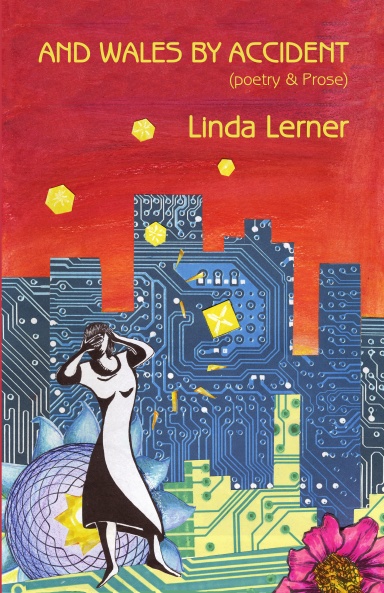
If a city block is a sentence, figuratively, a city is a page. A city is people, figuratively a person. Figuratively, the page is blank until the poet, by her living, fills the page with things that must be said, things others benefit from hearing: the truisms in her lines, her rhythms, her poems complemented by Angela Mark’s vibrant cover art: yellow lettering, a city in blue under a red sky, in one corner a flower, in another a globe, and between them a woman, her face hidden by her hand. She could be the poet, and that ambiguity, rather than obscures, enlightens. And Wales by Accident is a personal book of prose and poetry written so readers recognize themselves in its pages.
About the reviewer: Peter Mladinic’s most recent book of poems, The Whitestone Bridge, is available from Anxiety Press. An animal rights advocate, he lives in Hobbs, New Mexico.