 Reviewed by Magdalena Ball
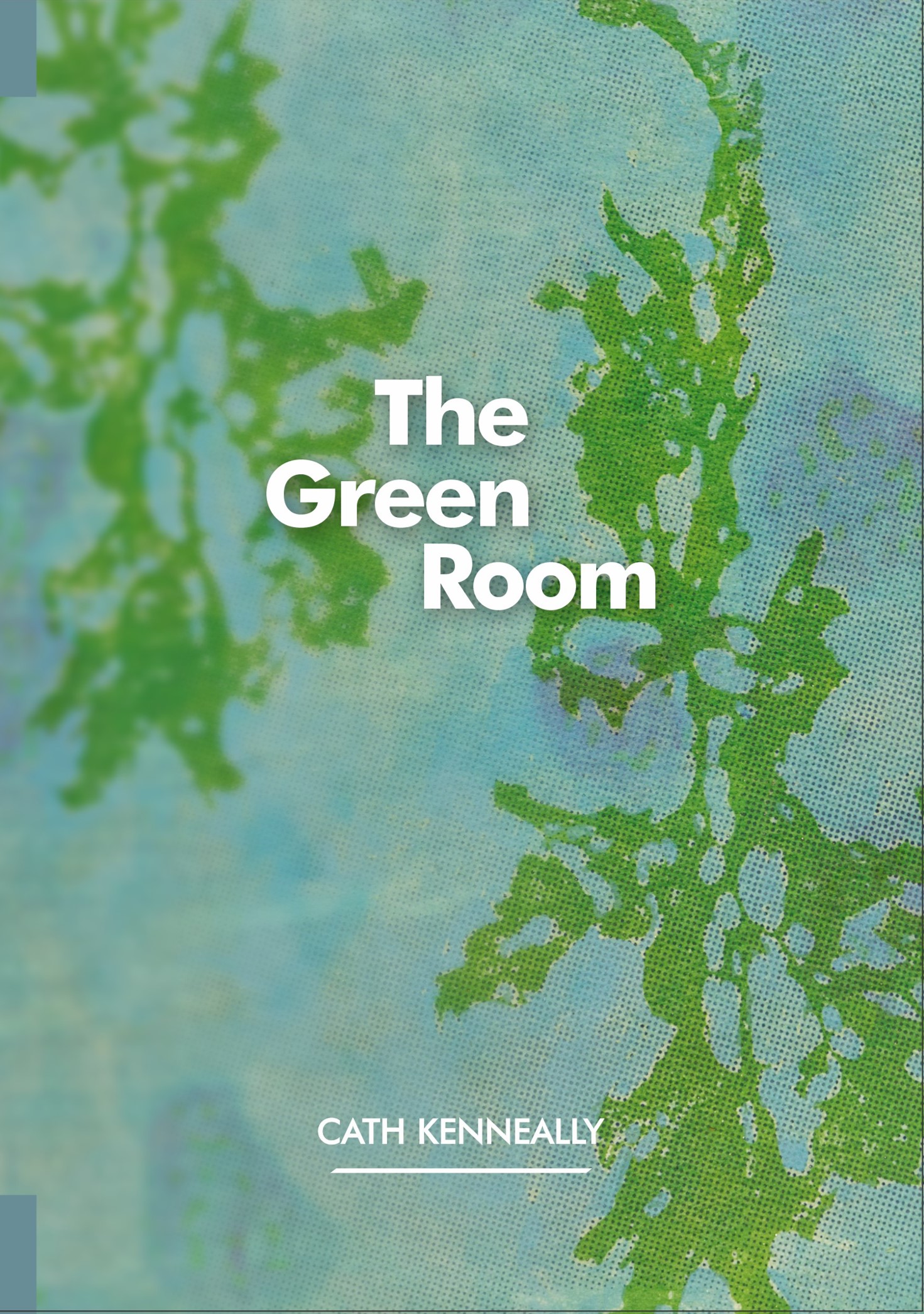
The Green Room
By Cath Kenneally
Liquid Amber Press
ISBN 978-1-923657-06-9, Paperback, 64 pages, June 2026
Cath Kenneally is a pillar of the Australian arts community. I’ll never forget the thrill of reading my reviews and poems on her wonderful Radio Adelaide show Writers Radio way back when I first arrived in Australia. She has written several novels, and has been an arts critic, assessor and broadcaster for years but she’s especially known for her poetry. The Green Room is her eighth collection, focusing on what is clearly a deep love of the ocean. The book began as a short, interlinked set of poems for the catalogue of Chris De Rosa’s ‘SeaWeeding’ at Adelaide’s Museum of economic Botany and then expanded into a full-length collection. The book is very much centred on water: its criticality to human and other forms of life, and the ways in which we are intimately connected by water to all living things. Though The Green Room is relatively short it covers a lot of ground, with thirty short poems that are powerfully condensed. Keneally utilises the gaps or silences between words and stanzas, often separating lines with double, triple or quadruple spaces. The poems flow like water, leaving plenty of room to pause and reflect between words.
The green room of the title is the ocean, both literal and metaphorical. Water is within us and without, life giving and present everywhere. The title poem, first in the collection, enters straight into it:
you answer the ancient summons:
Immerse, submerge
let yourself into the Green Room
Open all hours.
The swimming continues, “stroke for stroke”, the ocean reminding us that there is always something bigger, “incoming, outgoing, at the full, in retreat”. In spite of our bloody past and tenuous future, there is always hope, an opportunity to cleanse ourselves and recalibrate (or perhaps evolve):
A bloodthirsty planet, this
but water and wash are synonymous
some hope of atonement forever extended (“cold comfort”)
Water is a conduit here, holding memory and connecting the human lifecycle with the water cycle and the human to the many creatures that inhabit the ocean: a leopard seal, a skate, a bronze whaler shark, a bulbous red octopus, black swans, kelp gulls and a white bellied sea eagle to name a few of the creatures that swoop and swim through these pages. There is a kinship between the human and the more-than-human that comes through playfully, in the ways we frolic in the ocean:
literally, littorally, returning compulsively to
where the world began, the amniotic embrace
each emergence emulating the first stumble onto land
every time a little rebirth
The poems often utlise sound elements like repetition to create meaning. Kenneally employs a wide range of techniques like anaphora, as in the repetition of “where” at the start of lines in “waiariki”, or epizeuxis in the poem “in”, with its ending: “every time, every time, every time”. The combination of consonance, sibilance and alliteration create wavelike qualities that are almost hypnotic:
Cursus, courseway, causeway
a road dividing two stretches of water
most magical of routes
Sound play continues throughout the book, not just in the gaps created through each poem with line breaks, tabulation and stanza breaks, but also in the use of enjambment which drags the eye down and allows for a sudden turn, as in “not a drop” where we move from an inland sea to ice melting, the gap at the end of line between “I’d” and “drown” calling attention to the turn:
There is water on my mind, always,
an inland sea…if I could direct my dreams, I’d
drown my enemies. I consider
ice melting, flowing back to the ocean, revealing
corpses and plane-wrecks on glaciers
Some of the poems are dark, a reminder that we’re on track for a future apocalypse where fires rage and sea levels rise: “boats flake into matchsticks”, clouds are sinister, London is ringed by fire and extinction is imminent. In spite of this, the book is full of humour, woven throughout even the darkest poems: “salt’s the charm”, “you skittish flying saucer, you”, “Hi, Grandpa Seaslug, Great Aunt Hallucigenia (I like your/spikes—way cool)”. Kenneally’s casual colloquial brings in popular culture like commercial jingles, television shows like Michael Portillo’s “Great British Railway Journeys”, Rick Stein’s “Cornwall”, and Tim Winton’s “Ningaloo Nyinggulu” or has fun comparing a column of seaweed to empty condoms. The Green Room is a beautiful collection that does many things, but most of all it is a rich celebration of the beauty and joy of beaches and oceans:
All the beaches of the world
are waiting for me, their siren call
never wavering. I want to convert
all my loved ones to the faith. (“bless”)