 Reviewed by Ellen Harrold
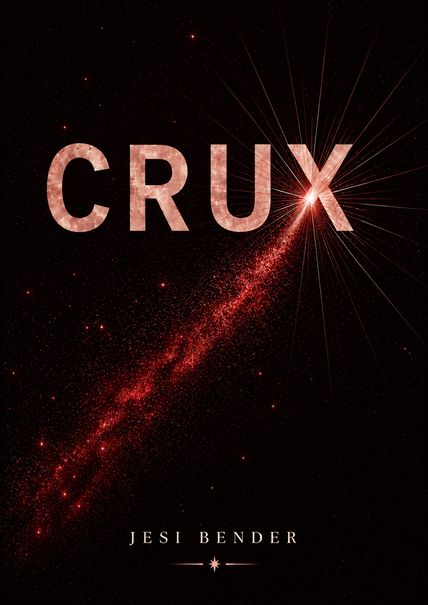
Crux
by Jesi Bender
Sagging Meniscus
November 2026, ISBN: 9781963846690, Paperback, 132 pages
Earlier this year, the annual ceremony of Eleventh Night took place across Ulster, with bonfires towering over the segregated neighborhoods of Northern Ireland. Among the usual symbols of loyalist disdain was an increasing number of symbols representing the Muslim, Jewish, and immigrant communities. Set alight, left to burn amongst chants and music. I still wonder how many of those in attendance could recount the meaning of the symbols they burned, the history and interwoven narratives that bound these disparate communities under the ire of colonialist worship. Interviews conducted in the aftermath showed that they could speak of their hatred with practiced ease, listing off their enemies with pride as if recounting the local GAA scores.
“Bayard: That man was right about violence. Bobby. It expounds and expands.”
Just a month prior, I had read Crux by Jesi Bender, a surrealist interpretation of Bobby Sands’ hunger strike. The play explored the interconnected world of anti-colonialist action, drawing on the political and philosophical discourse that emerges from movements founded on independent critical thought. As Sands descends into starvation and introspection, he begins to see the shadows of his fellow activists emerge from the near and distant past. Amongst our cast, we see figures from the suffragettes, the Romanian Communists, and Indian Hindustan Socialists. They ebb and flow from Bobby Sands’ dingy cell, punctuating his deteriorating state with debates on ethics, memory, and revolution.
“Bayard: Doubt is a sign of intelligence.
Haia: Everything contradicts itself if you give it enough thought.
Jatin: So is resolve.
Bayard: Plenty stupid happens in resolve.”
As a playscript, the body of Crux is its dialogue, split between the hallucinatory discourse of Sand’s fellow activists and the people around him in the prison. Each character’s personality feels natural, with a nuanced approach to their thoughts that keeps their perspective distinct from one another. With so many members of the core cast from different cultures and times, their distinct views and ways of speaking make the script feel authentic and keep the conversations lively. This empathetic style also acts as a humorous contrast to our contemporary cast, who almost seem to finish each other’s sentences, following a rhythmic stylised form of speech that harkens back to John Gay’s The Beggar’s Opera. The book is ripe with these artistic flourishes, switching between speech patterns in the blink of an eye. An act of grand revolution in the corner of a filthy prison cell, it captures the absurdity of the situation, the propaganda and orthodoxy required for a person to be stripped of their rights.
“ Marion: Isn’t it odd that I died before you were born?
Bobby: And that we’re still here together?
Marion: Yes. Time is so… you know how you think you can know something
but also not remotely understand it? We think we move through time but it moves
through us.
Bobby: I don’t know. I don’t feel time move at all anymore.”
A core narrative element of Crux is how Blender engages with the diverse range of experiences that sets our core group of characters apart. While they all strive for emancipation from systems of oppression, their modus operandi vastly differs due to their culture and their place in society. Martyrdom, being the impetus of Sands’s hunger strike, becomes a topic of tense debate as each character contests the efficacy and ethics of dying for a cause.
One of the highlights of Crux is the intellectual engagement with each perspective and the reasoning that fuels the characters’ outlook, even as they change their opinions in response to debate and the deteriorating health of Bobby Sands. No one person or belief is given credence or importance over another. It feels conversational and natural, keeping me grounded in the storytelling of the text.
“Jatin: I think the message itself is enough to die for. If Bobby can get his message out,
even if it means he dies, but in the process it saves more lives, then maybe it is worth it.
Bayard: The ‘maybe’ is worth it?
Haia: For Words Bob? For words?! They melt in the air.”
Throughout Crux Blender includes rich, detailed descriptions of the stage setting and character actions, intertwining them into the text through prose and images. This translates beautifully into a manuscript format and sets the pages apart from a theatre setting that takes full advantage of the physicality of a book. It allows the writing to go into detail that wouldn’t be practical for a live stage show, including the more complex details of what Bobby Sands’ cell looks and smells like, and the specific artistic references in how the characters arrange themselves on stage. One of the most unique uses of this format is the description of a ‘Web of Connection’ that hovers over the stage, outlining the connections between counter-colonialist figures throughout history and how they are connected to one another. This web acts as a character in its own right, pulsing and flowing above the decrepit cell like the Northern Lights. Within the medium of text, you get to read and stay with the names of the people emerging in this complex network. It gives the text a dimension that will complement the live production and allows the two editions of the same story to exist in symbiosis.
“The Web of Connections grows brighter, blinking, frantic. Bobby stands on his mattress
Center stage. He is naked, except for a yellow flag wrapped around his head and draped
down his back. He holds one end to his crotch. A wind blows in, and Lucy moves to
cover him with a large red flag. Outside, birds cry through the window. The scene
resembles Botticelli’s The Birth of Venus”
Crux stands as an original and beautiful rendering of Ireland amongst post-colonialist narratives. Embracing nuance and empathy at a time when reactionary views are becoming more pervasive than ever. History is not the disjointed narrative of a single nation; it exists within a network of communication and politics that have existed for as long as people have. Bobby Sands’ story spread from a prison cell to the world, carried by all those who see and share that struggle.
“Bobby: I am alive and dead. I’m not isolated by time.”
About the reviewer: Ellen Harrold (She/Her) is an Irish artist, writer and editor-in-chief of Metachrosis Literary. She has exhibited her art with the Irish Museum of Modern Art (Earth Rising, 2024), Lido Stores Margate (Memento Amoris, 2026), and The Laneway Gallery (New Lens, 2026). She has also recently published art in The Storms, An Áitiúil, and Orion. She has published poetry in English and Irish in magazines such as Shearsman, The Pomegranate, and Channel.
She has a website: ellenharrold.art, an Instagram: @ellenharroldart, and a Bluesky: @ellenharrold