 Reviewed by Magdalena Ball
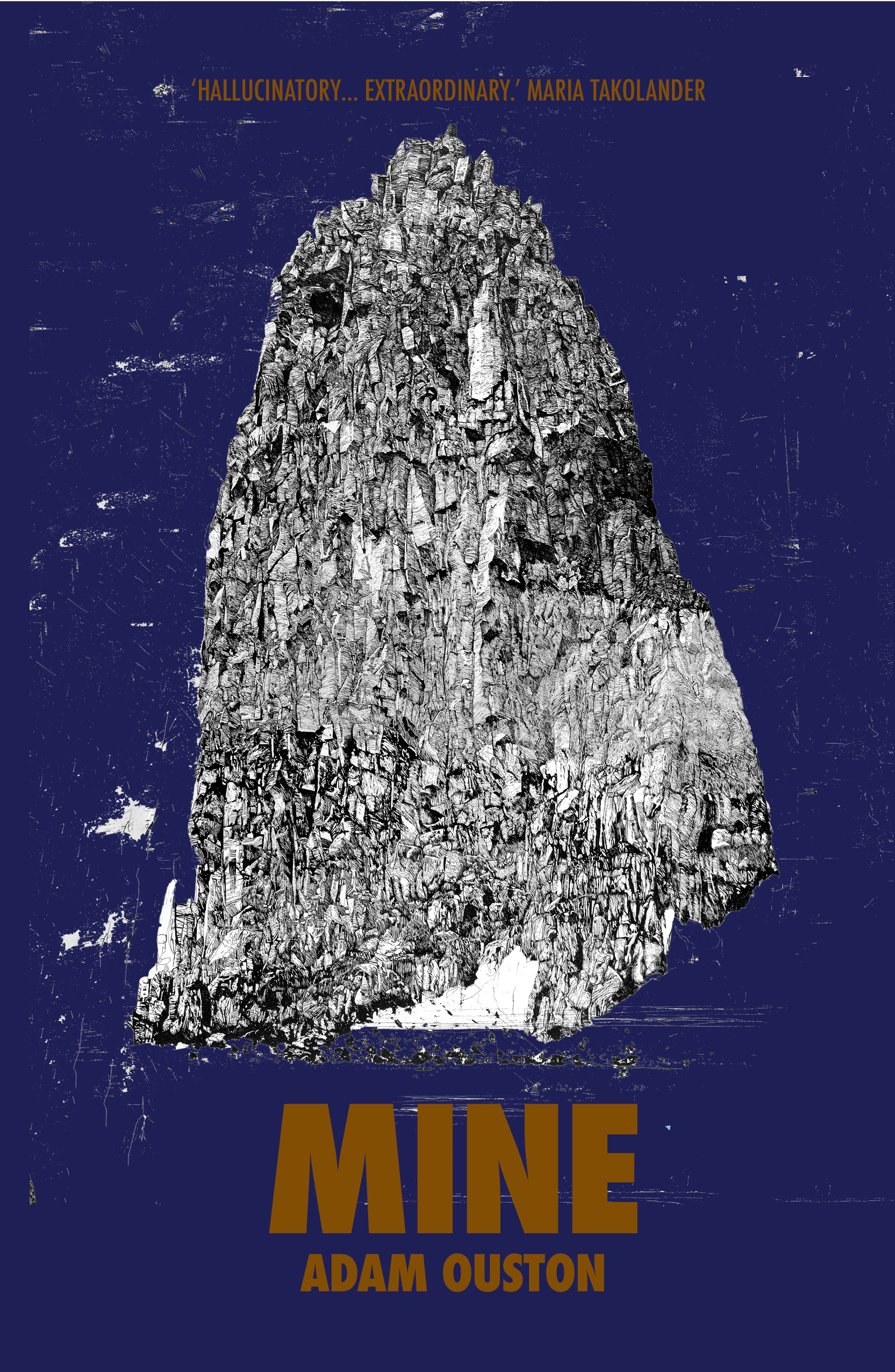
Mine
By Adam Ouston
Transit Lounge
August 2026, 288 pages, ISBN-13: 978-1923023604, Hardback
I spent many of my university years reading and analysing the 20th Century Modernists like James Joyce, Virginia Woolf and William Faulkner and have often wondered so few books being written today have tried to emulate their rich stream-of-consciousness style, nonlinear time shifts, and unreliable narration. Mine is that sort of book. It is written in one single 278 page long sentence with no paragraphs, no chapters, and no structural roadmap for the reader. In spite of this, the writing is not difficult to follow, and the narrative follows a recognisable trajectory driven by the protagonist’s desire to work out the chain of events that has led him being trapped in an abandoned Tasmanian mine. As we begin to understand the type of person he is–poet, professor, researcher, environmentalist–we also learn, in flashbacks or memories “fluting up like smoke” how, as a nearly eighty year old man (‘men at 700, men at 1000’), he decided to travel from his home in Hobart, leaving his wife behind, to visit Chester, a remote former mining settlement on the lower slopes of Mount Kershaw on the West Coast of Tasmania. He is writing what he can only call a “Hauntology” – his final project.
There are several narrative threads and poetic refrains that twist in and out of the narrative as we move through the arc of this unnamed mind in the mine. Sometimes he is pragmatic and precise, working through his dilemma in logical steps, and sometimes he’s feverish and wild. I found the writing and the way in which it traveled through time and space, history, trauma, love and loss to be haunting and yet surprisingly compelling. The narrator is credible but unreliable. He may be trapped at the bottom of a mine shaft but he may also be hallucinating, or even metaphorical. A great howl opens and closes the book. It is a noise that:
resonated inside him, rattled his teeth, a vibration that was at once consoling and terrifying; consoling in its frequencies, which in another setting might hav been labelled healing, and terrifying in the sheer mass it had acquired. (1)
The mine shaft itself begins to take on a kind of sentience, with its opening howl and the many ways it heaves and changes. The narrator himself is transforming, moving from human to geological time and rethinking what it means to be alive and not alive, to be human and to be part of the earth. His perceptions change:
Because if the mine could hurt you it could also communicate with you, and communion meant a degree of understanding, common ground, it was right there in the word itself, he would have said, for a poet was a the end of the day a lexical miner, and pain was a type of communication, if it could would you it could talk to you, and maybe it had been talking the whole time, his entire life, so old, too old, and he’d been trying to listen, to understand,…(7)
The writing is subtle and poetic, lingering in the space between memory, life and death. There are multiple references to the 1912 Mt Lyell mine disaster that killed 42 miners, and to the widespread environmental damage to local rivers and the surrounding landscape, acid drainage and rain, and the impact on ecosystems. The voice we hear is both grounded in the physical pain, desperate thirst and impending danger of the narrator in his current predicament coupled the historical horrors of the mine, the many people that have been hurt and those who profited, particularly James Crotty, Bowes Kelly, William Orr and the Mount Lyell Company along with an almost detached rumination on the writing process itself:
…he felt the urgent stirrings of his hauntology, the restlessness came over him, maybe the moment was to hand and he would be able to write again and not simply recite his old words into the cold with the younger poet beside him, when the absorption was complete and the anxiety began to push it forth and projected it from his…what?…mind?…soul?… where it would make its final journey from his body at his desk—-getting too old to write; can’t apply myself—that blind environment where it grew and tangled like bauera in an abandoned building, down his shoulders, across the plains of his wrists, over the forested hills of his knuckles, the highland-lake surface of his nails, to his fingertips and then jumped, though it was mot much of a leap, maybe the safest in history, over the nanoscopic gap—there was always a gap between everything, regardless how insignificant—to the keyboard…(42)
The novel is peopled with ghosts. Some of these are the maimed and diseased miners who have been victims of Mt Lyell, with their lung conditions, consumption of the bowels, headaches and crumbling teeth, and epileptic fits bought on by exposure to lead in the water and soil. These were all on record, the howls of the ghosts surrounding the narrator in ways that are both ephemeral and visceral, driving him to his destination, along with a slightly mad caretaker character named Louisa Orr, who maintains a defunct railway in case the owner ever returns and who takes over the narrative for a bit.
One of the many narrative threads is a memory from ten years prior when the narrator had a trip to Iceland on the Aurora Australia icebreaker to get a more visceral sense of the melting ice: “he’d wanted to touch the ice, to see it with his own eyes, even to taste it if he could, absorb it so that he would feel it more keenly…”. During that time the boat received a mayday call for the Russian vessel Akademik Shokalskiy which had become trapped in sea ice while conducting the Australasian Antarctic Expedition in order to recreate the “grim research expedition” headed by Douglas Mawson in 1911-1914. The Akademik Shokalskiy and the Mawson expedition become threads in the book, almost like musical refrains, which mingle with the the Mt Lyell narrative combining to create a resonant exploration of ecological destruction, exploitation, greed, and dispossession:
‘After you have a certain amount of money, you have to go after control, power, you have to conserve it’ she said, ‘This is what it looks like,’ she said, ‘Sickness, poverty, death, despair,’ she said as though naming huskies or electorates. ‘Complete power, absolute domination,’ It was a grim, appalling sight, and the poet stood stunned and silent in the eye of the storm, at the unveiling of what he as up against, the gruesome heart of his hauntology, ‘Modern slavery,’ she said, ‘A never-ending sentence,’ (200-201)
The book’s sentence does in fact end, but what we’re left with in Mine is a grand Ginsbergian howl, grotesque, funny, poignant and thought-provoking in its chaos and “gnarly confusion” which ultimately resolves to a kind of symphony. The poet down the mine becomes a synecdoche for all that is lost and all that remains against humanity’s endless hunger for power and riches. The poet’s aging body itself with its guilt, its desire and its memory of loss becomes the Hauntology he has been striving to create; the site of his final work. Mine is an extraordinary achievement: dense, powerful, and fully realised.