 Reviewed by Ben Nguyen
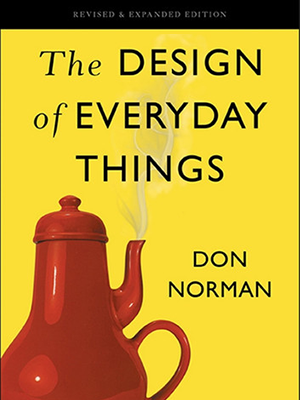
The Design of Everyday Things
Revised and Expanded Edition
by Don Norman
Basic Books
Nov 2013, 368 pages, Paperback, ISBN-13: 978-0465050659
The Design of Everyday Things by Don Norman is a book that argues that people experiencing frustration with everyday objects are not failing, but the design is – for example, the door. At almost every building, there’s a door you’ve pushed instead of pulled at least once in your life. The key is that you did not fail the door. The door failed you. He argues that designers, manufacturers, and engineers who produce these objects bear the responsibility of fixing them. Norman’s stated goal, in his own words, is to produce “a starter kit for good design” intended “to be enjoyable and informative for everyone: everyday people, technical people, designers, and nondesigners” (Norman xi). The book promises to speak to everyone but whether it does is a different question. Norman succeeds as a manifesto for designers, but falls short as a practical guide for everyone else because the examples he uses, the vocabulary within the guide, and proposed solutions to said designs are tailored to people with the power to change it – not the everyday people he claims to be writing for.
Originally published as The Psychology of Everyday Things in 1988 and revised in 2013, The Design of Everyday Things argues that when people struggle with the objects and interfaces around them, the fault lies with the design, not the person. Spanning seven chapters, the first three chapters introduce the foundational psychology (affordances, signifiers, mental models, the seven stages of action) and the concept of “natural mappings”: “What seems natural in one culture may not be in another” (Norman xv). Chapters four and five discuss constraints of design and error theory, while chapters six and seven are about applied design thinking and “radical innovations.” Norman’s core vocabulary shapes the book’s architecture: affordances (what an object permits), signifiers (what communicates those possibilities), mappings (the relationship between controls and effects), and conceptual models (the mental picture a user builds of how something works). These terms form the analytical spine of the book. Norman uses these terms consistently through the first five chapters, building a coherent system that trains the reader in his framework. However, in the last two chapters, which shift to design thinking and the world of business, the core vocabulary disappears. Norman shifts from affordances and signifiers to market competition and featuritis. Although this is really interesting to read, it breaks down the framework he has built over the first five chapters. It switches from psychology to business, an entirely different discipline. It gradually stops speaking to everyone and starts to narrow down to his real audience.
One of Norman’s most rhetorically forceful moves is his reframing of “human error” as a design failure. In Chapter One, he writes: “It is the machine and its design that are at fault. It is the duty of machines and those who design them to understand people. It is not our duty to understand the arbitrary, meaningless dictates of machines” (Norman 6). From this quote, it is clear Norman is addressing two different audiences: the first audience is everyday people, you and I. The line “It is the duty of…” shows that it is not our duty to understand the machines, but rather the other way around. The second half of the quote addresses the designers; to understand people is for those who design them. The everyday reader is validated, but only the designer is given something to act on. Norman is technically speaking to everyone, but only the designer can take action based on the quote. I believe “duty” has a strong meaning behind it. It acts almost morally. It implies obligation, responsibility, and even taking the blame. Norman uses this word not just to tell the designers what to do better, but rather to tell the designers “it is on them” to make it right. It also empowers you and me. Someone like me, who can get frustrated by the designs of everyday things, may read the passage and feel a sense of being seen, but it does not give you an action to fix it. On the other hand, a designer reading the same passage can see that they are given a mandate to fix the flaw in the design. Although it is subtle, it reflects who Norman might actually be addressing.
Another one of Norman’s concepts is “taught helplessness,” and this escalates the stakes beyond usability into psychology and, arguably, into ethics. He argues: “The design of everyday things (and the design of mathematics courses) seems almost guaranteed to cause this. We could call this phenomenon taught helplessness” (Norman 63). This concept is derived from “learned helplessness” and offers a way to explain self-blame (Norman 62). If bad design is annoying, it is probably a quality-of-life issue. If bad design causes something like clinical learned helplessness, such as technology phobia, math anxiety, or the deep belief that you are not a “tech person,” then it becomes a problem. I believe Norman uses this term exceptionally well, as it conveys a sense of urgency to the reader. However, there is a very clear gap in the book. Norman uses the first five chapters building towards something that sounds like an ethical argument: bad designs harm people psychologically, and designers have a duty to fix it. By Chapter Seven, his tone softens considerably. The end of the chapter is essentially: markets are complicated, companies face pressure, change goes by one small step at a time, and be patient. These two points within his book begin to clash. He gives a sense of urgency, yet he also says to be patient. If Norman believed that bad design produced learned helplessness, then he would have doubled down on holding designers accountable, but he never goes there. He basically diagnoses the problem, then gives in to the conditions that surround it. This ties into who Norman’s audience is supposed to be. The early chapters validate the reader; the later ones quietly concede that only the industry can act. It is not a book for everybody so much as a book for the industry, with a sympathetic nod to the rest of us.
Another passage that sums up Norman’s argument is: “The realities of the world impose severe constraints upon the design of products. Up to now I have described the ideal case […] Compromises must be made by all involved” (Norman 258). He is essentially admitting that everything he argued in the previous six chapters was for an ideal case – a vacuum. It quietly undercuts the framework he has spent the book building, since that framework only holds in an ideal case that the real world doesn’t provide. He follows with a statement that we must reach a compromise, but that is not exactly “the duty of machines” that he argues in chapter one. Norman draws a line between his manifesto and reality.
In hindsight, it is a really good book to read. I did enjoy the case studies, such as the case study for faucets and slide projectors. It gave me a genuinely new way of looking at everyday design. I go out on campus every day, and I am now able to see and appreciate the design in everyday things. Incorporating images really helped me visualize and understand the designs and their flaws, and the diagrams also helped with understanding ideas that I would not have understood from just words. Although it does have a subtle flaw in its flow of the book, I can confirm that it is an enjoyable book that almost everyone can casually enjoy. From a critic’s point of view, I noticed that the book is more tailored to designers and the industry instead of for everybody. In the grand scheme of things, it does fulfill its primary objective: the people are not failing; the design is. What it fails to deliver on is its promise that this book is for everybody. In fact, chapter seven implies that Norman wrote this book for designers. This is an informative book allowing readers to understand Norman’s ideas coherently. The central theme of that push/pull door is what my ranking system will revolve around. One door makes it easy to understand and is very intuitive, as I only need one attempt. Five doors would mean that the book was hard to understand, and that it became confusing as you read more, like guessing whether to push or pull five consecutive doors. For you, Norman, I would give you a rating of 3/5 Norman doors.
The Design of Everyday Things by Don Norman falls short as a practical guide for everyone, but it is tailored specifically to designers. That is why I believe this book should be read by those who produce everyday things: designers, engineers, and the industry itself. Should anyone else pick up and read this book, you can expect a book that allows you to understand the design of things you interact with every day, but you may not find it as a useful practical guide. For designers, it is a guide that shows you how you can take accountability for the design, and maybe find ways to do better, but for the rest of us, it is something quieter: the small, clarifying relief of finally knowing that the door was never our fault to begin with.