 Reviewed by Mark Massaro
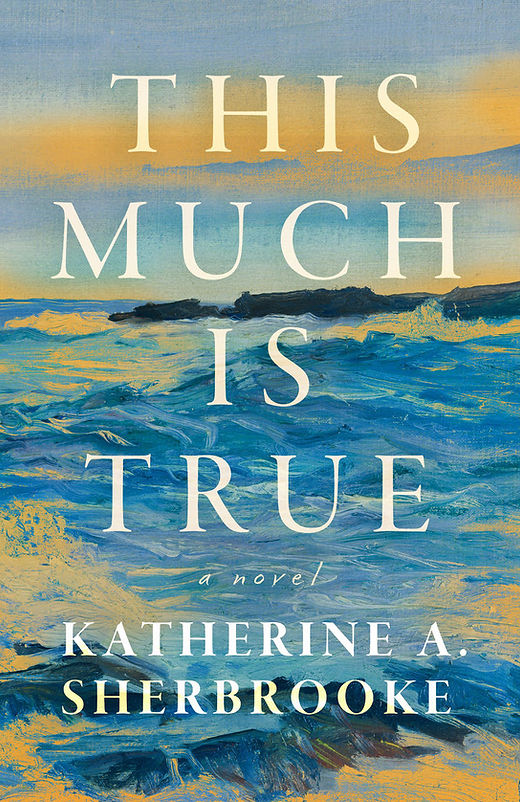
This Much is True
by Katherine A. Sherbrooke
Sibylline Press
ISBN: 9798897409181, September 2026, 280 pages,
In This Much Is True, Katherine A. Sherbrooke explores the lasting impact of trauma and the ways it can shape a person’s understanding of themselves and the world around them. Through shifting perspectives, the intimate novel moves between Veronica’s long-buried past and her daughter Mara’s hopes for the future. Veronica’s past resurfaces when she recognizes her future son-in-law’s father as the man who sexually assaulted her in high school, entangling the truth she has kept hidden for decades with her daughter’s happiness. During a weekend visit with her future in-laws, Veronica must confront the lasting impact of the assault and decide whether speaking the truth is worth risking the life she has carefully built. Through Veronica’s struggle, Sherbrooke examines the consequences of sexual violence while exposing the institutional failures that allow survivors to suffer in silence.
Sherbrooke deftly portrays trauma as something that can fracture identity, creating a painful divide between Veronica’s outward appearance and her private experience. She feels guilt as a wife and fear as a mother while carrying the shame of the teenage girl she once was, often referring to her younger self as though she were a separate person. Each of these identities has been shaped by the assault. Even as Veronica presents herself as composed and graceful, her internal world is marked by a growing sense that she has lost control over both her body and her place in the world. This disconnect becomes especially clear when she is confronted by an ex-boyfriend from high school. In the scene, Sherbrooke writes:
But my world had already started to disintegrate around me. The walls of the gallery, which had projected calming colors in soothing patterns just moments before, morphed into swirls of chaos. Light became shadow, and the shadows lurched toward me. The chattering faces in the room all swiveled in my direction like owls spotting prey. They sized me up, conspired, deemed me unworthy. And I stood alone, with no defenses, with no good answer to their judgement. I deserved all of it. And all I wanted was to disappear. (12)
Veronica has internalized shame, even decades later, as if the boundaries between her past and present have begun to collapse. Although she is surrounded by people who love her, she feels completely alone. The roles she occupies as a mother, daughter, and wife are deeply affected by the assault, shaping the way she loves, protects, and cares for others while keeping her own pain hidden. She equates telling the truth with setting “off a chain reaction, like lighting a match in a dry forest” and considers everyone who would be consumed by the flames (142).
Although most of the novel takes place over one weekend as Veronica and her husband host their future in-laws, Sherbrooke returns to Veronica’s adolescence to trace the beginnings of her fractured identity. When Veronica’s body changes during puberty, it becomes something she no longer fully recognizes as her own. After receiving unwanted attention and noticing the judgment of others, Veronica reflects, “It seemed I was in possession of a secret treasure that everyone wanted, even though I wasn’t quite sure where to find it” (14). Her body is suddenly treated as something to be judged and desired, yet she has little understanding of why it has become the focus of so much attention. When she is catcalled for the first time, she accepts that “an invisible line had been drawn in the world, like police tape marking hazardous zones I needed to avoid. And they were everywhere” (14). Through these early experiences, Veronica discovers how normalized the objectification of women is and how women are expected to adjust their behavior to remain safe. During a high school makeover, Tracy, the head cheerleader who pressures Veronica to join the team, tells her, “Look the part, feel the part” (22). Veronica learns that acceptance depends on performance. Years later, when she meets her future husband, Veronica carries this lesson into adulthood, clinging to the carefully conditioned identity she learned to present, explaining that he “saw me as responsible, careful, thoughtful, someone to be trusted. I promised myself to be that person for him, without fail” (155).
A highlight of This Much Is True is Sherbrooke’s prose, which balances vivid imagery with emotional depth. Her descriptions often move between the beauty of the visible world and the private experiences that remain beneath the surface, reflecting the tension at the center of Veronica’s conflict. Sherbrooke writes with a sharp eye and an ability to turn ordinary details into memorable images: “Fog licked at the house the following morning, so I decamped to the screened-in porch with my coffee. Polly and Moose followed and settled in with me to watch the rising sun turn each droplet of water clinging to the screens into a tiny orb of light” (137). Her language is equally effective when describing bodily sensations: “The chilled liquid contrasted starkly with her inner body temperature, and she felt it sluice through her body like a mountain river winding down a parched slope” (183). Veronica’s physical responses often seem to operate independently of her conscious thoughts, leaving her mind to make sense of what her body has already felt: “My insides twisted, like a net caught in a propeller” (17) and “A rush of nausea flooded my gut” (11). Through these moments, Sherbrooke demonstrates her control of language and her ability to make Veronica’s experience feel immediate, capturing the isolation she carries beneath her carefully constructed exterior.
As a male reader writing about a novel centered on female identity and survival after sexual assault, I am conscious that Veronica’s experience is not mine to define or explain. What I can recognize, however, is the urgency of Sherbrooke’s larger critique: the systems surrounding survivors often protect the status quo by questioning women’s choices while avoiding accountability for the men who commit sexual violence. Women are asked what they wore, how much they drank, or why they somehow placed themselves in danger, while the responsibility of the perpetrator is minimized or ignored. Veronica confronts this imbalance directly when she asks, “But what about the assholes that take advantage of the situation?” (239). She also considers how the American justice system “offers a false promise” to the women who speak up (239). Sherbrooke connects Veronica’s personal story to this broader cultural failure, including the public response to Christine Blasey Ford’s testimony during the Kavanaugh Senate hearings. As one character explains to Veronica, “This is a cultural malady. It’s its own kind of epidemic. It’s been around forever, and yet women who speak up about it still continue to be treated as the problem” (143). It is through these discussions between women that Sherbrooke highlights the strength found in shared experiences and the therapeutic connections that form between women, whether within families across generations or among strangers who recognize one another’s struggles.
Once I began following Veronica’s story, I found the novel difficult to put down. Sherbrooke is a skilled and compassionate writer whose prose gives emotional weight to Veronica’s private pain while never reducing her to her trauma. This Much Is True is a moving portrait of resilience and a necessary critique of the institutional failures that continue to leave survivors without justice. With this novel, Sherbrooke proves herself to be a storyteller who balances emotional honesty with literary precision, creating a work that is both deeply personal and profoundly human.
About the reviewer: Mark Massaro earned a master’s degree in English Language & Literature from Florida Gulf Coast University, and he is currently a Professor of English at a state college in Florida. His writing has been published in The Georgia Review, The Hill, Los Angeles Review of Books, The Master’s Review, Newsweek, The Colorado Review, and many others.