 Reviewed by Charles Rammelkamp
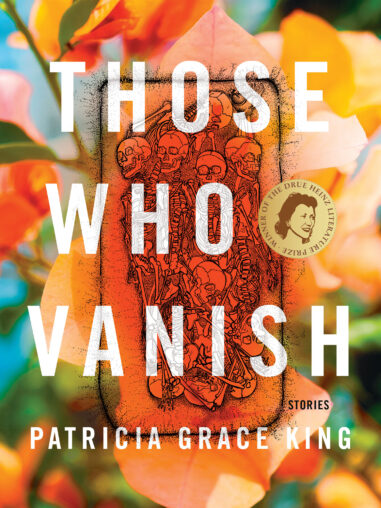
Those Who Vanish
by Patricia Grace King
University of Pittsburgh Press
Sept 2026, $24.00, 288 pages, ISBN: 978-0-8229-4923-7
“To disappear meant to die,” Patricia Grace King begins the story, “Already Gone,” which focuses on Ester, the daughter of two student revolutionaries abducted from the campus of San Carlos University in Guatemala City by government agents and later killed. Like the Argentinian desparecidos in the 1970s and the disappeared Chileans during the Pinochet regime, a large number of Guatemalan citizens were imprisoned and murdered by their government during what is known as the Guatemalan Civil War, which began in 1960 and did not end until 1996. The government targeted the Mayan population, in longstanding disputes over land distribution. President Reagan sent military advisors and equipment to root out the “Communists.”
The seven short stories and the novella, “Day of All Saints,” that make up Those Who Vanish, the 2026 winner of the University of Pittsburgh Press’s Drue Heinz Literature Prize for short fiction, some located in North Carolina, Kentucky, and Illinois as well as in Guatemala, all take place with reference to or within the context of that war. So often, the stories involve a clash of cultural points of view. Sometimes, as in the story “Pax Americana,” it’s between two Americans, and sometimes, as in the story “Rubia,” the clash involves the campesinos and the privileged city folk of Guatemala City.
Notably, there are also the misunderstandings between gringos and Guatemalans. The story “Adiós and Adiós” and the novella focus on the Guatemalan Martín Silva de Choc, a young language teacher at El Proyecto Linguistico Maya in Guatemala City and his gringa student-cum-girlfriend Abby, an impulsive, spoiled rich girl from Chicago whose symbolic fascination with Icarus, the boy in Greek mythology who flew too close to the sun, tells you all you need to know about their doomed relationship.
Martín grew up in a refugee camp beneath El Incienso Bridge in Guatemala City, with his grandmother and aunt, a community of homeless squatters, after his family was wiped out by the government on the land they’d cultivated in Ixcán, an area that borders Mexico, mainly because the government considered the region rich in oil. Martín was only four when the genocide happened, the entire village wiped out. By sheer determination Martín ultimately landed his modest job teaching Spanish.
Unfortunately for Martín, Abby chooses him as her next project, asks him to marry her, and they wind up back in Chicago as unfamiliar winter weather is coming. “Martín was bowled over, knocked off his feet,” King writes. “He thought it was the American way.” “Day of All Saints” takes place on Halloween. No longer a language teacher, Martín is a gardener, taking care of the property of wealthy Chicagoans, but in no time Abby dumps him, pressured by her mother and stepfather (whom Abby routinely refers to as a “Nazi” and an “asshole”). Abby remains self-justified to the end. “‘I thought I could handle your sadness,’” she tells Martín as they sit under a banana tree in the humid warmth of the Lincoln Park Conservatory. “‘I thought I understood it, you know? But I was drowning.’”
While most of the stories are told in the third person, “Rubia,” “Small Country” and “The Death of Carrie Bradshaw” are first-person narratives. These stories especially go to the heart of the misunderstandings that prevail throughout this collection. “Rubia” is related by Josie, a girl who tells us she grew up “at the bottom-ass edge of Delmarva, a landscape of crab shacks and chicken farms where the only thing flat as the Chesapeake Bay in your face were the swamps at your back.” “Rubia” means a blond woman, an exotic anomaly in Guatemala. Josie’s gringa blondness opens doors for her in the privileged classes of Guatemala City, where the contempt and distaste for campesinos is all too apparent.
Josie got a full ride to college, spent a junior year semester abroad in Guatemala and fell in love with the country. After graduation, she got a job with Harmony Arts, an outfit that dealt in fair-trade crafts (handbags, shawls, etc.). Her job involved going all over the highlands, negotiating with campesinas, the native craftswomen.
But back in the city, where she lives, she is befriended by a young man named Juan Carlos and his longtime childhood friend Fabiana, both smitten by her gringa blondness. Their scorn for the lower classes becomes all too apparent. “I’d never known rich people in the US, and I knew them in Guatemala only because I was white. Rubia. My skin and hair gave me power….”
At a cafe in Zona 1, the Bohemian center of the city, Fabiana tells Josie that Juan Carlos is “slumming” by coming there. “‘Isn’t that what you call it? Seeing how the other half lives.” It was when Josie accepted Fabiana’s invitation to meet there that “I believe that was the moment I started to hate all of them,” referring to these privileged Guatemalans. “Maybe I was just hating myself.”
“Small Country,” related by another bumpkin girl, Penny, daughter of Mennonites, who’d fled from Guatemala to North Carolina for their lives. In Guatemala, her father had helped farmers unionize and her mom had taught adults how to read. They’d been threatened for being “Communists.” Now Penny is spending a week at Bethany Mennonite Bible Camp in rural Kentucky, and talk about culture shock! She’s there with her friend Gina, both overwhelmed by the fundamentalist values of the camp counselors. And yet, things get out of hand there, too.
“The Death of Carrie Bradshaw” is a sad but hilarious story told by A.R. Eades, the gay religion professor at a college in northern Illinois, originally from Zebulon, North Carolina. He becomes involved with a student from Guatemala named Fernando, but it’s his dad, visiting from North Carolina, who freaks him out. “I haven’t outgrown the feeling I’m a child he gave up at birth.”
His father drives up from Zebulon in his truck and attends one of his son‘s classes. Professor Eades is lecturing about the Book of Judges when an alarm goes off. This is soon after several campus massacres have occurred in the United States. What happens next rivets the reader’s attention, the dynamic involving Fernando and Dr. Eades and his father. As the class is barricading itself in the classroom, responding to a possible shooter on campus, the professor thinks, “Maybe I’ll tell him, at least, how it ends, my lecture on Jephthah’s daughter. It’s about the failure to perceive.”
“Vanishing” is a subtle concept. While so often “those who vanish” are the disappeared, the dead, the victims of government genocide, frequently “vanishing” is simply this matter of a failure to perceive. Molly, the volunteer at Peace Action in “Dogs in Guatemala,” possibly seeing the corpse of a guerilla they’d sheltered the night before lying in a gutter, wonders for probably the millionth time, what have they accomplished, while her companion Naomi grieves for the abandoned dogs and cats, “objects of suffering that still make some sense. Whose pain is small enough to imagine.” Eric and Elsa in “Pax Americana,” the married couple who have miraculously stayed married for decades, despite their differences, tell the story of their love and marriage that they make up for their guests, neither acknowledging the story behind the story. These, too, involve vanishing. Patricia Grace King’s collection is compelling for so many reasons.
About the reviewer: Charles Rammelkamp is Prose Editor for Brick House Books in Baltimore and Reviews Editor for The Adirondack Review. His most recent releases are Sparring Partners from Mooonstone Press, Ugler Lee from Kelsay Books, Catastroika from Apprentice House, Presto from Bamboo Dart Press, See What I Mean? from Kelsay Books, The Trapeze of Your Flesh from Blazevox Books, and most recently, The Tao According to Calvin Coolidge, published by Kelsay Books.