 Reviewed by Victoria Xie
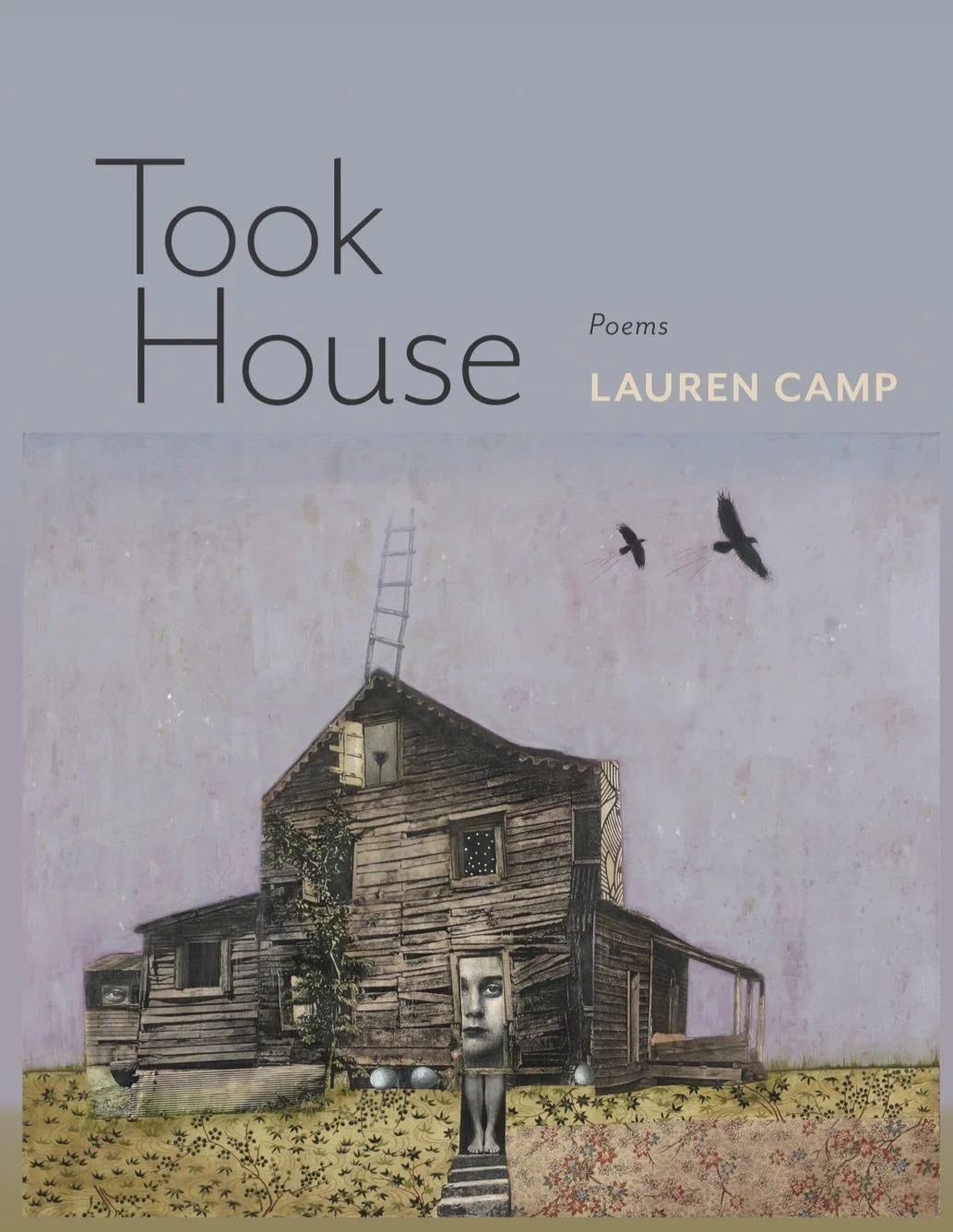
Took House
by Lauren Camp
Tupelo Press
August 2020, 90 pages, ISBN-13: 978-1946482327
There are books that narrate experience, and there are books that metabolize it. Lauren Camp’s Took House belongs firmly to the latter category. Rather than offering a linear account of intimacy, rupture, and aftermath, the collection reorganizes experience into a system of sensations—liquid, chromatic, tactile—through which the reader does not so much follow a story as inhabit a shifting perceptual field. As the introduction of the book suggests, this is a poetics less concerned with motive than with consequence: a chain reaction between pleasure and damage, appetite and dissolution, where what is seen is never stable and what is hidden never fully recedes.
Camp herself has remarked that the book emerged over more than a decade of writing and revision, during which she gradually shed narrative scaffolding in favor of what she “cared most about”: hunger, sound, landscape, intensity. This is crucial. Took House is not structured around events but around conditions of perception—what it feels like to remain inside a relationship that is at once sustaining and corrosive, intimate and estranging. The result is a collection that reads less like a sequence of poems and more like an extended phenomenology of attachment.
One of the most persistent structures through which this phenomenology unfolds is the table. As Rebecca Schumejda notes, “Camp’s table is your table,” and indeed, the table recurs throughout the collection as a mutable but enduring site: of negotiation, consumption, confrontation, and temporary equilibrium. It is at once domestic and theatrical, a place where bodies meet but also where they are exposed, evaluated, and transformed.
In “Fluid,” the table becomes the axis of a kind of biochemical poetics:
We were spoonfuls
of liquid. We left one container
and entered another: a glass to a glass.
We tracked
our demands across tables, fortified
by enzymes and acids and sediment.
Here, the lovers are not stable subjects but substances in transit, poured, transferred, recontained. The enjambment itself mimics this liquidity, each line slipping into the next without full syntactic closure. What is striking is the replacement of psychological language with chemical and material vocabulary—“enzymes,” “sediment,” “ratio.” Desire is no longer metaphorical but metabolic. To love is to dissolve.
Yet this dissolution is not purely ecstatic. It is also violent, often in a quiet way. In “Drops,” intimacy is rendered through a scene that oscillates between tenderness and exposure:
His fingers collect my sweet sap
and I paint the bed
with a dozen drops
of blood.
The softness of “sweet sap” is immediately undercut by the blunt materiality of blood. What follows is a choreography of surveillance and stillness—the wine glass “watches,” the room accumulates “flavors,” the body becomes a site of both nourishment and depletion. Camp’s attention to sound—sibilance in “sweet sap,” the liquidity of “sluice the shiny surface”—produces a kind of whispered intensity, as if the poem itself were complicit in the act it describes.
This tension between stillness and motion, between gaze and exposure, recurs throughout the collection. The lover often appears less as a fully realized subject than as a force—predatory, consuming, intermittently tender. In “Answers to Why,” the speaker admits:
Listen, I was dissolving. An ongoing
volatility enveloped the inside
of my thighs.
The body here is not a boundary but a site of ongoing reaction. What is perhaps most unsettling is the line that follows: “The table wished to be between us.” The table—previously a site of connection—now becomes a desired barrier, a structure that might impose distance where none exists. Yet the speakers “held it,” suggesting that even this attempt at mediation remains entangled in the relationship it seeks to regulate.
If the table functions as a horizontal plane of encounter, Camp’s engagement with visual art introduces a different spatial logic—one that extends outward into abstraction and architecture. Several poems in Took House are ekphrastic, yet they resist the conventional task of description. Instead, they use the artwork as a point of departure for associative expansion.
In “The Bed on the Wall,” inspired by Robert Rauschenberg’s Bed (1955), Camp transforms the object into a charged urban and psychological landscape:
So garish: the arc of his interior
thinking. So red,
so deceptive.
The painting, already a hybrid of painting and object, is reimagined as a site of interior collapse. What begins as an encounter with an artwork becomes an exploration of spatial disorientation: “the coordinates of this project fall / between sheets and box spring.” The domestic space is destabilized, its boundaries blurred, its surfaces made porous. By the end of the poem, the bed has absorbed not only paint but history, violence, and exhaustion, becoming less an object than a condition of being.
A similar transformation occurs in “Empirical Theories of a Box-Maker,” which engages Donald Judd’s minimalist installations. Where Judd’s boxes emphasize repetition and clarity, Camp’s poem introduces uncertainty and recursion:
A century of boxes looking for daylight or moonborder.
In each box, I separate distance.
The boxes, rather than containing space, proliferate it. Through Camp’s unending list of each box, they become units of perception, each one framing an aspect of existence, from the daily to the ontological. The poem’s fragmented structure mirrors this logic, creating a sense of movement that is paradoxically static. One does not progress through the poem so much as circle within it.
These ekphrastic moments are crucial because they reveal the extent to which Camp’s poetics is intermedial. Her background in visual art is not incidental, it shapes the way language functions in the collection. Images are not merely descriptive but spatial, almost architectural. They invite the reader to inhabit them, to move through them, to experience their tensions bodily.
This bodily dimension is perhaps most evident in Camp’s synesthetic associations. In “Find the Color of Survival,” perception is explicitly cross-sensory. Color here is not visual alone but temporal, affective, almost ethical. It becomes a way of measuring endurance—what can be seen, what can be borne, what must be reworked. The poem’s insistence on simultaneity (“everything at once”) reflects the larger structure of Took House, where past and present, pleasure and pain, are never fully separable.
At the level of form, this simultaneity often manifests as breathlessness. Many of Camp’s poems resist conventional punctuation, allowing sentences to extend across lines in a continuous flow. This produces a reading experience that is both immersive and destabilizing: one is carried forward without pause, yet never fully grounded. The effect recalls what White describes as poetry that is not merely like interior life but is interior life—language as the direct articulation of thought and sensation before they cohere into narrative.
And yet, for all its intensity, Took House is not without moments of stillness, even of tentative resolution. In “Homeostasis: Birdwatching,” the collection turns outward:
then we looked outside
at green on green three acres
of bindweed rose petals new mornings.
The repetition of “green on green” suggests a kind of equanimous equilibrium, yet paradoxically a return to continuity. The body, previously a site of volatility, now participates in a larger ecological rhythm. This is not redemption in any conventional sense, but it is a recalibration—a recognition that survival may lie not in escape but in adaptation.
Similarly, in “Perennials,” the speaker concludes, “I returned empty, without.” The line resonates with a paradoxical fullness. To return “empty” is not to be depleted but to be released from excess—from narrative, from accumulation, from the need to account for everything that has occurred. It is, perhaps, a form of acceptance: not of the relationship itself, but of the conditions it has produced.
If Took House ultimately resists closure, it is because it understands that intimacy does not resolve neatly into before and after. Instead, it persists—as memory, as sensation, as a set of habits inscribed in the body. Camp’s achievement lies in her ability to render this persistence without resorting to explanation. She trusts the image, the line, the fragment. She allows language to carry more than it can comfortably hold.
What remains, after the final page, is not a story but a residue: of color, of taste, of breath. One does not “finish” this book so much as emerge from it, altered in ways that are difficult to articulate. And perhaps that is the point. In a collection so attuned to the limits of language, the most honest response may be to acknowledge that what has been experienced exceeds what can be said.
Or, as Camp writes: I returned empty, without.
About the reviewer: Victoria Xie is a multi-genre writer and visual artist currently based in the UK and China. Her works have been featured or upcoming in Voice and Verse, Mingled Voices, Inkwell Journal, and elsewhere. Her works have been supported by Kenyon Review Writers’ Workshop and Yale Writers’ Workshop. She loves trees and writes with blue ink.