 Reviewed by Matt Usher
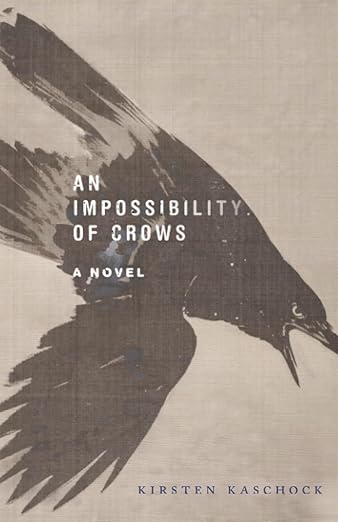
An Impossibility of Crows
by Kirsten Kaschock
University of Massachusetts Press
March 2026, Paperback, 245 pages, ISBN-13: 978-1625349255
Everyone dies alone. Though there are many who have company as they prepare for their journey, it is a road that must be walked without company. Considering it, there’s not a surprise that psychopomps like Charon and the Grim Reaper permeate culture so thoroughly. Humans abhor true isolation. Notwithstanding the idea that we must also persist somehow even as we moulder.
An Impossibility of Crows by Kirsten Kaschock soaks fully in the chill waters of death and loss, the palimpsest of memories overwriting what we once knew. It’s rare that an adult can retain, not merely memories of, but the actual feeling of being a child. Orwell, writing about Dickens, spoke to the difficulty for novelists in doing so.
Impossibility instead treads the mind of a dissociated, thwarted chemist as she tries to reconcile her past with a real sense of loss in her present. To this end, the opening has many clipped lines in short paragraphs; they are the cleaved musings of the bereft, unable to marshall the strength for verbosity. The setting and circumstances are fitting, a wrecking divorce and a dying patch of inherited farmland that carries many considerations and much fewer answers. It is in memory that we see longer, thorough paragraphs when Ness, our narrator, sifts through the ghosts of the family who left her this dwelling.
Apropos to this, the diction is straightforward, opting for simple, diagnostic language save for a few technical terms that escape from Ness’s background in industrial chemistry. Ness is very literal-minded and clear about how she feels, all throughout the novel suggesting, if not neurodiversity, at least a very right-brained voice. Kaschock offsets this well with one of the lingering spectres, Ruth, a relative whose letters punctuate the story. Ruth is more given to figurative language and feeling for words; the execution is deft and made more so by the layering of first person, in what we learn to be Ruth’s letters, of which she was prolific. A pleasant addition is a section of poetry, Ruth using a rare in modern works flair of meter, masculine meter to be specific. A curious choice of an archaically termed phrase.
Ness’s loss is framed around her raising of an oversized crow, kept in a barn and still growing when the size of a large dog. Solo, so named because of his bereavement of his egg-mates, is frequently Ness’s only company. She has complicated feelings toward him, one feels that she’s unable to train him while bringing herself to love him. Love is a difficult matter for Ness, as we learn, and it is foreshadowed in the prose and characterization when she thinks about her ex-husband and daughter. Solo is both easier and harder to deal with, an impassive presence that she can never fully understand.
As we learn about Ness, “I would’ve been a son if I could’ve but Pop hadn’t wanted kids, not of no gender.” Consistent throughout the narrative is the struggle against gender norms, the grasping attempts to find a place with her family as well as in isolation, when norms aren’t enforced. It’s a thoughtful treatment of the struggles of being gendered, which is inevitably to be othered. Terms are used to grossly categorize; they cannot encompass each individual’s relation to them. Ness rarely thinks of hers, but it is poignant when she does; where her peers might engage in girl talk, she rides free in the wilderness on a motorbike.
Crows is in conversation with other works covering bereft women, Ruth alluding in her letter to a bell jar, evocative of Sylvia Plath. Throughout the narrative it is the unasked and unanswered question, the always present attendant of crows. Ness can’t be said to be happy, and is indeed surrounded by death. As well, the central thrust of the novel touches very close to the ethos of Frankenstein, taking a parallel angle on the dangers of engendering forces beyond our control. It is to the author’s credit to evoke other works in the genre.
A less subtle element is the coverage of rape. It is first touched upon in an offhand remark, but grows later to be central to characterization and our understanding. It feels as though one is unable to write a serious book without the topic, at least in my experience. It’s possible it can be excused here in the exploration of women’ s struggles and the persistent presence that a large segment of humanity cannot ignore. That said, it doesn’t feel necessary to the narrative and may put off some readers.
Pick up this book if you want to be immersed in the reflections of a tortured mind which is often too straightforward to even languish in its pain. It is eminently approachable to read, though it must be said that it is quite heavy material. It builds an effective dread throughout as we learn more and more that points toward tragedy. It is well worth the time for those not faint of heart. Gothic horror is never a tired genre, and Crows is a fantastic entry into it.
About the reviewer: Matt Usher is an agender, highly neurodivergent writer and musician who likes poetry, tabletop roleplaying, trading card games (mtg and ygo), and professional wrestling. They are based out of Brooklyn with their two partners in a happy polecule. Most of their works are short stories but it happened that their first credit was in literary criticism. If you want to reach out and/or contact them regarding their reviews or stories (please do), you can find them at https://bsky.app/profile/mattusher.bsky.social