 Reviewed by Julianne Di Nenna
Identifying the Pathogen: An Inquiry
by Jennifer Militello
Tupelo Press
February 2026, Paperback, 132 pages, ISBN-13: 978-1961209442
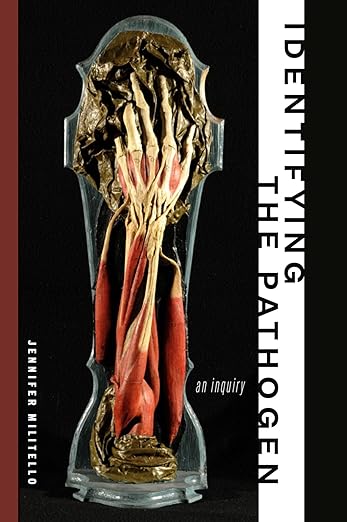
Jennifer Militello’s collection, Identifying the Pathogen: An Inquiry, is both homage and a scientific exploration into the existential question about the meaning of life. The collection is told in the voice of Anna Morandi Manzolini, a scientist, anatomist, sculptor, professor, artist, wife, and mother, who becomes caregiver and then widow. We follow the main persona —and maybe the poet herself —through her fascination, passion, and love for science and art as well as grief, mourning, loss, rebirth.
A list poem describing the tools used by the narrator opens the book and steps readers instrument by instrument into spheres both unfamiliar and astounding. Militello’s mastery of poetic language and eye for detail mirrors the art and science of the main persona of the collection; it’s calculated, rich, measured, precise, bewitching. Militello’s poetics also reflect the epoch during which the main persona lived, bringing Morandi Manzolini back to life through the collection. Readers become intimate with the workings of the main persona’s mind.
While Militello’s collection expresses many details of the intertwining of art and science, it also expresses how one woman’s priceless work can be undervalued and sometimes overlooked. Anna Morandi Manzolini lived one hundred years before Marie Sklodowska Curie was born. In “the Influence of Vision on the Mind”, readers feel the weight of societal expectations of women: “I am allergic to knowing where I am. Despite the eye, which wears the ice feathers of each random afternoon, I am left hidden and dazed, as if the wilderness of seeing had a tree’s variation and a mind’s trail of blossoms” — the voice of a woman pressing on with her work, her sense of mission, having to ignore outside influences. We see a woman’s sheer determination in ‘the Body”: “the core of me bloomed, it would be useless before I knew, a stain at the collar, a fray at the cuff. I drank my share of the imaginings we thought were impossible. I did and did.”
Militello portrays with great tenderness the strains of caregiving while pursuing a profession and raising a family. Scrutiny can tend to turn inward, the mind can fascinate over worries, allow itself to ruminate over troubles. “What I studied parted like water and then returned, the very adversary of the spirit, fed vividly with silver and a filth made of frog’s skin and Queen Anne’s Lace.” Loneliness and solitude compose the collection as much as science and art, following the persona from each sculpture, dissection, and re-creation.
Militello vividly and poignantly describes what many caregivers can feel watching loved ones decline into a space all on their own: “His trim jacket is a kind of skin that says no organs, no heart inside. He cannot smile with his eyes instead of his mouth. His brain is a series of wires and sparks”. The beginning of the collection reveals that the spouse becomes incapacitated from depression. Militello exposes the shock and realization of loss as well as the agency of the scientist and artist: “There is policy. There is protocol.” Protocol is a theme that recurs through the collection. As a caregiver myself, I know how that type of negative space can alienate and leave one feeling not only abandoned but utterly alone. Militello superbly and skillfully brings to life those feelings through the voice a woman living two-hundred years ago who, like countless women of today, takes nothing for granted. Militello personifies that type of agency: “… mummified women woke”, as she describes the destroyed marriage.
Militello weaves different perspectives into the collection, sometimes stepping away from the point-of-view of the main persona and drawing parallels with her own life and of women today. She looks at the persona from the angle of both subject and object, introducing what it feels like to undergo surgery and calling it an autopsy report. The collection stems from its many facets: elegy, incantation, reflection, art and science as life, ways life is measured through art, math, music, science, love.
Bravo Militello for a fascinating and gripping mixed-breed of poems, flash, and essays, from beginning to end, with the devotion of keeping alive the memory of a groundbreaking woman who paved way for others to come, and with an artist’s insight on the innumerous wonders of women in science, art, and caregiving during life’s most fragile and tenuous moments.
About the reviewer: Julianne Di Nenna is a world traveler and author of Girl in Tulips. She is a humanitarian aid worker and has worked on four different continents in over 30 countries. She was a finalist for the Harbor Editions Marginalia series, a semi-finalist for the Wicked Woman Book Prize from BrickHouse Books, and winner of several poetry prizes.