 Reviewed by Margaret Lee
No One Knows Us There
Poems
by Jessica Bebenek
Book*hug Press
July 2025, 76 pages, $20.00 (paperback)
Here is what happened: I took a walk. So begins the debut poetry collection of Canadian artist, bookmaker, and poet, Jessica Bebenek. In fact, there were four walks, and they were all the same walk, to and from a room in a hospice, a room containing all the bodies I knew/in varying states of decomposition (“Hospice,” 2). In similar fashion, Bebenek’s poems circumambulate the finality and physicality of life and death and find that these are the same journey.
Bebenek organizes her collection of poems into two sections, titled only with a number, “One” and “Two,” as if their themes could not be named but only sequenced as successive phases. Section One deals with the death of a beloved grandfather. Section Two views his death from the perspective of life in subsequent years. Death comes first, and Bebenek rewrites its traces in her second section, where she uses poem titles from section One for poems with new implications.
“Garden” in section One concerns the deathbed of the speaker’s grandfather, while “Garden” in section two speaks from a lover’s bed, yet the poems echo similar sensibilities. Death comes without drama, and love is laced with reflection, not ecstasy. In section One, “Garden” explains,
The mug didn’t drop.
No, not so
dramatic. I was taking a turn
when the call struck
through the window.
…
Life fumbled its way through him,
clutched lungs, his breath ripped
out….(14-15)
In section Two, the speaker in “Garden”
…wonders about Neanderthals
Had they been instructed yet
on how everything needs me
to be a part of itself to be complete
…
how everything I push out of myself
and try to bury remains (45)
In another example, section One’s “The Way Fish Drown” states the banal outcome of death:
…Death
is a full stop we lace
into chronology, tie bows
on the articles of the living. File
his face into some subcategory. (11)
The poem of the same name in section Two reflects,
He left me so much
more than his remains.
…
His final words: Goodbye sweetheart
as I stroked back his thin hair.
How, even now,
when Chris calls me sweetheart,
my chest cracks open just a little more,
lets in a little more light. (51)
In section One, Bebenek recounts the experience of death with vivid detail. “This is the Morning of a Meaningless Sparrow at the Window” reports the stench, lungs rotting, shaken breaths, gasps, comatose moans, the curl of the toes, their grey-blueing. The poem declares,
This is not you
…
This is existence
loosening its ties. (5)
“Forestalled Decomposition for Public Display” enumerates the steps of embalming, from the draining of bodily fluids to the pumping of formaldehyde and methanol via the jugular./The slow, downward/growth of a tree (3). Exhausted by grief, the speaker finally confesses,
Even knowing change to be the way of all life
…
I longed to stop forever
In a way that is not death
Just let me be a table lamp a lap a tea
My mind buried as a cottage in honeysuckle (“The World Without,” 22)
The second section begins with a new rendition of “Hospice,” the book’s opening poem. It reflects on that initial death from the vantage of passing years:
I’m sure you heard at some point
how the human body’s cells shed and renew completely
every seven years
The antiseptic ablutions
of the final hallway—that room—have passed
through my blood, the last
infused cells rubbed off on a hand towel
how unceremoniously we redistribute….(38)
Moving on from grief entails surmounting depression: I once kept a mini-fridge in my bedroom;/that’s how holed-up my heart has been (“The Place You Leave and The Place You Return To,” 44).
In my heart, I am a pet snail in a mason jar
cheesecloth rubber-banded to the mouth, crunching
nearly audibly on a piece of parboiled carrot. (“Pet Snail,” 59)
The speaker of Bebenek’s poems then marks significant gains by observing animals, understanding that an instinct for survival drives evolution. She accepts the potentially destructive fluttering of moths trapped in her papermaking studio because it is in their nature to be (“Moths,”49). She puts herself in the place of a startled, nesting killdeer who charged us,//her heart surging with threat. The speaker reflects, I thought/in a thinking I imagined as hers//you get this one chance (“This Is the Morning of a Meaningless Sparrow at the Window,” 63). Taking delight in the nocturnal rummaging of raccoons, the speaker announces of herself and the raccoon, We are in love/with what everyone else/calls trash (“Raccoons,” 56). She recognizes snakes as symbols of the Great Circle of History and coaches herself, You must open yourself to fear (“Snake,” 50). The feeding behavior of loons reveals that love cannot be anything more than an impulse (“Love as an Instinct,” 57), despite the reality and comfort of human, sexual love. We accept love/now knowing/it will leave us (“This Is the Morning of a Meaningless Sparrow at the Window,” 65).
Just as Bebenek gazes without flinching at the brutal reality of death, so she registers the mundane activity of ordinary life. Only this and nothing more/then only this again, she observes, with neither despair nor disdain. Here again/in imperfect future/life just goes on (“The Island,” 46). As a model for selfhood, Bebenek’s speaker turns to kintsugi, the Japanese art of visibly mending ceramics using precious metals:
…if bent rings and broken chains can
transmute, deform…so I can
draw experience
into my fractures…and still
I will not become the gold, nor
ever me again. Only me now
and now
and now:
chimeral—
a thing of many things—
a finite being—
a time-fused-together-being—
a burst and blended being— (“Kintsugi,” 55)
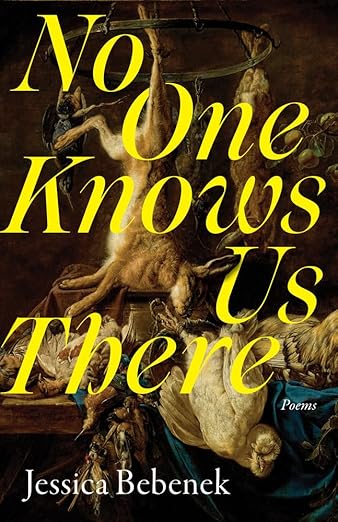
The two sections of No One Knows Us Here explore life and death as inseparable and interwoven realities. Living necessarily entails the knowledge and threat of death, and death generates the emotional power and empty space to enable fresh dimensions of life. The book’s cover image hints at this paradox with a painting by Adriaen van Utrecht, a 17th century Flemish artist known for hyper-realistic still lifes. The image displays in sepia tones the harvest of a hunt—rabbits and game birds strung up by their feet. Although the animals are obviously dead, the vivid image tempts a viewer to enumerate, even to touch, each colorful feather and the soft, tawny rabbit fur—simultaneous hints of life and death.
Bebenek’s poems begin with death, not birth or young life full of promise. The reality of death, richly explored and entwined with memory, becomes the portal to meaningful life. I have observed that Bebenek repeats poem titles in the two sections of her book. Tellingly, one title occurs three times: “Trust.” The three, short poems encapsulate Bebenek’s poetic journey. At the end of section One, “Trust” discloses,
I’m waiting for the time when it will feel
like I never lived this life,
never had to. (29)
Early in section Two, “Trust” moves beyond longing to the ineluctability of fact:
When someone tells me
this will all have been worth it.
Yes and no. I mean,
this will all have been. (39)
Finally, the collection ends with “Trust” as a beginning:
It is Friday morning
and the world is happy to be
nearly through with it.
I am just starting
ever just starting still
in the morning of my life (66)
Brilliantly and realistically, Bebenek narrates no turning point, reaches no culminating moment, offers no conclusions. The final poem sends the reader back to the beginning and the inescapability of death. Rooted in concrete images, the poems resist both pious moralizing and maudlin regret by honestly depicting an embodied self, enmeshed in the empirical world. With economy and specificity, Bebenek’s lines embrace the totality of experience.
About the reviewer: Margaret Lee is a poet, scholar, fiber artist, watercolor sketcher, and aspiring naturalist in Tulsa, Oklahoma. Her poetry collection, Sappho Prompts with Finishing Line Pres, uses Sappho’s fragmentary lines as prompts for new poems. Margaret’s previous chapbooks with Finishing Line Press include Someone Else’s Earth (2021), Sagebrush Songs (2022), Oklahoma Summer (2023), and Orange Persephone (2025). Her poems also appear in From Behind the Mask, (Paperback-Press 2020), Echoes of Tradition: Indigenous Orientation to Community, Time, and Land (Tulsa NightWriters 2024), The Atlanta Review, eMerge Magazine, and Pangyrus. Her poetry book reviews appear in American Poetry Review, The Compulsive Reader, and the Taos Journal of Poetry. Margaret earned a B.A. in History from Seattle University, Seattle, WA; an M.Div. from Phillips Theological Seminary, Tulsa, OK; and a Th.D. from the Melbourne College of Divinity, Melbourne, Australia. Her academic research and publications focus on the ancient Greek language and the history and culture of the ancient world.